BookRags.com Literature Guides Literature
Guides
Criticism & Essays Criticism &
Essays
Questions & Answers Questions &
Answers
Lesson Plans Lesson
Plans
My Bibliography Periodic Table U.S. Presidents Shakespeare Sonnet Shake-Up
Research Anything:        
History | Encyclopedias | Films | News | Create a Bibliography | More... Login | Register | Help

Not What You Meant?  There are 25 definitions for Carnival.  Also try: Thurber or Xingu.

Thurber, James (1894-1961)

Print-Friendly  Order the PDF version  Order the RTF version
About 3 pages (803 words)
James Thurber Summary

Bookmark and Share Know this topic well? Help others and get FREE products!

Thurber, James (1894-1961)

Ohio-born satirical writer James Thurber was most noted for his ability to illustrate, through the use of humor, the frailties of human beings in a world seemingly dominated by forces of their own making. His primary media, the short story and his famous pen-andink cartoon sketches, have served as models for later critics and observers of the social scene who write in a casual style reminiscent of the New Yorker, which began publication in the 1920s and for which Thurber was a regular contributor. Much of his work, including his writings and drawings of animals, especially dogs, and the unforget-table Walter Mitty have become permanent fixtures in American literary folklore.

Thurber was born in Columbus in 1894, during a time when the United States was experiencing great change due to the forces ofindustrial development: explosive urban growth, immigration, labor upheavals, and the dizzying pace of technological advancement. All of these influenced Thurber's work. Thurber's poor eyesight—as a child his brother William accidentally shot him in the eye with a bow and arrow—prevented him from enjoying an active childhood and later in life rendered him legally blind. After a difficult start at Ohio State University, Thurber found his stride as editor of the school newspaper and literary magazine. While in college, he befriended future playwright and film director Elliott Nugent, with whom he would collaborate in New York in later years.

Thurber's writing career foundered from the start. He accepted a job as a reporter for the Columbus Dispatch after World War I, moved to Europe in the 1920s to write for overseas newspapers, then returned to the United States and wrote for the New York Post. While living in New York, Thurber met author E. B. White, who introduced him to the editors of the New Yorker, a new magazine that hoped to capitalize on the "Roaring Twenties" image of the city by developing a smart, lighthearted, and slightly irreverent literary style. Thurber was hired as an associate editor, and then later managed to get himself "demoted" to a contributing author. The marriage of the New Yorker and Thurber was fortuitous: his articles and sketches graced the pages of the magazine for years to come and helped set the overall tone for the publication. Thurber and White collaborated on the 1929 bestselling book Is Sex Necessary?, a spoof on the sex-psychology books popular during the 1920s.

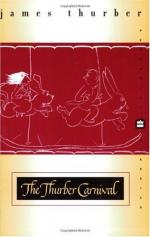
Thurber's use of humor to point out human shortcomings took several forms. His cartoons often depicted people struggling with the trials and tribulations of everyday life, especially in the face of modern technology that often made things more, rather than less, troublesome. Thurber believed that humans often unnecessarily complicated their lives through an excess of "abstract reasoning" instead of being practical. Thus, he always portrayed animals in a sympathetic light, commending their reliance on instinctive wisdom instead of the fuzzy reasoning of humans. Males were especially targeted for ridicule by Thurber; his cartoons often included spineless husbands being berated by their domineering and opinionated wives. In "The Secret Life of Walter Mitty," (1939) Thurber's most famous New Yorker story, he created a title character who escaped his meager, workaday world by becoming a larger-than-life hero in his daydreams, a gentle symbol of humanity's loss of direction and purpose in modern times. Thurber's work also found its way to the stage, as in The Male Animal (1940), a Broadway collaboration with Elliott Nugent, and A Thurber Carnival (1960), an off-Broadway revue in which Thurber himself performed.

Beset with alcoholism, rage, and blindness, Thurber's last years were not happy ones for him or his friends, and his personal problems were reflected in his creative output. In a piece for the New York Times Book Review, John Updike commented that "The writer who had produced Fables for Our Time and The Last Flower out of the thirties had become, by the end of the fifties, one more indignant senior citizen penning complaints about the universal decay of virtue." Still, Thurber is considered one of the century's most prominent humorous writers, with works that took many forms over the span of his career, including novels, short stories, articles, and sketches—almost all of them containing a strain of melancholia that is distinctly modern in style. A quotation from one of his many fables perhaps best describes Thurber's attitude: A dinosaur, talking to a human, remarked "There are worse things than being extinct, and one of them is being you." Thurber was not a hater of mankind; he was a modernist who saw the limitations of man in a conspicuously optimistic age.

Further Reading:

Holmes, Charles S. The Clocks of Columbus: The Literary Career of James Thurber. New York, Atheneum Books, 1972.

Thurber, James. Thurber's Dogs. New York, Simon & Schuster, 1955.

——. A Thurber Carnival. New York, Samuel French, 1962.

——. Vintage Thurber. 2 Volumes. London, Hamish Hamilton, 1963.

This is the complete article, containing 803 words (approx. 3 pages at 300 words per page).

More Information
  • View Thurber, James (1894-1961) Study Pack
  • 25 Alternative Definitions
  • Search Results for "Thurber, James (1894-1961)"
  • Add This to Your Bibliography
  • More Products on This Subject
    James Grove Thurber
    In a general survey of American humor, James Thurber comes after the traditional horsesense humoris... more

    James Grove Thurber
    James Grove Thurber (1894-1961) was an American writer and artist. One of the most popular humorist... more


    Ask any question on James Thurber and get it answered FAST!
    Answer questions in BookRags Q&A and earn points toward
    discounted or even FREE Study Guides and other BookRags products!
    Learn more about BookRags Q&A
    Copyrights
    Thurber, James (1894-1961) from St. James Encyclopedia of Popular Culture. ©2005-2006 Thomson Gale, a part of the Thomson Corporation. All rights reserved.


    Join BookRagslearn moreJoin BookRags


    About BookRags | Customer Service | Report an Error | Terms of Use | Privacy Policy