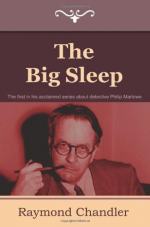
The Big Sleep
In The Simple Act of Murder (1935) Raymond Chandler (1888-1959), one of America's premier hard-boiled novelists, wrote of his detective hero, Philip Marlowe, " … down these mean streets a man must go who is not himself mean, who is neither tarnished nor afraid. The detective in this kind of story must be such a man. He is the hero; he is everything." Unlike James M. Cain and other hard-boiled novelists of his time, Chandler was a romantic whose famous detective was a knight in slightly battered armor. Marlowe appears in Chandler's four most famous novels, The Big Sleep (1939), Farewell My Lovely (1940), The Lady in the Lake (1943), and The Long Goodbye (1953) as well as several lesser known works. Philip Marlowe was a character made for Hollywood: street smart, wise cracking but ultimately an honorable man—a prototype for the American detective hero ever since. Several of Chandler's stories, including The Big Sleep, were made into Hollywood movies, some more than once.
In The Big Sleep Marlowe is hired by wealthy General Sternwood to track down a blackmailer who is trying to extort money out of him with nude pictures of his daughter Carmen. From this rather simple beginning, Marlowe is led into a tangled world of sexual perversion, drug addiction, murder, and deceit. The plot of The Big Sleep is complex, leading Howard Hawks, the first and most successful of the filmmakers to adapt it for the movies, to say that he never did understand who killed one of the characters—and when he telegraphed Chandler for clarification, Chandler himself was unable to provide a definitive answer.
The world of The Big Sleep has much in common with the world in other hard-boiled novels and films noir. It is a dark world full of violent and twisted men and women—often the most beautiful and charming are the most savage of all. Chandler's description of Carmen Sternwood is instructive: "She came over near me and smiled with her mouth and she had little sharp predatory teeth." Even Carmen's father describes her as "a child who likes to pull the wings off flies."
What sets Chandler apart from other hard-boiled writers is that his work has a moral center in the honorable Marlowe who always prevails in the end—beaten up, disappointed, and cynical, but at the heart of a universe which has a moral standard no matter how threatened it is. Other novels in this genre, like Double Indemnity, are less reassuring on this score.
Howard Hawks cast Humphrey Bogart, one of Hollywood's most famous tough guys, as Marlowe. No one has played Marlowe as successfully as Bogart, who had a world weary face and a suitably sarcastic delivery on such classic Chandler lines as "I'm thirty-three years old, went to college once, and can still speak English if there's any demand for it. There isn't much in my trade."
Hawks' The Big Sleep (1946) is better realized than the Michael Winner version in 1978 which starred Robert Mitchum and is set not in California (where many hard-boiled novels and films are set, and from which they take their flavor), but in London of the 1970s. However, the main problem with Hawks' version, which has generated a good deal of critical interest on its own, is that it ends with Marlowe and Vivian Sternwood falling in love; in the novel Marlowe is the archetypal loner—he must stand apart from the world and its corruption. In true Hollywood fashion this change was made to capitalize on the real world relationship between Bogart and Lauren Bacall, who was cast as Vivian (Bogart left his wife for the very young Bacall during this time, causing a mild Hollywood scandal). This fiscally motivated plot change, however, weakens the noir aspect of the film, and along with the changes which the censorship laws of the era demanded, makes it a far less disturbing experience than the novel.
In some ways The Big Sleep seems to be unpromising material for Hawks, who tended to make either action films or comedies. Unlike Fritz Lang and Billy Wilder, who came to film noir from the downbeat German Expressionist cinema of the 1920s, Hawks' cinema is an optimistic one, filled with action, charm, sly humor, and characters who value professionalism and who are "good enough" to get a job done. Analyses of the adaptation of novels to films, however, often founder on arguments about the faithfulness of the adaptation. The film is a new work with virtues of its own and as David Thomson writes, Hawks' version is vastly different than Chandler's original in that it "inaugurates a post-modern, camp, satirical view of movies being about other movies that extends to the New Wave and Pulp Fiction."
Further Reading:
Chandler, Raymond. The Big Sleep. New York, Vintage Books, 1976.
——. The Simple Art of Murder. New York, Pocket Books, 1964.
Lauren Bacall and Humphrey Bogart in a scene from the film The Big Sleep.
Kuhn, Annette. "The Big Sleep: Censorship, Film Text, and Sexuality." The Power of the Image: Essays on Representation and Sexuality. London, Routledge & Kegan Paul, 1985.
Mast, Gerald. Howard Hawks, Storyteller. New York, Oxford University Press, 1982.
Speir, Jerry. Raymond Chandler. New York, Frederick Ungar Publishing Co., 1981.
Thompson, David. The Big Sleep. London, British Film Institute Press, 1997.
Walker, Michael. "The Big Sleep: Howard Hawks and Film Noir."The Book of Film Noir. Edited by Ian Cameron. New York, Continuum, 1993.
This is the complete article, containing 894 words
(approx. 3 pages at 300 words per page).