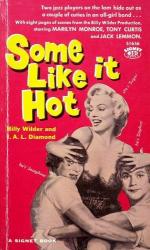
Some Like It Hot
Some Like It Hot, a critically acclaimed farcical romp produced by United Artists and directed by Billy Wilder, premiered at Loew's Capitol Theatre on Broadway in 1959. Set in Chicago in the 1920s, the film stars Tony Curtis and Jack Lemmon as hapless musicians who are pursued by gangsters when they witness the Saint Valentine's Day Massacre. Joe and Jerry decide to disguise themselves as "Josephine" and "Geraldine," and join a female band headed for Florida. (Actually, Jerry takes to his new role quickly, spontaneously introducing himself as "Daphne.") On the southbound train, the pair befriend Sugar Kane, played by Marilyn Monroe, and begin competing for her affections. It turns out that Sugar is on the run as well, fleeing the string of saxophone players who have loved her and left her. In Florida, Joe woos Sugar by masquerading as a millionaire, and "Daphne" is courted by Osgood, who is indeed a millionaire.
Wilder was by this time an established auteur. Reviews of Some Like It Hot compare his sophisticated comedy to that of Ernst Lubitsch and refer to "the Wilder touch." Wilder enjoyed a great deal of control over the production of the film. For example, although few films were shot in black and white by the end of the 1950s—especially since Hollywood was competing with television for view-ers—Wilder felt that Lemmon and Curtis would look too garish in color and got his way.
Some Like It Hot marked Monroe's emergence from semi-retirement. She had made 21 films between 1950 and 1956, only one in 1957, and none in 1958. She was married to Arthur Miller and pregnant with his child during filming, but suffered a miscarriage shortly after. She had long since earned the reputation of being extremely difficult to work with: showing up late, drinking on the set, stumbling over lines, and consulting with her drama coach constantly. Wilder is the only director ever to work with her more than once, and he was extremely critical of her unprofessionalism afterward. According to Carl Rollyson in his Marilyn Monroe: A Life of the Actress, "He had been cautious with the press during filming, but shortlyafterwards he allowed his disgust with her to show. She had seldom worked a full day on the set, and because of her the production had gone several weeks past its scheduled end and had exceeded its budget by about half a million dollars. He took his revenge in a series of sarcastic statements"; for example, suggesting that the Screen Directors Guild should give him a Purple Heart for casting her in two of his films, and he was too old and too rich to ever go through such an ordeal again. Curtis also spoke of her contemptuously, describing their love scene as "like kissing Hitler." In the final film, however, the ensemble acting of the cast was considered superb.
Tony Curtis (left) and Jack Lemmon in a scene from the film Some Like It Hot.
According to Bernard F. Dick, "It would not be hyperbole to call Some Like It Hot a comic masterpiece. It has the classic comic plot of disguise, deception, and intrigue where a single complication generates a series of subplots the way a single pebble creates concentric ripples in a pool. Some Like It Hot also possesses a quality found in the best comedies—a sense of umanity and an attitude of compassion for the lunatics and lovers who play the fool for our sake."
Further Reading:
Dick, Bernard F. Billy Wilder. New York, DeCapo Press, 1996.
Dyer, Richard. Heavenly Bodies. New York, St. Martin's Press, 1987.
French, Brandon. On the Verge of Revolt: Women in American Films of the Fifties. New York, Frederick Ungar Publishing Company, 1978.
Haskell, Molly. From Reverence to Rape: The Treatment of Women in the Movies. New York, Penguin Books, 1974.
Rollyson, Carl E. Marilyn Monroe: A Life of the Actress. Ann Arbor, UMI Research Press, 1986.
Straayer, Chris. "Redressing the 'Natural': The Temporary Transvestite Film." Wide Angle. Vol. 14, No. 1, 1992, 36-55.
This is the complete article, containing 661 words
(approx. 2 pages at 300 words per page).