BookRags.com Literature Guides Literature Guides Criticism/Essays Criticism/Essays Biographies Biographies My Bibliography Periodic Table U.S. Presidents Shakespeare Sonnet Shake-Up
Research Anything:        
History | Encyclopedias | Films | News | Create a Bibliography | More... Login | Register | Help
Not What You Meant?  There are 10 definitions for Diver.

Search "Sir Francis Bacon (1561 – 1626) English Statesman, Author, and Philosopher"

Contents Navigation


Sir Francis Bacon (1561 – 1626) English Statesman, Author, and Philosopher

Print-Friendly  Order the PDF version  Order the RTF version
About 2 pages (566 words)
Francis Bacon Summary

Bookmark and Share

Sir Francis Bacon (1561 – 1626) English Statesman, Author, and Philosopher

Sir Francis Bacon, philosopher and Lord Chancellor of England, was one of the key thinkers involved in the development of the procedures and epistemological standards of modern science. Bacon thus has also played a vital role in shaping modern attitudes towards nature, human progress, and the environment.He inspired many of the great thinkers of the Enlightenment, especially in England and France. Moreover, Bacon laid the intellectual groundwork for the mechanistic view of the universe characteristic of eighteenth and nineteenth century thought and for the explosion of technology in the same period.
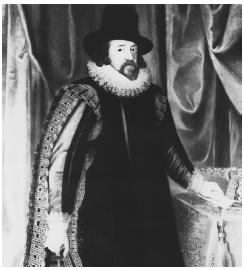
Sir Francis Bacon. (Painting by Paul Somer. Corbis-Bettmann. Reproduced by permission.)Sir Francis Bacon. (Painting by Paul Somer. Corbis-Bettmann. Reproduced by permission.)

In The Advancement of Learning (1605) and Novum Organum (1620), Bacon attacked all teleological ways of looking at nature and natural processes (i.e., the idea found in Aristotle and in medieval scholasticism that there is an end or purpose which somehow guides or shapes such processes). For Bacon, this way of looking at nature resulted from the tendency of human beings to make themselves the measure of the outer world, and thus to read purely human ends and purposes into physical and biological phenomena. Science, he insisted, must guard against such prejudices and preconceptions if it was to arrive at valid knowledge.

Instead of relying on or assuming imaginary causes, science should proceed empirically and inductively, continuously accumulating and analyzing data through observation and experiment. Empirical observation and the close scrutiny of natural phenomena allow the scientist to make inferences, which can be expressed in the form of hypotheses. Such hypotheses can then be tested through continued observation and experiment, the results of which can generate still more hypotheses. Advancing in this manner, Bacon proposed that science would come to more and more general statements about the laws which govern nature and, eventually, to the secret nature and inner essence of the phenomena it studied.

As Bacon rather famously argued, "Knowledge is power." By knowing the laws of nature and the inner essence of the phenomena studied, human beings can remake things as they desire. All knowledge is for use, and the underlying motivation of science is technical control of nature. Bacon believed that science would ultimately progress to the point that the world itself would be, in effect, merely the raw material for whatever future ideal society human beings decided to create for themselves.

The possible features of this future world are sketched out in Bacon's unfinished utopia, The New Atlantis (1627). Here Bacon developed the view that the troubles of his time could be solved through the construction of a community governed by natural scientists and the notion that science and technology indeed could somehow redeem mankind. Empirical science would unlock the secrets of nature thus providing for technological advancement. With technological development would come material abundance and, implicitly, moral and political progress.

Bacon's utopia is ruled by a "Solomon's House"—a academy of scientists with virtually absolute power to decide which inventions, institutions, laws, practices, and so forth will be propitious for society. Society itself is dedicated to advancing the human mastery of nature: "The End of Our Foundation is the Knowledge of Causes and secret motions of things; and the enlarging of the bounds of the human empire, to the effecting of all things possible."

Resources

Books

Bacon, F. The Advancement of Learning. 1605.

Sibley, M. Q. Nature and Civilization. Itasca, IL: Peacock, 1977.

——. The New Atlantis. 1627.

——. Novum Organum. 1620.

This is the complete article, containing 566 words (approx. 2 pages at 300 words per page).

More Information
  • View Sir Francis Bacon (1561 – 1626) English Statesman, Author, and Philosopher Study Pack
  • 10 Alternative Definitions
  • Search Results for "Sir Francis Bacon (1561 – 1626) English Statesman, Author, and Philosopher"
  • Add This to Your Bibliography
  • More Products on This Subject
    Francis Bacon
    "I have taken all knowledge to be my province," wrote Francis Bacon in 1592 to his uncle, Lord Burg... more

    Francis Bacon
    The English artist Francis Bacon (1909-1992) was one of the most powerful and original figure paint... more


    Copyrights
    Sir Francis Bacon (1561 – 1626) English Statesman, Author, and Philosopher from Environmental Encyclopedia. ©2005-2006 Thomson Gale, a part of the Thomson Corporation. All rights reserved.

    Join BookRagslearn moreJoin BookRags


    About BookRags | Customer Service | Report an Error | Terms of Use | Privacy Policy