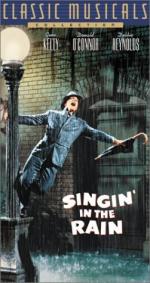
Singin' in the Rain
Co-directed by dancer Gene Kelly and Stanley Donen, Singin' in the Rain epitomizes how the musical works as Hollywood genre, studio (MGM) product, and instrument of American popular culture. Produced in 1952, the movie's narrative, scripted by Broadway writers Betty Comden and Adolph Green, is set in the 1920s, when viable sound synchronization spawned the "talkie," forcing universal adoption of sound and the invention of the musical. Singin' in the Rain is a parody of the backstage musical and the biopic; it playfully mocks the trials of the early studio system and the egos of its silent film stars being tutored to speak and perform in sound pictures.
The movie pays homage to the musical's classical form, tracing its roots from vaudeville to its influence on film. Gene Kelly plays Don Lockwood, who rises from variety shows to the silver screen with dance partner Cosmo Brown (Donald O'Connor). Within the musical's formula of narrative-inspired production numbers and romance, Lockwood guides the object of his desire, Kathy Selden (Debbie Reynolds), into the emotional effects of song-and-dance.
It is the Hollywood kiss, that staple of romantic resolution, which seals the attraction between Lockwood and Selden, then prompts Lockwood to begin "singin' in the rain." Critic Jane Feuer, in Film Genre Reader II, dubs such outburst into song-and-dance "the myth of spontaneity" common to the musical genre. Kelly's athletic free spirit in the "singin' in the rain" number celebrates the individual male at play within the American neighborhood. In this liberating, public site, Lockwood moves his feet skillfully through rain with umbrella as ballast, gets soaked and loves it, is chided by a local cop and shrugs it off. His "gotta dance" compulsion not only drives Rain's theme-song number, as if coming from the streets as well as his heart, it also inspires Lockwood to move instinctively into the full-blown artistry and seduction of Cyd Charisse's enigmatic dance/love object in the "Broadway Melody Ballet" fantasy.
Critic Rick Altman, in The American Film Musical, calls this device of courtship through dance the male's "loving lesson." In the film's major dance suite, the "Broadway Melody Ballet," the sexual connotations of Lockwood's earlier loving lesson with the neophyte Selden are projected as a fantasy danced with an "other" woman (Cyd Charisse). In the course of the suite, Charisse's vamp transforms into bride, then ethereal "angel", then back to vamp willingly controlled by gangster "hoods." Only dance itself safely permits this eruption of coded sex and this evocation of American culture's darker forces.
These forces, inflected in Rain as fantasy, are made central in Charles Vidor's Love Me or Leave Me (1955). A biopic of another order, Love Me or Love Me is based on singer Ruth Etting's successful career and dark personal life in the 1920s and her marriage to a petty gangster whose possessiveness turns into rape on their wedding night. Domestic melodrama delineates the couple's fraught relationship, with musical numbers playing out of, and off, the drama. In Rain, Don's loving protection of the amber-voiced Kathy from the wily, tinearred silent star Lina Lamont (Jean Hagen) is without social threat, while Love Me or Leave Me's foregrounding of obsessive male control is made tough by it basis in melodrama. In Stanley Kubrick's A Clockwork Orange (1971), the darkly parodic "Singin' In the Rain" song-and-dance by Alec (Malcolm McDowell) in the act of torturing a woman makes a cold ritual of violence, a major ideological reach from the original source, Rain, but closer to Love Me or Leave Me. But in his television special, You Must Remember This (1994), Canadian figure skater Kurt Browning's skilled athletic homage restores to family entertainment Rain's 1950s classicism and the nostalgia of Kelly's muscular dancer's persona. Browning's faithful recreation of Kelly's "Singin' In The Rain" number—complete with rain-covered ice surface, look-alike set, and original soundtrack of Kelly's singing and tapping—circulates a memory of the film, specifically a myth of wholesomeness for popular culture of the 1990s. In the 1990s, figure skating's popularity has grown as its imitative performers, tour-shows, and television specials have adopted elements of the production number established and conventionalized by the Hollywood musical, including costuming, lighting, familiar theme songs, dance-step choreography, tributes to screen and pop music stars, and the loving lesson evident in pairs and dance skating.
The impulse to act out in song-and-dance form reveals the gears of social engineering adapted by the Hollywood musical to produce and to promote show-musical culture as a vital ingredient of American popular culture. Singin' in the Rain reveals the seams of this process, much as it enfolds audiences into its veiled pleasures.
Further Reading:
Altman, Rick. The American Film Musical. Bloomington, Indiana University Press, 1987.
Croce, Arlene. "Dance in Film." Cinema: A Critical Dictionary. Vol. 1. New York, The Viking Press, 1980.
Feuer, Jane. "The Self-Reflexive Musical and the Myth of Entertainment." Film Genre Reader II. Austin, University of Texas Press, 1995.
Maltby, Richard. Hollywood Cinema. Oxford, Blackwell Publishers, 1995.
This is the complete article, containing 816 words
(approx. 3 pages at 300 words per page).