Sextant
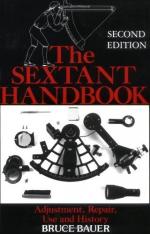
The sextant is an instrument that measures angular distance of the sun and stars from the horizon to determine latitude. It is used with a chronometer and nautical charts by navigators of ships at sea to determine location. The sextant consists of a telescope rigidly mounted to a bar and aligned with the horizon. A pair of mirror s, one fixed in line with the horizon, the other mounted on an adjustable arm, reflect the celestial object. When the object aligns with the horizon in the fixed mirror, the angular reading is taken from the sextant's arc.
Mariners originally took sightings with an astrolabe, a flat circular instrument that had a map on its face and an adjustable ring that represented the local horizon. They were compact, but complicated to use. Many seafarers preferred the simpler cross-staff. It had a staff topped with a peep-sight and a graduated slide-rod from which the apparent altitude of the sun could be determined. The quadrant , or "hog-yoke," was the immediate predecessor to the sextant. It was invented simultaneously in 1730 by Englishman John Hadley (1682-1744) and American, Thomas Godfrey (1704-1749).
Hadley was an instrument maker and friend of astronomer Edmond Halley (1656-1742). His was a double-reflecting quadrant, with a 90° arc, or 1/4 of total arc. At the suggestion of Captain John Campbell (c. 1720-1790), Hadley extended the arc to 120°. From then on it was referred to as a sextant. Hadley also added a spirit level for readings in foggy conditions. Thomas Godfrey was a glazier; he installed the windows at Independence Hall in Philadelphia. Encouraged by the Governor of Pennsylvania, James Logan, and influenced by his landlord, Benjamin Franklin, Godfrey entered into mathematics and science. He completed work on his quadrant in the same year as Hadley, but never received recognition for it from the Royal Observatory.
Sextants have become more sophisticated, though their basic working principle has remained unchanged. Any sextant has a set of mirrors or prisms through which the observer gazes at the objects he wishes to measure. As it is adjusted, the sextant brings the objects together into a single image, and the observer reads the angle between them on a graduated scale. Both in the air and at sea, sextants are often mounted to the frame of the craft for greater stability and more accurate readings. The mounts are often gimballed for easy adjustment. With the advent of electronic navigation instruments, and more recently, satellite-linked computers, like the Global Positioning System, traditional instruments like the sextant has generally fallen out of use. Indeed, as of 1998, the United States Naval Academy ceased to teach celestial navigation.
This is the complete article, containing 438 words
(approx. 1 page at 300 words per page).