BookRags.com Literature Guides Literature
Guides
Criticism & Essays Criticism &
Essays
Questions & Answers Questions &
Answers
Lesson Plans Lesson
Plans
My Bibliography Periodic Table U.S. Presidents Shakespeare Sonnet Shake-Up
Research Anything:        
History | Encyclopedias | Films | News | Create a Bibliography | More... Login | Register | Help


Race Riots

Print-Friendly  Order the PDF version  Order the RTF version
About 3 pages (853 words)
Race riot Summary

Bookmark and Share Questions on this topic? Just ask!

Race Riots

Although baseball, Mom's apple pie, and the Fourth of July are staples in the cultural fabric of the United States, nothing is more American than race riots. Throughout the nation's history nothing has been more constant than racial warfare. In many ways race riots have taken on a life and a culture of their own.

The 1906 riot in Atlanta, Georgia, would set the stage for the majority of white attacks on African Americans. The conflict erupted on September 22, when approximately 10,000 whites, angry at a report that black men were allegedly assaulting white women, "beat every black person they found on the streets of the city." In all, twelve deaths were registered, at a time when African Americans had begun to assert themselves as men and women, shedding an image of compliancy. Two years later, a similar attack occurred in Springfield, Illinois.

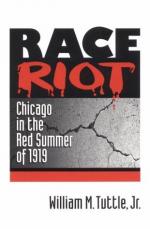
The period of World War I ushered in a new era of racial conflict. As African Americans migrated to urban areas in search of better social and economic conditions, the immediate post-war period was a literal powder keg as white GI's returned home to find a "New Negro" emerging. The first World War I-related riot occurred in East St. Louis, Illinois, in 1917, and left forty African Americans dead, all at the hands of white attackers. This riot foreshadowed the notorious "Red Summer of 1919" when twenty-five cities witnessed racial conflict, leaving 100 dead and another 1,000 wounded. The most dramatic riot of 1919 was in Chicago, where an incident at a Lake Michigan beach touched off thirteen days of rioting, leaving fifteen whites and twenty-three blacks dead. In 1921, Tulsa was the scene of a race "war" after whites destroyed over $1 million worth of black-owned property.

The aftermath of the riots in Watts, Los Angeles.The aftermath of the riots in Watts, Los Angeles.

The World War II period represented a watershed in the history of race riots in the United States. Whereas the previous riots/conflicts were initiated by whites, these new eruptions would be fueled by both black and white frustration. The most notorious World War II riot occurred in Detroit in 1943, leaving twenty-five blacks and nine whites dead. In what was largely a battle over jobs and housing, the all-white Detroit Police Department was responsible for the majority of black deaths.

Following World War II, the second great migration brought over three million African Americans from the South to the urban North and West. But black frustration would set in when black Southerners realized that the "Promised Land" was anything but that. Greeted with poor housing, unequal police protection, de-facto school segregation, and employment discrimination, black migrants became increasingly frustrated. As conditions continued to worsen in the mid-1960s, they took their battle to the streets, destroying white property in hopes of drawing attention to their plight. In 1964, Harlem, Chicago, and Philadelphia were the scene of incidents that left more than 100 citizens dead. One year later, the black enclave of Watts in Los Angeles erupted leaving thirty-four dead and approximately $200 million in property damage. In all, the 35,000 active rioters caused 1,000 injuries, but the riot also highlighted the conditions faced by the urban poor.

The year 1967 was by far the worst year of racial disturbances in American history. Serious riots occurred in Newark and Detroit, leaving twenty-six and forty dead, respectively. Most of these deaths were at the hands of white policemen who valued white property over black lives. Thirty-eight other cities experienced outbreaks as well, as black Northerners continued to take out their frustrations upon white property. Similar riots occurred on the night of Martin Luther King, Jr.'s assassination, when over 110 cities erupted.

The decades of the 1970s and 1980s witnessed a decline in rioting; however, in 1992 Americans who were unfamiliar with this aspect of our country's past would be jolted by the Rodney King riots in Los Angeles. In March of 1991 King was brutally beaten by at least four white officers from the Los Angeles Police Department (LAPD). A nearby resident videotaped the incident and within hours the image of a big black man being beaten like a dog was broadcast throughout the world. The officers were indicted but ultimately acquitted of police brutality in the all-white suburb of Simi Valley by a jury composed of eleven whites and one Hispanic. This verdict touched off several days of rioting. At the end of the riot there were thirty-eight fatalities, 4,000 arrests, and over $500 million in property damage. The most infamous image of the riot was the beating of Reginald Denny, a white truck driver who was caught in a black neighborhood. Denny was pulled from his truck and almost beaten to death. Although many Americans expressed shock at the riot, few understood how the Rodney King riots were merely building upon a longstanding tradition in U.S. culture.

Further Reading:

Hersey, John. The Algiers Motel Incident. New York, Alfred A. Knopf, 1968.

Horne, Gerald. The Fire This Time: The Watts Riot and the 1960s. Charlottesville, University of Virginia Press, 1997.

Report of the National Advisory Commission on Civil Disorders. New York, Bantam, 1968.

Sugrue, Thomas. Origins of the Urban Crisis. Princeton, Princeton University Press, 1997.

This is the complete article, containing 853 words (approx. 3 pages at 300 words per page).

More Information
  • View Race Riots Study Pack
  • Search Results for "Race Riots"
  • Add This to Your Bibliography
  • More Products on This Subject
    Race riot
    Race Riot is a 1929 animated short subject, featuring Oswald the Lucky Rabbit. The short concerns Os... more


    Ask any question on Race riot and get it answered FAST!
    Answer questions in BookRags Q&A and earn points toward
    discounted or even FREE Study Guides and other BookRags products!
    Learn more about BookRags Q&A
    Copyrights
    Race Riots from St. James Encyclopedia of Popular Culture. ©2005-2006 Thomson Gale, a part of the Thomson Corporation. All rights reserved.

    Join BookRagslearn moreJoin BookRags


    About BookRags | Customer Service | Report an Error | Terms of Use | Privacy Policy