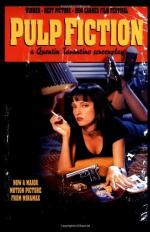
Pulp Fiction
Crime drama is given stylish and original treatment in Quentin Tarantino's 1994 film Pulp Fiction. In his take on the genre there is an easy interplay between the mundane and the brutal. Told with visual panache and unconventional dialogue, three stories of the Los Angeles underworld interweave in a complex structure.
The tales were written separately, with two of them written years before the film was conceived. In the first story, two professional hitmen, Jules and Vincent, kill some young men who have stolen a brief case containing something of great beauty and value from gang boss Marcellus Wallace. The routine job becomes a life-changing incident for Jules when one of the young men shoots repeatedly at Jules and Vincent from across the small room, but every shot misses. Jules takes this "miracle" as a sign from God. The job is further complicated when Vincent creates a literal and figurative mess by accidentally blowing their informant's brains out in the back seat of the car. The second story begins when Marcellus Wallace asks Vincent to take his wife Mia out and show her a good time while he is away. After dinner and a dance contest, Vincent and Mia return to the Wallace home where Mia overdoses on Vincent's powerful heroin and almost dies. In the third story, Marcellus Wallace pays an aging fighter, Butch, to take a dive. Instead, Butch wins the fight and attempts to flee the country before Wallace can have him killed. In addition to these three stories, the film begins and ends with a framing incident of a husband and wife team of small-time crooks deciding to hold up the restaurant where Jules and Vincent are having breakfast. The incident takes place chronologically between stories one and two.
The seemingly unrelated stories all tie together in a highly unconventional plot. The structure of the film is not only non-chronological, but there are also repeated actions and parallel actions. A single viewing of the film is a powerful experience, but subsequent viewings are also rewarding, as more of the subtleties and complexities of the film become apparent. It often takes more than one viewing to become comfortable with the film's blending of the horrifying and the oddly funny; not every viewer is prepared to find dark humor inscenes that involve scooping skull fragments off of the upholstery, homosexual rape, or a family heirloom hidden for years in a rectum. The film is an unpredictable mix of the lurid and the absurd, told in dialogue that is alternately hip, mundane, or intriguingly odd.
The dialogue in Pulp Fiction does more than simply advance the plot. Tarantino avoids the typical gangster stereotypes by giving his thugs distinctive speech patterns and quirky conversations that bring the characters to life. No two characters in the film speak alike. Mr. Wolf, the professional problem-solver who comes in to take care of Vincent and Jules's mess, speaks in clipped, efficient sentences. Jules freely spices his erudite vocabulary with the harshest profanity, and just before putting a bullet into his target he likes to give a dramatic and frightening recitation of Ezekiel 25:17. Although the dialogue often meanders, just like real conversation, it is still very memorable. On the way to make the hit on the college boys, Vincent explains to Jules that at the Paris McDonalds a Quarter-pounder is called a Royale with cheese. It is just the type of inane conversation that goes on between two co-workers passing the time during the morning commute.
Pulp Fiction's style and originality did not go unnoticed in the film community. At the Cannes Film Festival the film won the Palm d'Or. Pulp Fiction revitalized the career of John Travolta, making him the hottest property in Hollywood for the next several years. Travolta garnered Academy Award, Golden Globe, and Screen Actors Guild nominations for Best Actor. The film was nominated for seven Academy Awards, including Best Picture, but only Roger Avary and Quentin Tarantino won for Best Original Screenplay. Pulp Fiction established Quentin Tarantino as a major player in Hollywood.
Further Reading:
Clarkson, Wensley. Quentin Tarantino: Shooting from the Hip. Woodstock, New York, Overlook Press, 1995.
Dawson, Jeff. Quentin Tarantino: The Cinema of Cool. New York, Applause, 1997.
Jami, Bernard. Quentin Tarantino: The Man and His Movies. New York, Harper Perennial, 1995.
Woods, Paul. King Pulp: The Wild World of Quentin Tarantino. Plexus, 1998.
This is the complete article, containing 721 words
(approx. 2 pages at 300 words per page).