Forgot your password?  

Not What You Meant?  There are 29 definitions for Pop.

Pop Art | Research & Encyclopedia Articles

Print-Friendly   Order the PDF version   Order the RTF version
About 3 pages (1,021 words)
Pop art Summary


Pop Art

Pop art developed in the turbulent cultural milieu of the early 1960s as a response to the brooding intellectual and emotional aspects of abstract expressionism. Originally a British movement of the mid-1950s, in American hands pop art became commentary on the mass production culture and the banality of everyday life. Artists like Andy Warhol, Roy Lichtenstein, and Claes Oldenberg utilized the images and production techniques of daily American life in a consumer society, transforming them into objects that were neither wholly real nor wholly art; in the process, they strove to make viewers aware of the extent to which advertising and the production/consumption cycle had come to dominate their lives.

The phrase "Pop Art" seems to have originated from two sources: from British artist Richard Hamilton's 1956 collage picture Just What is it that Makes Today's Homes so Different, so Appealing?, which featured a bodybuilder holding a gigantic "Tootsie Pop" sucker; and as a descriptor of an art which highlighted "popular" everyday objects. The latter definition is more relevant. Pop Art was filled with images of consumer products, rendered in styles derived from advertisements or familiar images. The subject matter, as an early critic described it, was "the twentieth century communications network of which we are all a part." Pop artists borrowed heavily from the slick, flashy, cliché-ridden advertising industry to depict the objects that were a part of American consumerism. Subjects were rendered in a simple, flat manner that emphasized the thinness of the canvas. Strong, bright colors were favored, and the image was centralized within the pictorial space. All of this was in direct contrast to the work of the abstract expressionists, who created formless, nonobjective art that grappled with existential questions of meaning.

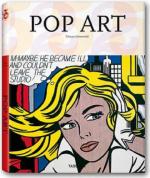
The most successful pop artists adopted these techniques in different ways. Roy Lichtenstein used the style of comic strips—bright colors, single scenes, Ben Day dots, and dialogue balloons. He depicted a world of prepackaged emotions (parallel to consumer products) and gender stereotypes. The women in Lichtenstein's paintings were concerned with love and marriage, as in the romance comics; the men inhabited the war comic world of violence and death. In the mid-1960s, Lichtenstein also drew from art history within his comic strip style, integrating such genres as cubism and abstract expressionism. His work thus shifted from a critique of the banal world of everyday America to a commentary on the secularization of high culture.

James Rosenquist's referent was the billboard. A former sign painter, Rosenquist painted on huge canvases a succession of seemingly random fragmented images. For example, his most famous painting, F-111 (1965), features a military jet, a young girl beneath a missile-shaped hair dryer, and close-ups of spaghetti and an automobile tire. Rosenquist described his work in these words: "I treat the billboard image as it is. I paint it as a reproduction of other things. I try to get as far away from it as possible."

This retreat from the thing itself into the image of the thing was most evident in the work of pop art's most famous practitioner, Andy Warhol. His Campbell's Soup cans, Brillo pad boxes, and Coca Cola bottles epitomized the tension between high art and popular culture. Rather than stacking actual Brillo boxes, he made his own—at a studio appropriately called The Factory—thus demonstrating a preference for the representation over the original. Perhaps this was most cogently demonstrated in Warhol's The Marilyn Diptych (1962), which reduced the late actress to a single repeated image that exemplified Hollywood's commodification of the individual. This detachment from the real thing became a desensitization or anesthetization in Warhol's images of automobile crashes and electric chairs. The banality of the every day had spilled over into our emotional lives, numbing us to the real feeling that should naturally arise in the face of violence or tragedy. Warhol, like other pop artists, used the mass production techniques of advertising. His particular favorite was the silkscreen, which he used to repeat identical images across a canvas.

Claes Oldenberg transformed common consumer products into sculptures. In 1961, he turned his New York studio, which occupied a converted shop front that he called The Store. He lined the space withhis plaster recreations of food items and consumer goods. Visitors who purchased his work, such as a plaster soda can, were thus recreating the activity of a traditional store. Oldenberg succeeded in treating the gallery as a pseudo marketplace, underscoring the producer/consumer aspect of the artist/patron relationship. Later, he created huge soft sculptures—foam-filled images of everyday items which sagged and drooped, like the human body, under the effects of gravity.

Perhaps the greatest legacy of pop art was the union of art and popular culture. Pop art expressed the idea that the American common stock of shared cultural knowledge no longer came from "high culture" sources like literature or mythology, or from religion, but rather from television, movies, and advertisements. While increasingly fewer Americans in the late twentieth century were familiar with great poetic works, for example, nearly all could recite a good line from a popular movie a cliched phrase from a television advertisement. Pop artists sought to reflect this increasing banality by blurring the distinction between art and consumption. After the heyday of pop art, the public no longer could be sure whether a Coca Cola bottle was an object, a work of art, or both. In pop art and commercial advertising the image became more important than the thing. Pop art begged the question: What is more important, the thing or its image? In the end, pop art may have been, as the poet and critic Frank O'Hara called it, merely a "put on." Nevertheless, it was important in that it facilitated the examination of the effects of consumerism on human thought, emotion, and creativity.

Further Reading:

Alloway, Lawrence. American Pop Art. New York, Collier Books, 1974.

Lippard, Lucy R. Pop Art. New York and London, Oxford University Press, 1970.

Livingstone, Mario, editor. Pop Art. London, Royal Academy of Arts, 1991.

Mamiya, Christin J. Pop Art and Consumer Culture: American Super Market. Austin, University of Texas Press, 1992.

Mahsun, Carol Anne Runyon, editor. Pop Art: The Critical Dialogue. Ann Arbor, Michigan, UMI Research Press, 1989.

This is the complete article, containing 1,021 words (approx. 3 pages at 300 words per page).

Ask any question on Pop art and get it answered FAST!
Answer questions in BookRags Q&A and earn points toward
discounted or even FREE Study Guides and other BookRags products!
Learn more about BookRags Q&A
Copyrights
Pop Art from St. James Encyclopedia of Popular Culture. ©2005-2006 Thomson Gale, a part of the Thomson Corporation. All rights reserved.

Join BookRagslearn moreJoin BookRags

Join BookRagslearn moreJoin BookRags