Forgot your password?  

Not What You Meant?  There are 6 definitions for Apeman.  Also try: POTA.

Planet of the Apes | Research & Encyclopedia Articles

Print-Friendly   Order the PDF version   Order the RTF version
About 2 pages (558 words)
Planet of the Apes Summary


Planet of the Apes

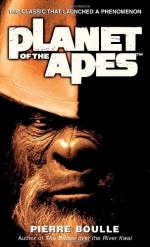
Planet of the Apes, directed by Franklin Schaffner and released in 1968, was almost singlehandedly responsible for elevating cinema's science fiction genre from traditional "B" movie budgets into the lavish and expensive blockbuster art form.

Schaffner's Planet of the Apes, based on Pierre Boulle's novel La Panete des Singes (1963), portrayed misanthropic George Taylor (Charlton Heston) and his fellow astronauts' deep-space mission to find other forms of life. These voyagers program the ship's computersto wake them from their hibernation some 2,000 years in the future, when they expect to be light-years from Earth but in the same physical state due to the effects of travelling at the speed of light. Upon awakening, the crew guides their spaceship to a remote planet, barren and seemingly devoid of life. Soon, though, the astronauts encounter a race of reasoning and talking apes that hold court over a complex aristocratic ape civilization. They also discover a rogue group of primate-like humans, against whom the apes make war. Upon discovering Taylor, the ape leader Dr. Zaius (Maurice Evans) reacts in horror and demands his death. The apes Cornelius (Roddy McDowell) and Zira (Kim Hunter) risk their lives to protect Taylor; in the process, they uncover the damning secret of the planet's history.

Charlton Heston under contol of the Apes in a scene from the film Planet of the Apes.Charlton Heston under contol of the Apes in a scene from the film Planet of the Apes.

Previous science fiction films such as The Man From Planet X (1951) and The Day the Earth Stood Still (1951) had been big boxoffice hits despite their shoddy low-budget depictions of futuristic worlds and beings. Planet of the Apes, with its expensive makeup and costumes, demonstrated the economic viability of big-budget science fiction fare to Hollywood studios. The following three decades were characterized by a host of similar blockbuster futuristic productions. By the late 1990s, the big-budget science fiction film had become one of the most popular styles of filmmaking and also one of the surest returns on studio investment.

Planet of the Apes became such a cultural phenomenon that it spawned four sequels—Beneath the Planet of the Apes (1970), Escape from the Planet of the Apes (1971), Conquest of the Planet of the Apes (1972), and Battle for the Planet of the Apes (1973)—as well as a live action (1974) and an animated (1974-1975) television series.In addition, the film occasioned its own merchandising line, as children of the 1970s could purchase Planet of the Apes action figures and lunch boxes. The film's cultural resonance continued into the 1980s and 1990s. Greenpeace, for instance, seized upon the film's image of Taylor kneeling before the fallen Statue of Liberty as the basis for a series of antinuclear posters. White supremacists have embraced Planet of the Apes as well, reading the film's ape dominance as a coded warning against increased racial tolerance.

As of late 1998, Twentieth Century Fox was considering another Apes -related production to capitalize on the film's continued cultural appeal and also to honor its contributions to science fiction filmmaking by treating it in the context of elaborate production costs and special effects, both of which the film made possible.

Further Reading:

Greene, Eric. Planet of the Apes as American Myth: Race and Politics in the Films and Television Series. Jefferson, McFarland & Company, 1996.

Kim, Erwin. Franklin Schaffner. Metuchen, Scarecrow Press, 1985.

Pohl, Frederick and Frederick Pohl IV. Science Fiction: Studies in Film. New York, Ace Books, 1981.

This is the complete article, containing 558 words (approx. 2 pages at 300 words per page).

Ask any question on Planet of the Apes and get it answered FAST!
Answer questions in BookRags Q&A and earn points toward
discounted or even FREE Study Guides and other BookRags products!
Learn more about BookRags Q&A
Copyrights
Planet of the Apes from St. James Encyclopedia of Popular Culture. ©2005-2006 Thomson Gale, a part of the Thomson Corporation. All rights reserved.

Join BookRagslearn moreJoin BookRags

Join BookRagslearn moreJoin BookRags