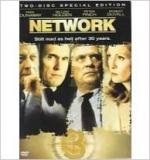
Network
The black comedy film Network (1977) explored a brief period of populist indignation presided by President Jimmy Carter during which distrust of big government and multinational corporations pervaded America's post-Watergate consciousness. A crazed television talk show commentator's weekly battle cry that he's "mad as hell and not going to take it anymore" captured a crisis of public confidence in American business and political leaders that was fueled by economic recession, Arab oil cartel price-fixing, and poor health and safety standards in industry.
Written by television industry veteran Paddy Chayefskey and directed by socially conscious filmmaker Sidney Lumet, the film also indicted the television news business as a profit-driven enterprise that compromised the public interest by sacrificing prestige-driven, hard news reporting for ratings-driven, lurid tabloid sensationalism. Far ahead of their time, the creators of Network anticipated the negative impact television's role as an entertainment medium had on the quality of news reporting and public discourse in an age of "reality" television and "personality-driven" political salesmanship.
The parallel themes of how corporate profiteering can subvert the public service potential of a powerful mass communication technology and how a gullible public can be seduced by pseudo-populist personalities were also explored in earlier Hollywood offerings like Meet John Doe (1933) and A Face in the Crowd (1957). Both films are cautionary tales about the mass media's co-optation by power-hungry corporate magnates and about the American public's willingness to vest faith in barefoot political messiahs (a Will Rogers-inspired radio personality in the former, a guitar-strumming folk musician in the latter). However, both films' endings also suggested that the mass media's political integrity remained intact and that the American public was capable of distinguishing a celebrity from a hero.
Anticipating the rise of a 200-channel cable universe as the public's window to the world, Network jettisoned from its outset any residual faith in television news's integrity and the people's ability to distinguish between reality and televisual fiction. Veteran television news anchorman Howard Beale (Peter Finch) appears on-camera drunk during his final six o'clock newscast after being told he had been fired for poor ratings. Denouncing the state of the world as "bullshit" while bordering on a nervous breakdown, the aging journalist's overnight ratings soared. The following week, the new chairman of the network (Robert Duvall) transfers control over its news programming from an Edward R. Murrow-inspired network news executive (William Holden) to a baby-boomer entertainment executive raised on television (Faye Dunaway).
The latter performs a makeover of the newscast, transforming it into a three-ring circus featuring Sybil the Soothsayer, the gossip Mata Hari "and her skeletons in the closet," and a "Vox Populi" segment starring the "mad prophet of the airwaves" himself, Howard Beale. As "The Howard Beale Show" takes off in overnight ratings, the network follows it up with "The Mao-Tse Tung Hour," during which it broadcasts home movies of a communist "revolutionary" group's (modeled on the Symbionese Liberation Army) weekly bank robberies and kidnappings. A particularly hilarious send-up of television network dealmaking occurs when the Afro-coiffed leader of the group warns network lawyers during negotations not to "fuck with my distribution costs."
Ironically, "The Howard Beale Show's" weekly mantra (announcer cue: "How do you feel?" Audience: "I'm mad as hell!") became a real-life bumper sticker slogan in 1978 for supporters of Jimmy Carter's successor, California Governor Ronald Reagan. In many ways, Reagan's election to the presidency proved a watershed in television's evolution as an entertainment medium. His deregulation of the television industry hastened the rise of ratings-driven news and talk show programming. A former television actor, Reagan also successfully sold himself as a "little guy" railing against the system while drawing support from wealthy, politically powerful Southern California business leaders.
This is the complete article, containing 611 words
(approx. 2 pages at 300 words per page).