Forgot your password?  


My Lai Massacre | Research & Encyclopedia Articles

Print-Friendly   Order the PDF version   Order the RTF version
About 4 pages (1,083 words)
My Lai Massacre Summary


My Lai Massacre

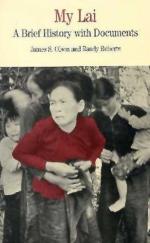
On March 16, 1968, in the wake of the Tet Offensive, American soldiers committed perhaps the most brutal, and certainly the most infamous, atrocity of the Vietnam War. The tragedy occurred in My Lai 4—one of several hamlets in Song My village in Quang Ngai province, a historic stronghold of the National Liberation Front. During an uneventful search-and-destroy mission, members of Charlie Company, First Battalion, 20th Infantry Division, commanded by Lieutenant William Calley Jr., massacred from 300 to 500 unarmed,unresisting Vietnamese women, children, and elderly men. They raped, sodomized, and mutilated many of their victims. Once the full story of My Lai reached the American public, it reshaped how they viewed the war, and, in no small way, how they understood their own hallowed history. My Lai seared America's collective memory with seemingly indisputable proof that American behavior often failed to live up to its self-righteous rhetoric.

Remarkably, initial press reports presented the "battle" of My Lai in a positive light. Misled by army publicity reports, one news agency even spoke of an "impressive victory" by American soldiers. The army's misinformation represented only part of a systematic cover-up. The entire chain of command related to the massacre, from Capt. Ernest Medina of Charlie Company through the division commander, Maj. Gen. Samuel Koster, imposed neither corrective nor punitive measures despite their awareness of the events at My Lai. Not until a year later, when in the spring of 1969 ex-GI Ronald Ridenhour requested the House Armed Services Committee to explore rumors of mass killings, did the army initiate an investigation. Even then, however, the army conspired to downplay the massacre.

If not for Seymour Hersh, a freelance investigative reporter, the army's indictment of a single soldier would have been the last Americans ever heard about My Lai. Pursuing the army's low-key announcement of Lt. William Calley's indictment, Hersh uncovered the full story of the massacre, which the New York Times published on November 13, 1969. For weeks thereafter, My Lai dominated news reports across the nation. CBS and other networks aired confessions by soldiers who had participated. Life magazine, calling My Lai "a story of indisputable horror," published ten pages of gut-wrenching photographs of the massacre in process.

Although it had taken over a year and a half, the massacre of My Lai, in all its graphic detail, had become a household topic of conversation. Never before had ordinary Americans directly confronted the brutality of their own soldiers. For some, My Lai con-firmed their worst fears about America's war in Vietnam. For others, My Lai contradicted not just their vision of the war in Vietnam, but also a longstanding American tradition of depicting the enemy, whether Indians, Nazis, Japanese, or Vietnamese, as the perpetrators of heinous atrocities—not typical American "boys."

Either way, Hersh's story set off a maelstrom of controversy. Americans responded with both denial and outrage. Despite the evidence, many Americans refused to accept that American soldiers, and by extension, America itself, could commit such barbarous crimes. A December 1969 poll, for instance, found that 49 percent of Minnesotans felt the story was false. Congressman John R. Rarick from Louisiana dubbed My Lai a "massacre hoax." Even President Nixon referred to My Lai as an "isolated incident." Others, however, charged that My Lai typified a brutal war of muddled tactics and flawed strategy. Many veterans of the war, welcoming the opportunity that My Lai presented, came forward with other similar stories, suggesting that civilian killings typified the fighting. Spurred by this controversy, the Army appointed Lt. Gen. William R. Peers to head a full-scale investigation of My Lai. The Peers Commission indicted 25 Americans: 13, including Calley, for war crimes; 12 for the cover-up. Sentenced to life imprisonment for murder, only Calley was convicted. Legal appeals on his behalf lasted for years afterwards.

Much of the cultural response to My Lai cut across ideological lines, focusing more on how the war had corrupted typical American "boys" than on the massacre's real victims. A Time poll showed that events like My Lai concerned only 35 percent of Americans. Calley's plight, however, became a cause celebre, especially among those who saw him as a scapegoat for the Army and U.S. government. Veterans groups called for leniency. State legislatures passed resolutions of support. "Free Calley" bumper stickers appeared. A pro-Calley song, "The Battle Hymn of Lt. Calley," sold 200,000 copies in three days. Sensing the political winds, President Nixon intervened on Calley's behalf. The public sympathy for Calley, who was released on parole in 1974, epitomized Americans' obsession with what the war had done to them—as well as their general disregard for what theU.S. had inflicted upon Vietnam. The theme of the exploited or psychologically scarred Vietnam veteran became a narrative fixture in later cinematic treatments of the war, common to both anti-war films like the Deerhunter (1978) and Coming Home (1978) as well as to conservative films like Rambo.

My Lai and American war tragedies in Vietnam also found their way into popular culture, but at first only through analogy. Two movies—Little Big Man (1970) and Soldier Blue (1970)—recreated U.S. army massacres of native Americans during the nineteenth century. While such movies clearly emerged in response to the war in Vietnam, they seemed to open all of American history to reinterpretation. Eventually, more direct treatment of American atrocities became a common, if often secondary, feature of Vietnam films. Not until Brian De Palma's Casualties of War (1989) did a My Lai-type atrocity become the driving story of a film. The film, which refueled the debate on the legacy of the war, recounts the story of an American platoon that kidnaps, gang-rapes, and murders a Vietnamese woman during a search-and-destroy mission. The film is perhaps best understood as rebuke to conservative revisionism of the Reagan era, calling into question Reagan's claim that the war should be considered a "noble crusade." After My Lai, Americans had to work harder to convince themselves that they were indeed the same shining "City upon a Hill" that John Winthrop spoke of in 1630 as he led anxious Puritans towards life in the new world.

Further Reading:

Anderson, David L., editor. Facing My Lai: Moving beyond the Massacre. Lawrence, Kansas, University Press of Kansas, 1998.

Bilton, Michael, and Kevin Sim. Four Hours in My Lai. New York, Viking, 1992.

Engelhardt, Tom. The End of Victory Culture: Cold War America and the Disillusion of a Generation. New York, Basic Books, 1995.

Hersh, Seymour. My Lai 4. New York, Random House, 1970.

Peers, William R. The My Lai Inquiry. New York, Norton, 1979.

This is the complete article, containing 1,083 words (approx. 4 pages at 300 words per page).

More Information
  • View My Lai Massacre Study Pack
  • Search Results for "My Lai Massacre"
  • More Products on This Subject
    My Lai
    My Lai was the site of a massacre of hundreds of civilians during the Vietnam War. Disclosure of th... more


    Ask any question on My Lai Massacre and get it answered FAST!
    Answer questions in BookRags Q&A and earn points toward
    discounted or even FREE Study Guides and other BookRags products!
    Learn more about BookRags Q&A
    Copyrights
    My Lai Massacre from St. James Encyclopedia of Popular Culture. ©2005-2006 Thomson Gale, a part of the Thomson Corporation. All rights reserved.

    Join BookRagslearn moreJoin BookRags

    Join BookRagslearn moreJoin BookRags