Forgot your password?  

Not What You Meant?  There are 113 definitions for Velocity.  Also try: VF or Delta-v.

Moving Objects and Velocity | Research & Encyclopedia Articles

Print-Friendly   Order the PDF version   Order the RTF version
About 3 pages (771 words)
Velocity Summary


Moving Objects and Velocity

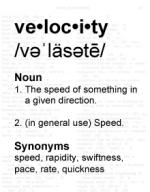
When an object moves, its position changes as a function of time, which is the definition of displacement. The distance (d) of the displacement is a scalar quantity and the displacement (d) of the object is a vector quantity, i.e. it has both a magnitude and a direction. If at time t the object is at position P and if it is displaced to position P at a time t, the displacement, d in the time interval t = t- t, is equal to P-P. The average velocity during the displacement is equal to v = d/t, another vector quantity. The distance traveled during the displacement divided by the time interval of the displacement is the average speed of the object, v = d/t, a scalar quantity. More useful when studying moving objects however, are the concepts of instantaneous velocity and speed, that is the velocity or speed at a given instant in time. The instantaneous velocity is defined as v = dr/dt or the displacement (dr) in the time interval dt. The instantaneous speed is the magnitude of the instantaneous velocity. When the instantaneous velocity of the object is changing, then the object is accelerating. The change in velocity is equal to v = v-v in the time interval t = t-t and the average acceleration in that time interval is a = v/t. The instantaneous acceleration is a = dv/dt, where dv is the change in velocity in the time interval dt. These concepts and definitions are the most elementary ones in that branch of physics which concerns itself with understanding the motion of bodies under the action of forces, i.e. mechanics.

There are many types of motion and a basic distinction is between motion that does not change the shape of the object undergoing the motion (rigid body motion) and motion which changes the shape of the object. Another distinction is between center-of-mass motion and rotation. The motion of any rigid body can thus be motion of its center of mass, i.e.

motion through space, rotational motion about an axis, or a combination of both types of motion.

Galileo Galilei is credited with fundamental contributions to the modern study of motion as shown by his mathematical descriptions of the behavior of freely falling bodies and parabolic trajectories. His insights about motion are summarized by his principle of inertia which states that no force is required to maintain motion with constant velocity in a straight line and that absolute motion does not cause any observable physical effects. In his systematic work on freely falling objects, i.e. objects not supported by anything and not acted on by any force except gravity, Galileo not only speculated that in addition to the force which pulls objects downward there is also a force exerted upward on falling bodies. He proved this experimentally by measuring the displacement of objects in water (so as to slow them down), thus showing that lighter objects took a longer time to reach the bottom. His experiments with balls rolling down inclined planes, to reduce the acceleration along the plane and thus reduce the rate of descent of the balls, also allowed him to show quantitatively that the velocity vs. time graph was linear. However, it was Isaac Newton who discovered the relationship between force and motion. Simply, he realized that there is only one cause for a change in motion, i.e. a force. Forces may be different, but they all produce changes in motion in conformity with the same laws. His first law of motion, the law of inertia, states that a moving object continues in its state of constant velocity unless it is acted upon by an external force. If the moving object is initially at rest, it will stay at rest; if it is moving with a given speed in a certain direction, it will keep on moving with the same velocity in the same direction. The first law of motion is a powerful restatement of Galileo's principle of inertia and the converse of the first law is also true: if an object is moving with constant velocity along a straight line, then the total force acting on it must be zero. Newton's second law applies to moving objects on which the total acting force is not zero, i.e. on accelerating objects, which experience changes in instantaneous velocity. It states that the acceleration of such an object is directly proportional to the net force acting on it, and inversely proportional to its mass. In other words, unbalanced forces cause acceleration and the net force is the vector sum of all forces acting on the object.

This is the complete article, containing 771 words (approx. 3 pages at 300 words per page).

More Information
  • View Moving Objects and Velocity Study Pack
  • 113 Alternative Definitions
  • Search Results for "Moving Objects and Velocity"
  • More Products on This Subject
    Velocity
    The term velocity is often confused with speed; to understand the concept of velocity, it is helpfu... more

    Differentiating Distance and Velocity
    The kinematic quantities of distance and velocity are some of the most basic concepts in introducto... more


    Ask any question on Velocity and get it answered FAST!
    Answer questions in BookRags Q&A and earn points toward
    discounted or even FREE Study Guides and other BookRags products!
    Learn more about BookRags Q&A
    Copyrights
    Moving Objects and Velocity from World of Physics. ©2005-2006 Thomson Gale, a part of the Thomson Corporation. All rights reserved.

    Join BookRagslearn moreJoin BookRags

    Join BookRagslearn moreJoin BookRags