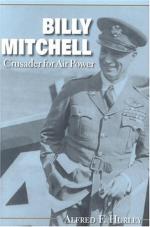
Mitchell, Billy
(b. December 29, 1879; d. February 19, 1936) Commander of Air Service, First U.S. Army during World War I, and airpower theorist.
Billy Mitchell's leadership was instrumental in the early development of American air forces, and his ideas about airpower exert their influence to this day. He served as the top combat commander of the Air Service of the American Expeditionary Forces in World War I. Afterward he became an outspoken proponent of airpower, resulting in a court-martial that shortened his military career. As a civilian he continued to widely publicize his beliefs until his death.
William Mitchell was born on December 29, 1879 in Nice, France. He grew up in the Midwest and joined the army during the Spanish-American War. His father was a U.S. senator, and Billy used that connection to garner a second lieutenant's commission in a volunteer signal company. After a rather uneventful tour in Cuba, he served in the Philippines during the insurrection there. He did well in these early assignments, and soon accepted the army as his career. He eventually became involved with the development of the Aviation Section of the Signal Corps. He began his own flight training in the fall of 1916, and was sent to France as an aeronautical
Colonel Billy Mitchell (far right) at his court martial. Mitchell provoked the court martial in order to draw attention to his ideas for changing military air power strategies. COURTESY OF THE LIBRARY OF CONGRESS
observer in early 1917. He learned much from the British and the French that he would apply in helping to create an air service for the American Expeditionary Forces in World War I.
Mitchell witnessed firsthand the futility of French assaults on German trenches. He was impressed by French aircraft designs and French concepts of concentrated airpower as a modern tactical weapon. However, he much preferred the type of air operations conducted by the independent British Royal Flying Corps under the command of Major General Hugh Trenchard. The RFC emphasized that command of the air over the battlefield could be accomplished only by an incessant air offensive. Mitchell may have also picked up some ideas from Italian theorists Gianni Caproni and Giulio Douhet.
Colonel Mitchell got along well with General John J. Pershing, who appointed the aggressive airman Chief of Air Service, First United States Army. Mitchell clashed with the first Chief of the Air Service, AEF, Benjamin Foulois, but had better relations with Mason Patrick, his replacement. During the Battle of St. Mihiel, Mitchell earned a promotion to Brigadier General. He loosely commanded the largest concentration of aircraft during the war, a total of over 1,480 British, French, Italian, and American planes, and quickly achieved air superiority. His aircraft continued to support friendly units and bomb enemy troop concentrations during the subsequent Meuse-Argonne campaign. Though he was fascinated by new ideas such as strategic bombing and dropping troops by parachute, the war ended before Allied airmen really had a chance to try them.
Though Mitchell exaggerated his prescience in his memoirs, he did develop a vision for future American air-power from his World War I experience that emphasized its revolutionary and offensive nature. He returned home to become assistant chief of the Air Service. After Mitchell sank the battleship Ostfriesland in a much ballyhooed, and somewhat rigged, demonstration in 1921, the Joint Army-Navy Board recognized the possible vulnerability of ships to aerial bombardment, but their report fell far short of condoning the revolutionary changes Mitchell desired.
Always willing to attract attention to further his cause, Mitchell deliberately provoked a court-martial in 1925 by accusing the War and Navy Departments of "incompetency, criminal negligence, and almost treasonable administration of the National Defense" because of their failure to build-up or maintain their air components. He had achieved some success in 1921 because the public was prepared to accept the concept of using inexpensive airplanes against seaborne invasions, but four years later Americans were even more devoted to a return to "normalcy," isolationism, and economical government. Mitchell had also profited from inept opposition from the Navy in 1921, while the War Department proved more adept in the way it handled his court-martial.
After his conviction for insubordination Mitchell resigned from active duty in 1926. His treatment enraged some supporters in the House of Representatives and attracted the media attention he desired, facilitating his efforts to get many of his ideas into print. He continued to refine his views about an independent air force attacking enemy vital centers until his death in 1936, publishing five books and many more articles in journals and newspapers. His unyielding radical views about airpower had little immediate impact on developments in military aviation, but they did help condition the public to accept the changes that were to come.
Mitchell's ideas eventually had great significance in shaping the emerging American air service. Two of his disciples, Henry "Hap" Arnold and Carl Spaatz, were especially important in achieving Mitchell's goal of an independent air service with a strong strategic bombing force. Arnold led the Army Air Forces during World War II, while Spaatz succeeded him and guided the new United States Air Force into existence in 1947. Mitchell's ideas contributed to American air doctrine, and he is still perceived within the Air Force as an example of principled leadership to emulate, willing to sacrifice his personal career to further airpower ideals.
Bibliography
Hurley, Alfred F. Billy Mitchell: Crusader for Airpower. Bloomington: Indiana University Press, 1975.
Mets, David R. The Air Campaign: John Warden and the Classical Airpower Theorists. Maxwell Air Force Base, AL: Air University Press, 1999.
Mitchell, William. Memoirs of World War I. New York: Random House, 1960.
This is the complete article, containing 929 words
(approx. 3 pages at 300 words per page).