
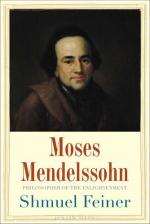
MENDELSSOHN, MOSES (1729–1786), German-Jewish philosopher and public figure of the Enlightenment period. Born in Dessau, the son of a poor Torah scribe, Mendelssohn received a traditional education that, rather exceptionally, included the study of the philosophy of Moses Maimonides. In 1743 Mendelssohn followed his teacher to Berlin to continue his Jewish studies. There he was able to acquire considerable knowledge of contemporary mathematics, philosophy, poetry, and classical and modern languages. The German dramatist and critic G. E. Lessing encouraged Mendelssohn to publish his first German essays and used him as the model for the tolerant and modest Jew in his play Nathan the Wise. In 1763 Mendelssohn received first prize from the Prussian Royal Academy of Sciences for a treatise on evidence in metaphysics; in the same year he was granted the status of "protected Jew" with rights of residence in Berlin. Mendelssohn supported himself successively as family tutor, bookkeeper, manager, and partner of a Berlin Jewish silk manufacturer; his home became a gathering place for Berlin intellectuals. In the nineteenth century members of the Mendelssohn family (most of whom converted to Christianity after Moses' death) achieved considerable financial, academic, and artistic prominence.
General Metaphysical and Religious Writings
Mendelssohn's philosophical position was derived from the English philosophers John Locke (1632–1704) and Shaftesbury (1671–1713) and especially from the German rationalists Gottfried Wilhelm Leibnitz (1646–1716) and Christian Wolff (1679–1754). The publication of Mendelssohn's Phädon (1767), a work on the immortality of the soul and named after Plato's dialogue, established his reputation among the enlightened public. Drawing on Leibnitz's theory of monads, Mendelssohn argues that souls are primary, imperishable elements that impose unity on the changing features of the body. Continued personal consciousness of the soul after death is guaranteed by God, inasmuch as divine wisdom and goodness would not allow the soul to relapse into nothingness without fulfilling its natural impulse to self-perfection. Morgenstunden, oder Über das Dasein Gottes (Morning hours, or lectures on the existence of God, 1785), the most methodical of Mendelssohn's major works, moves from a discussion of epistemological issues to the importance of a belief in God, providence, and immortality for man's happiness, to a formal ontological proof of God's existence.
Jewish Writings and Activities
In the mid-1750s Mendelssohn collaborated in a short-lived Hebrew weekly and published a commentary to Maimonides' treatise on logic. He was forced to speak out as a Jew, however, after 1769, when he was publicly challenged to explain why he, an enlightened man, did not convert to Christianity. In a reply to the Swiss pastor, Johann Kasper Lavater, Mendelssohn rejected the implication that his loyalty to Judaism was inconsistent with his innermost enlightened religious convictions and devotion to rational inquiry. In the 1770s Mendelssohn used his influence with liberal Christians to deflect threatened anti-Jewish measures in Switzerland and Germany. In connection with efforts to protect the Jews of Alsace, Mendelssohn encouraged Christian Wilhelm von Dohm to write his classic defense of the civic betterment of the Jews but demurred from Dohm's support of limited judicial autonomy for Jews and the right of Jewry to excommunicate recalcitrant Jews.
Mendelssohn's translation of the Pentateuch into German was published in 1780. It was accompanied by a commentary (the Bi'ur) that draws on both traditional exegesis and modern literary aesthetics. Often reprinted, the translation drew the ire of some traditionalist rabbis but served as an important bridge to modern culture for many young Jews in the nineteenth century.
Jerusalem, or on Religious Power and Judaism
Mendelssohn's principal contribution to Jewish thought was the result of yet another challenge by a Christian, this time concerning an alleged inconsistency in his supporting the abolition of excommunication while remaining loyal to biblical law, which condones coercion. Mendelssohn's reply, Jerusalem, oder Über religiöse Macht und Judenthum (1783), was one of the first works in German to plead for freedom of conscience in religious matters, separation of church and state, and (indirectly) civil rights for the Jews. According to Mendelssohn both states and church have as their final goals the promotion of human happiness. The state is permitted to enforce specific actions, whereas the church's task is to convince its followers of their religious and ethical duties through persuasion alone. To the question of the continued authority of Jewish law, which was adumbrated by Spinoza in the Tractatus Theologico-Politicus, Mendelssohn replied that the ceremonial law stemming from the Hebrew Bible is binding solely on the Jewish people; Judaism is a religion of revealed legislation, not of revealed beliefs. The existence and unity of God, the reality of divine providence, and the immortality of the soul are to be affirmed on the grounds of natural reason, not miracles or supernatural revelation. Mendelssohn acknowledges the importance of Spinoza in the history of philosophy but vigorously rejects Spinoza's pantheism. Spinoza's primary concern was the noninterference by the state or religious authorities in the intellectual freedom of the philosopher and scientist. Mendelssohn, while still affirming the continued authority of Jewish law, was concerned with freedom inside one religion as well as freedom of religion for minority communities.
Mendelssohn argued that the identification of church and state in biblical Israel ceased with the destruction of the ancient commonwealth; laws remaining in force are personal religious duties that preserve the universal principles of Jewish faith against lapses into idolatry and polytheism. These laws will not lose their force until God arranges another indubitable supernatural revelation to the Jewish people to supersede that of Mount Sinai. Loyalty to the Jewish law, however, does not prevent Jews from assuming the legitimate duties of citizenship in an enlightened society.
The Place of Mendelssohn in the History of Jewish Thought
Although Mendelssohn's synthesis of philosophical theism and traditional religious observance was viewed as outdated by the next generation of Jewish thinkers influenced by Kant and Hegel, Mendelssohn could be seen as forebear of the conflicting trends of nineteenth-century German Jewry: Reform, for his openness to change; and Neo-Orthodoxy, for his insistence on the binding nature of Jewish ceremonial law. Mendelssohn's disciples among the writers who collaborated with him in the Bi'ur were prominent in the Jewish Enlightenment (the Haskalah) that emerged in Prussia in the 1770s and later spread to eastern Europe. Mendelssohn was revered by the Enlighteners (maskilim) for having moved from the ghetto to modern society without abandoning the Jewish tradition or the Jewish people. In the 1880s, however, at the end of the Haskalah period, Mendelssohn was assailed for having paved the way to the loss of Jewish distinctiveness and, therefore, to assimilation. In retrospect, his thought and life can be seen to have posed some of the fundamental issues of Jewish religious survival in secular, liberal society.
Bibliography
The standard edition of Mendelssohn's writings is Gesammelte Schriften Jubiläumsausgabe, 7 vols., edited by Fritz Bamberger and others and incompletely published between 1929 and 1938; a completed edition in 20 volumes is being prepared under the editorship of Alexander Altmann (Stuttgart, 1971–). The most recent English translation of Jerusalem is by Allan Arkush, with an introduction and commentary by Alexander Altmann (Hanover, N.H., 1983). Useful is Moses Mendelssohn: Selections from His Writings, edited and translated by Eva Jospe (New York, 1975). The magisterial biography of Mendelssohn is Alexander Altmann's Moses Mendelssohn: A Biographical Study (University, Ala., 1973). On Mendelssohn's role in the intellectual history of Judaism, see Michael A. Meyer's The Origins of the Modern Jew: Jewish Identity and European Culture in Germany, 1749–1824 (Detroit, 1967), chap. 1; Julius Guttmann's Philosophies of Judaism, translated by David W. Silverman (New York, 1964), pp. 291–303; and H. I. Bach's The German Jew: A Synthesis of Judaism and Western Civilization, 1730–1930 (Oxford, 1984), pp. 44–72).
New Sources
Arkush, Allan. Moses Mendelssohn and the Enlightenment. Albany, 1994.
Berghahn, Cord-Friedrich. Moses Mendelssohns "Jerusalem:" ein Beitrag zur Geschichte der Menschenrechte und der pluralistischen Gesellschaft in der deutschen Aufklärung. Tübingen, 2001.
Sorkin, David Jan. Moses Mendelssohn and the Religious Enlightenment. Berkeley, Calif., 1996.
This is the complete article, containing 1,301 words
(approx. 4 pages at 300 words per page).

