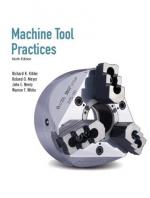
Machine Tools
Machine tools are used in the construction of other tools and instruments. They are fundamental implements that change the shape, surface, or properties of an blank object made of metal, plastic, wood, or other material. In a basic sense they cut or chip away at a material, and typically they are powered by electricity. Often they require cooling in order to dissipate the heat that is generated.
The choice of machine tool is important, because the object to be constructed must frequently be to a certain accuracy, dimension, or specification. It might be required to have a certain surface finish, or a tapered edge, or grooves on a side.
There are basic machine tools in any machining shop. They include: (1) the lathe, which allows boring of a hole in an object. The object to be cut is placed on a rotating spindle, and a cutting tool is fed into the object, gouging a hole that is then shaped and made exact, (2) the drill, which is one of the most common machine tools. Drills cut cylindrical holes in objects. (3) An extruder is a machine that forces the material through a die, resulting in a specific shape. (4) Gear cutters produce a uniform series of toothed projections on the surface of the workpiece. (5) Grinding wheels remove material from an object by rubbing against it, slowly wearing the material away. The grinding wheel is typically used near the end of the machining task, to smooth a finish or to obtain extremely accurate dimensions. (6) Polishing wheels are typically built up from layers of a soft material like leather, and are used to obtain a very fine finish.
Machine tools have advanced along with technology. Where once drilling had to be done by hand, it is now powered by electricity, as in a drill press or a hand-held portable drill. Machine tools have become more powerful, and some have also allowed for greater and greater accuracy. Lasers are now used to cut metal. The vibrations of ultrasonic sound (about 20,000 Hz) are used to drive an abrasive, suspended in liquid, against the workpiece, which can produce impressions in glass, ceramics and other materials. In electric-discharge machining, electrically conductive materials (like metals) can be removed by repeated electric sparking.
A Machine Variation Analysis" system developed by researchers at the Massachusetts Institute of Technology (MIT) allows designers to create machine tools on a computer, and use those virtual tools to build a computer model of a machine part. The system can predict the exact shape of the part given by any error in the machine tool. Real-life tools always have some error or imprecision, and the Machine Variation Analysis system takes some of the uncertainty from the machining process.
This is the complete article, containing 454 words
(approx. 2 pages at 300 words per page).