BookRags.com Literature Guides Literature Guides Criticism/Essays Criticism/Essays Biographies Biographies My Bibliography Periodic Table U.S. Presidents Shakespeare Sonnet Shake-Up
Research Anything:        
History | Encyclopedias | Films | News | Create a Bibliography | More... Login | Register | Help
Not What You Meant?  There are 3 definitions for Bartolomé.  Also try: Las Casas.

Search "Las Casas, Bartolomé De"

Contents Navigation


Las Casas, Bartolomé De

Print-Friendly  Order the PDF version  Order the RTF version
About 3 pages (932 words)
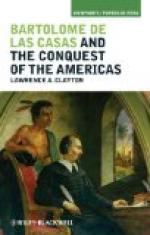
Bartolomé de Las Casas Summary

Bookmark and Share

Las Casas, BartolomÉ De

LAS CASAS, BARTOLOMÉ DE (1474–1566), was a Christian missionary. Las Casas was born in Seville, Spain. In 1502 he went to the island of Hispaniola (present-day Dominican Republic and Haiti), where he participated in the conquest of the Indians. As a reward he received lands and Indians under the encomienda system, a kind of indentured servanthood. He exercised the lay office of catechist, worked to evangelize the Indians, and was ordained a priest about 1512. His commitment to evangelization did not keep him from participating in the bloody conquest of Cuba, for which he received additional lands and Indians. However, in 1514, at forty years of age, he was converted to concern for the plight of the Indians while reading Ecclesiasticus (Ben Sira) 34:22. Four months later he preached his famous sermon in the Church of the Holy Spirit, denouncing the grave injustices being committed, and turned his Indians over to the governor of Cuba. Until his death at ninety-two, he was the tireless "Defender of the Indians," a title conferred on him in Madrid in 1516.

Las Casas returned to Spain four times, in attempts to save the Indians from the cruelties of the Spanish conquest and to find new methods to convert them to Christianity. In his efforts he became a court reformer in Spain (1515); the leader of the unsuccessful colony of peace in Curmaná, Venezuela (1520), which attempted to establish agricultural communities of Spanish and Indian workers; a Dominican monk and prior in Santo Domingo (1523); the unrelenting foe of the unjust wars of suppression in Nicaragua (1535); a defender of the Indians against ecclesiastics in Mexico (1532); a promoter and participant in the project to colonize and Christianize the natives of Guatemala by peaceable means (1537); a successful attorney for the Indians before Charles V, urging the adoption of the New Laws (1542), which, for example, negated the rights of the encomienda over Indian children; and the rejected bishop of Chiapas (1545). When he returned to Spain for the last time in 1547, it was as a legal adviser and theologian in defense of Indian rights.

In his prophetic crusade, alternately encouraged and denounced by creoles and clerics, Las Casas doggedly and dogmatically followed what he conceived to be his life's purpose. With a missionary conviction that his truth could not be negotiated, he proclaimed, "All peoples of the earth are men." He categorically denied the claims of Juan Ginés de Sepúlveda that "the Indians are inferior to the Spanish as are children to adults, women to men, and … almost as monkeys to humans." Rather, he lauded the cultural and artistic achievements of Indian cultures, which he considered equal to that of ancient Egypt. In some respects, he declared in his Apologetic History, Indians are superior to Spaniards.

Las Casas wrote in reaction to what he viewed as horrible inhumanities committed with hypocritical religious justification. Must people be converted by slavery and the sword? In his Only Method of Attracting All People to the True Faith (1537), he argued for means that persuade by exhortation and gentle attractions of the will. With furious verbal assaults and chilling realism, he recounted the relations of the Indians with their European conquerors in his History of the Indies, on which he worked from 1527 to 1566. Equally brutal in exposing the grave crimes against the Indian race, his Very Brief Account of the Destruction of the Indies (1542) and eight more tracts for public dissemination (1552) raised storms of protest against Las Casas. But the prophet was unbending: His Advice and Regulations for Confessors (1545) advocated denial of the sacraments of the church to all who had Indians and did not "pay a just wage." In later years British royalists, New England colonists, French rationalists, and Latin American nationalists freely used his condemnation of the Spanish atrocities as propaganda for their own causes.

Crusader, traitor, prophet, paranoiac, servant of God, anarchist, visionary, pre-Marxist, egalitarian—these are but a few of the epithets hurled at his memory. The issues Las Casas raised are dangerously modern.

Bibliography

An admirable collection of the principal writings of Las Casas is Orbras escogidas, 5 vols., edited by Juan Pérez de Tudela (Madrid, 1957–1958). The missionary's view that the gospel requires a peaceful evangelization of the Indians without the use of arms is contained in his Del único modo de atraer a todos los pueblos a la verdadera religión, edited by Augustín Millares (Mexico City, 1942). Two of his principal works are available in English: Devastation of the Indies: A Brief Account, translated from Spanish by Herman Briffault (New York, 1974), and In Defense of the Indians, edited and translated from Latin by Stafford Poole with Lewis Hanke, V. Friede, and Benjamin Keen (De Kalb, Ill., 1974). The first work defends the thesis that the cause of the destruction of an "infinite number of souls" by Christians is solely the latter's thirst for gold and "to become fat with riches in a few brief days." The second work denounces the imperialistic exploitation of the Indians inspired by the conquistadors' greed and ambition; as such, it may be considered a tract for all times against economic and social exploitation.

A useful bibliography is Lewis Hanke and Manuel Giménez Fernández's Bartolomé de las Casas, 1474–1566: Bibliografía crítica y cuerpo de materiales para el estudio de su vida (Santiago de Chile, 1954). Though dated, this work gives a valuable accounting of studies on historical background and additional bibliographical sources. Manuel Giménez Fernández's Bartolomé de las Casas, 2 vols. (Seville, 1953–1960), is an excellent, though unfinished, biography of the first part of his life.

This is the complete article, containing 932 words (approx. 3 pages at 300 words per page).

More Information
  • View Las Casas, Bartolomé De Study Pack
  • 3 Alternative Definitions
  • Search Results for "Las Casas, Bartolomé De"
  • Add This to Your Bibliography
  • More Products on This Subject
    Bartolomé de Las Casas
    Bartolomé de Las Casas (1474-1566) was a Spanish priest, social reformer, and historian. He ... more

    Critical Essay by David M. Traboulay
    SOURCE: Traboulay, David M. “Bartolome de las Casas and the Issues of the Great Debate of 1550-155... more


    Copyrights
    Las Casas, Bartolomé De from Encyclopedia of Religion. Copyright © 2001-2006 by Macmillan Reference USA, an imprint of the Gale Group. All rights reserved.

    Join BookRagslearn moreJoin BookRags


    About BookRags | Customer Service | Report an Error | Terms of Use | Privacy Policy