
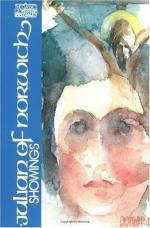
Julian of Norwich
JULIAN OF NORWICH (1342–1416?), known as Lady Julian, Dame Julian, and Mother Julian, was an English mystic and Christian theologian. Julian lived in the century in which Europe was ravaged by the Black Death, and England and France were torn by the Hundred Years War. Against a background of war, plague, social turmoil, and religious unrest she shared in a flowering of English mysticism along with Walter Hilton, Richard Rolle, Margery Kempe, and the anonymous author of The Cloud of Unknowing.
Highly literate—despite a polite disclaimer in her book Revelations [or Showings] of Divine Love—and demonstrating a knowledge of the Vulgate rare for a layperson of her day, she was the first woman to compose a literary work in English. Although scholars have traced many general theological influences in Julian's book, specific influences are hard to identify, so thoroughly assimilated are they into a theology that is at once deeply traditional and highly original. She was probably familiar with the writings of William of Saint-Thierry (d. 1148) and Meister Eckhart (d. around 1327), but the only two writers whom she mentions by name are Dionysius the Areopagite (c. 500) and Gregory I (d. 604), from whose Life of Saint Benedict she quotes.
Little is known about Julian's life. In May 1373, when Julian was thirty years old, she became severely ill. At what seemed the point of death, she revived and received what she described as fifteen "showings of God's love"; on the following day she had a sixteenth such experience. Her mother, her parish priest, and possibly others were with her at these times. Some time later Julian wrote a description of these showings that is now referred to as the "short text" or "short version." Twenty years later, after profound meditation, she felt she had come to a fuller understanding of the showings, and she wrote a much longer version, concluding: "So I was taught that love is our Lord's meaning. And I saw very certainly in this and in everything that before God made us he loved us, which love was never abated and never will be" (Colledge and Walsh, Showings, p. 342).
At some time in her life Julian became an anchoress, living in a cell attached to the church of Saint Julian in King Street. It was probably from this saint that she took the name by which she is known.
The all-encompassing theme of Julian's Revelations is the compassionate love of God as universally manifested throughout the process of creation and as focused in the passion of Jesus, whose delight was to suffer for his beloved humankind. One aspect of Christ stressed by Julian is his "motherhood." Many earlier writers, including Anselm, had written of Christ's motherhood, but Julian wrote more extensively on this theme.
Julian's theology is eschatologically orientated. The resolution of the problem of evil (a problem over which she agonizes at length) will come through a "great deed ordained by our Lord God from without beginning, treasured and hidden in his blessed breast, known only to himself, through which deed he will make all things well" (Colledge and Walsh, Showings, pp. 232–233). This aspect of Julian's theology proved particularly interesting to T. S. Eliot, who quotes from her book and alludes to her thought in his mystical poem Four Quartets.
The enduring contemporary interest in Julian was expressed in an ecumenical celebration in Norwich in May 1973, the six-hundredth anniversary of her Revelations. Her influence continues at the Julian shrine in Norwich, where prayer and spiritual counsel continue in a chapel built where her cell once stood.
Bibliography
Basic information on Julian herself and on the six-hundredth-anniversary ecumenical celebration of Revelations is conveniently given in Julian and Her Norwich: Commemorative Essays and Handbook to the Exhibition "Revelations of Divine Love," edited by Frank D. Sayer (Norwich, U.K., 1973). This book includes a useful bibliography of Julian publications prior to 1973: five manuscripts, twenty-six printed editions (in German, French, and Italian as well as English), and fifty-six books and articles about Julian and her thought. For works published since 1973, the Fourteenth-Century English Mystics Newsletter (Iowa City), published quarterly since 1974, is indispensable. Renamed Mystics Quarterly in 1984, this journal contains articles, book reviews, descriptions of scholarly studies in progress, and bibliographies of the many books and articles on Julian, including a Swedish translation and two French translations of Revelations. Among the post-1973 works, one of the most significant is the definitive edition of the original text prepared by Edmund Colledge and James Walsh, Juliana, anchoret, 1343–1443: A Book of Showings to the Anchoress Julian of Norwich, 2 vols. (Toronto, 1978). From this critical text Colledge and Walsh have made a modern translation, Julian of Norwich: Showings, "The Classics of Western Spirituality," vol. 1 (New York, 1978). Another significant English translation published since 1973 is Revelations of Divine Love by Juliana of Norwich, translated with a particularly good introduction by M. L. Del Mastro (Garden City, N.Y., 1977). The chaplain of the Julian shrine in Norwich, England, Robert Llewelyn, has written With Pity, Not with Blame: Reflections on the Writings of Julian of Norwich and on The Cloud of Unknowing (London, 1982). Many Julian publications are available at the shrine. In addition, the Norwich Public Library has a sizable collection of printed material on Julian.
This is the complete article, containing 877 words
(approx. 3 pages at 300 words per page).

