
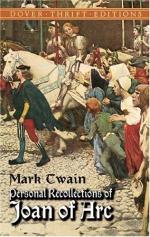
Joan of Arc
JOAN OF ARC (c. 1412–1431) was a French visionary; also known as the Maid of Orléans. Joan, who called herself Jeanne La Pucelle, used her claims to mystical experience to influence the course of French history in the fifteenth century. Led by her visions, she inspired the French army to turn the tide of the Hundred Years' War. Born around 1412 in Domrémy-la-Pucelle, a village on the border between Lorraine and France, Joan was a peasant who, in her own words, did not "know A from B." As she grew up she heard the magical lore and local saints' legends of Lorraine and reports of continuing French defeats at the hands of the English.
At age thirteen Joan began to hear a voice from God instructing her to go to the dauphin Charles, the uncrowned Valois king. Believing that she was called to drive the English out of France, Joan privately took a vow of virginity and prepared herself for the role of prophetic adviser to the king, a type of female mystic familiar in the late medieval period. At some point in these troubled years the voice became three voices, whom she later identified as the saints Catherine of Alexandria and Margaret of Antioch, both known for their heroic virginity, and the archangel Michael, protector of the French royal family.
Joan established her authority through her urgent sincerity, by identifying herself with prophecies about a virgin who would save France, and by accurately announcing a French defeat on the day it took place 150 miles away. No longer able to ignore her, the garrison captain at the nearby town of Vaucouleurs refused to endorse her mission to save France until she was exorcised, raising the issue that would haunt her mission henceforth: Did her powers come from God or from the devil? Not fully assured, the captain nonetheless gave her arms and an escort. Cutting her hair short and donning male clothing, Joan and her companions made their way through enemy territory, reaching the dauphin's court at Chinon in late February 1429.
Joan's indomitable belief that only she could save France impressed Charles, his astronomer, and some of the nobles. But they too moved carefully, requiring an examination for heresy by theologians at Poitiers, who declared her a good Christian, and a physical examination by three matrons, who certified that she was indeed a virgin. For a woman about to attempt the "miracle" of defeating the English, virginity added an aura of almost magical power.
Given the desperate nature of Charles's position, he had little to lose in allowing Joan to join the army marching to the relief of Orléans, which had been besieged by the English. Her presence attracted volunteers and raised morale. Charging into the midst of battle, Joan was wounded and became the hero of the day. With Orléans secured, Joan impatiently counseled the army to move on. Town after town along the Loire fell, others offered their loyalty without battle. By late July, the dauphin could be crowned King Charles VII at Reims with Joan by his side.
But Joan's days of glory were brief. Driven by her voices, she disobeyed the king and continued to fight. Her attack on Paris failed, and several other ventures ended inconclusively. In May 1430, Joan was captured in a skirmish outside Compiègne. Neither Charles nor any of his court made an attempt to rescue or ransom her.
Determined to discredit Joan as a heretic and a witch, the English turned her over to an inquisitional court. Manned by more than one hundred French clerics in the pay of the English, Joan's trial in Rouen lasted from February 21 to May 28, 1431. Under inquisitional procedure she could not have counsel or call witnesses. As a layperson she had no religious order to speak for her, nor had she ever enlisted the support of a priest. Yet although she had spent months in military prisons, in chains and guarded constantly by men, Joan began with a strong defense. Reminding her interrogators that she was sent by God, she warned that they would condemn her at great risk. The charges came down to the question of ultimate authority: The judges insisted that she submit to the church's interpretation that her visions were evil, but Joan held to her claim that they came from God. Perhaps without intending it, Joan thus advocated the right of individual experience over the church's authority.
After weeks of unrelenting questioning, Joan began to break. Threatened with death by fire, she finally denied her voices and agreed to wear women's dress. It is not known precisely what happened next, but three days later she was found wearing male clothing again. She claimed that she had repented of betraying her voices; there are indications that her guards may have tried to rape her. Whatever her motivation, her actions sealed her fate. Declared a relapsed heretic on May 31, 1431, Joan was burned at the stake.
In 1450, because he was uneasy that he owed his crown to a convicted heretic, Charles instigated an inquiry into the trial, which led to a thorough papal investigation. Although the verdict of 1431 was revoked in 1456, the main charges against Joan were not cleared. Despite this ambiguity, Joan's memory received continuous attention from the French people through the centuries. It is ironic that in 1920 she was declared a saint, because none of the church's proceedings has acknowledged her right to interpret her divine messages, leaving the main issue for which she was condemned unaddressed.
Bibliography
The basic materials relative to the trial are found in Jules Quicherat's five-volume Procès de condamnation et de réhabilitation de Jeanne d'Arc (Paris, 1841–1849; New York, 1960). For an updated edition of the trial in French and Latin, see Procès de condamnation de Jeanne d'Arc, 3 vols., edited by Pierre Tisset and Yvonne Lanhers (Paris, 1960–1971), and of the retrial, see Procès en nullité de la condamnation de Jeanne d'Arc, 3 vols., edited by Pierre Duparc (Paris, 1979–1983). An abridged English translation of the trial can be found in Wilfred P. Barrett's The Trial of Jeanne d'Arc (London, 1932), and of the retrial, in Régine Pernoud's The Retrial of Joan of Arc, translated by J. M. Cohen (London, 1955).
Of the vast secondary literature, the following biographies are good places to begin: Frances Gies's Joan of Arc: The Legend and the Reality (New York, 1981), Lucien Fabre's Joan of Arc (New York, 1954), and Victoria Sackville-West's St. Joan of Arc (London, 1936; New York, 1984). See also my study Joan of Arc: Heretic, Mystic, Shaman (Lewiston, N.Y., 1985) and Régine Pernoud's Joan of Arc by Herself and Her Witnesses, translated by Edward Hyams (London, 1964).
This is the complete article, containing 1,112 words
(approx. 4 pages at 300 words per page).

