 Print
Print Word
Word PDF
PDF|
This section contains 6,221 words (approx. 21 pages at 300 words per page) |

|
Born April 13, 1743 (Shadwell, Virginia)
Died July 4, 1826 (Monticello, Virginia)
U.S. president, vice president, secretary of state, scientist, inventor,
philosopher, foreign diplomat, architect
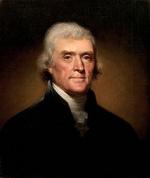
Thomas Jefferson, a slave-owning aristocrat and philosopher who believed in reason, science, and education, was the primary spokesman for the common people in the early years of the United States. Despite coming from a wealthy family, he had a strong ability to connect with the common person; he also had a talent for writing in plain, direct, yet eloquent language. His revolutionary thought profoundly influenced the direction of American independence. Though he spent most of his career in public office, Jefferson always considered himself a common citizen rather than a politician.
Jefferson rejected all existing European notions of society and governmental authority. He contended that government derives its authority from the consent of the people it governs. Believing in self-government by the people, Jefferson...
|
This section contains 6,221 words (approx. 21 pages at 300 words per page) |
|