
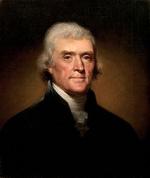
Jefferson, Thomas(1743–1826)
"Here was Buried Thomas Jefferson
April 2, 1743 O.S. –July 4, 1826
Author of the Declaration of Independence
And of the Virginia Statue for Religious Freedom
and Father of the University of Virginia."
These are the words that Thomas Jefferson wrote for his epitaph. They indicate what he thought were his life achievements. What is notable here is that he does not mention that he was secretary of state, vice president, and president. These political accomplishments were not at the top of his list.
Jefferson was born in Shadwell, Virginia. His father, Peter Jefferson, was a self-taught surveyor and mapmaker. Thomas was sent to William and Mary College in the colony's capital, Williamsburg. Jefferson took to the law under the tutelage of George Wythe. It should be noted that Thomas Jefferson had wide-ranging intellectual interests (as evidenced by the personal libraries he assembled that included natural philosophy, history, and the fine arts). Jefferson was also a man of action and in 1769 was elected to the House of Burgesses. He became active in politics and published "A Summary View of the Rights of British America." This tract took a Whig-oriented republican view. In 1776 he wrote the Declaration of Independence from a Lockean standpoint. And in 1787 he completed his only full-length book, Notes on the State of Virginia (part encyclopedia and reflections on the same). Most of his other writings consist of speeches, legislation, and letters. He was the architect for his famous house, Monticello, and he founded the University of Virginia.
His Philosophy
Most commentators cite the influence of John Locke on Jefferson. Locke's Second Treatise on Government depicted the strong individual within a state of nature. This individual possessed natural rights that came into play in establishing the social contract. Government was created by the people and could be dissolved if it did not serve popular purposes. Locke's approach is so greatly in evidence within the Declaration of Independence that Carl Becker has said that "Jefferson copied Locke" (1945, p. 79).
This is probably most true of the Declaration but is less true of Jefferson's other works, which show a broad influence from the liberal Enlightenment. The argument for this can be illustrated by Jefferson's repudiation of the Church of England (which set out a default religious position modified by toleration of other religions—a position accepted by Locke). Jefferson, however, insisted upon the absolute separation of church and state. The result of this is the Virginia Statute for Religious Freedom, which Jefferson wrote.
J. G. A. Pocock (1969) has argued that Jefferson's thought reflects the thinking of nonliberal republican thinkers such as Cicero, Machiavelli, and James Harrington. This argument follows from humankind's nature as political beings and the political heritage from ancient Rome onwards. The argument for this interpretation lies largely in discursive passages of the Notes and in his correspondence.
The empiricism of Francis Bacon is also present in Jefferson's work on agriculture. In the end, it seems safe to conclude that though Jefferson was greatly influenced by John Locke, there are many philosophical lights that guided him. What Jefferson did was to assimilate these various influences and apply them to practical problems that confronted him in his role as a prominent man of action.
A Man of Contradictions
In the end, any evaluation of Thomas Jefferson must come to terms with his many contradictions. On the one hand, he was an agrarian, individualist, advocate for limited government, and yet on the other hand he served in three national offices (including the presidency) and expanded the country greatly—particularly through the Louisiana Purchase. He also stated in the Declaration that "all men are created equal." Slavery certainly flies in the face of equality. At times in both "The Rights of British America" and in his correspondence, Jefferson calls for various versions of ending slavery. And yet Jefferson continued to own slaves himself. This can probably be explained by the fact that Jefferson did not completely believe that nonwhite individuals were fully human. For example, Jefferson says in the Notes (query 14) that "Never yet could I find that a black had uttered a thought above the level of plain narration …" If blacks and Native Americans were not fully human, then they have no place in the new Republic. They must be exiled so that the "pure" fully human European Americans might appropriate the wilderness—viewed as the state of nature. In the Lockean state of nature, if one could work the land and make productive use of it, then it was his. Because the native peoples were not fully human, the fact that they were using the land first would be irrelevant.
However, once we set out the above position, we are again faced with a contradiction. In November 1998 the magazine Nature published an article that strongly suggested that Thomas Jefferson was the father of his slave Sally Hemmings's last son, Madison Hemmings (1805–1877). It was also possible that Jefferson and Hemmings had five other children: four daughters and one other son. Though the evidence for this is not conclusive (because the DNA tests could have also been the same if another Jefferson relative were the father), still these results raise questions of the relationship between the races in Colonial times. Why would Thomas Jefferson have children with someone he believed to be subhuman? Two possibilities present themselves: (a) either Jefferson thought that interracial sexuality was merely a way to satisfy desire without thought of outcome; or (b) Jefferson's private actions did not match his public writings. The first alternative makes Jefferson into the sort of animal brute he publicly eschewed. The second alternative humanizes Jefferson and shows that he might fall in love with and honor a woman of color. Under this second hypothesis, he might personally believe in a realm of equality that he could never publicly express (even though it matched his words in the Declaration of Independence). Racism against native peoples and African slaves was the public dogma. Yet, perhaps he found a human with whom he could share and cherish true human love? The real truth may be a combination of (a) and (b). Such tortured reasoning is reminiscent of William Faulkner's Absalom, Absalom! The worldviews of the public and private are so riddled with contradictions that they often lead to bizarre and brutal results.
In the context of all these contradictions stands Thomas Jefferson, the third president of the United States—though (in his own mind) most to be honored as the author of the Declaration of Independence, the Virginia Statue for Religious Freedom, and founder of the University of Virginia.
Bacon, Francis; Cicero, Marcus Tullius; Deism; Enlightenment; Harrington, James; Locke, John; Machiavelli, Niccolò; Rights.
Bibliography
Works by Jefferson
The Writings of Thomas Jefferson, edited by Paul L. Ford. 10 vols. New York: G. P. Putnam's Sons, 1892–1899.
The Writings of Thomas Jefferson, edited by Andrew Lipscomb. 20 vols. Washington, DC: Thomas Jefferson Memorial Association, 1903–1904.
The Papers of Thomas Jefferson, edited by Julian Boyd, Charles Cullen, and John Catanzariti. 27 vols. (to date). Princeton, NJ: Princeton University Press, 1950–.
Jefferson: Political Writings, edited by Joyce Appleby and Terrance Ball. Cambridge, U.K.: Cambridge University Press, 1999.
Secondary Texts
Adams, William Howard. The Paris Years of Thomas Jefferson. New Haven, CT: Yale University Press, 1997.
Becker, Carl L. The Declaration of Independence: A Study in the History of Political Ideas. Rev. ed. New York: Knopf, 1945.
Bernstein, R. B. Thomas Jefferson. Oxford: Oxford University Press, 2003.
Brown, Stuart Gerry. "The Mind of Thomas Jefferson." Ethics 63 (1963): 79–99.
Cooke, J. W. "Jefferson on Liberty" Journal of the History of Ideas 34 (1973): 563–576.
Dumbauld, Edward. Thomas Jefferson and the Law. Norman: University of Oklahoma Press, 1978.
Gordon-Reed, Annette. Thomas Jefferson and Sally Hemings: An American Controversy. Charlottesville: University Press of Virginia, 1997.
Kennedy, Roger G. Mr. Jefferson's Lost Cause: Land, Farmers, Slavery, and the Louisiana Purchase. New York: Oxford University Press, 2003.
Lewis, Jan Ellen, and Peter S. Onuf, eds. Sally Hemings & Thomas Jefferson: History, Memory, and Civic Culture. Charlottesville: University Press of Virginia, 1999.
Maier, Pauline. American Scripture: Making the Declaration of Independence. New York: Knopf, 1997.
Malone, Dumas. Jefferson and His Time. 6 vols. Boston: Little Brown, 1948–1981.
Mayer, David N. The Constitutional Thought of Thomas Jefferson. Charlottesville: University Press of Virginia, 1994.
McColley, Robert. Slavery and Jeffersonian Virginia. 2nd ed. Urbana: University of Illinois Press, 1973.
Miller, John C. The Wolf by the Ears: Thomas Jefferson and Slavery. New York: Free Press, 1977.
Peterson, Merrill. Thomas Jefferson and the New Nation: A Biography. New York: Oxford University Press, 1970.
Pocock, J. G. A. The Machiavellian Moment: Florentine Political Thought and the Atlantic Republican Tradition. Princeton, NJ: Princeton University Press, 1969.
Reck, Andrew J. "The Declaration of Independence as an 'Expression of the American Mind'" Revue Internationale de Philosophie 31 (1977): 401–437.
Sheldon, Garrett Ward. The Political Philosophy of Thomas Jefferson. Baltimore, MD: The Johns Hopkins University Press, 1991.
This is the complete article, containing 1,451 words
(approx. 5 pages at 300 words per page).

