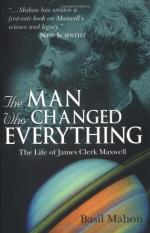
James Clerk Maxwell
1831-1879
Scottish Physicist
James Clerk Maxwell developed the mathematical theory of electricity and magnetism, and introduced statistical methods to the kinetic theory of gases and thermodynamics. Arguably the nineteenth-century scientist who exerted the greatest influence on twentieth-century science, his work had widespread significance in a variety of fields, including the development of relativity and quantum mechanics. The importance of Maxwell's work is ranked with that of Isaac Newton (1642-1727) and Albert Einstein (1879-1955).
Maxwell was born into a family whose original surname was Clerk; his father added the name Maxwell when he inherited the Maxwell estate. Maxwell's mother, who was 40 years old when he was born, died of abdominal cancer when he was eight. He was initially tutored at home, then attended Edinburgh Academy where he published his first scientific paper at age 14.
Maxwell entered the University of Edinburgh at age 16 and moved on to Cambridge at age 19. He subsequently became one of the most influential members of the group of nineteenth-century scientists, now known as the Cambridge School, who provided leadership in the application of mathematics, especially calculus, to physical problems.
In 1856 Maxwell became professor of natural philosophy at Marischal College in Aberdeen, Scotland, and in 1860 was appointed professor of natural philosophy at King's College in London. Between 1860-65 he wrote two papers that introduced his mathematical treatment of thefield theory of electricity and magnetism. He also had a continuing interest in vision, color, color blindness, and geometric optics, and in 1861 showed the feasibility of color photography by demonstrating that photographs of the same subject, successively taken through filters of the three primary colors, could be combined to produce a colored image of the subject.
Among the most important contributions that resulted from Maxwell's application of mathematical methods to a variety of physical phenomena was the introduction of statistical methods to thermodynamics. In his treatment of the thermodynamics of gaseous systems he assumed that the amount of kinetic energy possessed by individual molecules is distributed statistically about an average energy that is related to the temperature of the system. This became the basis of a general statistical kinetic theory of gases and the statistical interpretation of thermodynamics.
Maxwell became a member of the Royal Society in 1860. In 1865, at age 34, he retired to the family estate to concentrate on his scientific work. The principal result was the full development of his field theory of electromagnetism, recognized as one of history's greatest shifts in scientific thinking. He published his results as A Treatise on Electricity and Magnetism in 1873. This theory treats electricity and magnetism as aspects of a single force—electromagnetism. Maxwell demonstrated that this force could be regarded as extending out through space as a field that did not require the presence of matter for its propagation. He showed that the rate of movement of this force through space is equal to the speed of light and, furthermore, that visible light itself is electromagnetic in nature and is a part of a broad range of electromagnetic radiation. The field and wave nature of his electro-magnetic equations introduced an approach that would later be fundamental in the development of Einstein's special theory of relativity and the wave equations of quantum mechanics.
In 1871 Maxwell returned to Cambridge to become the first Cavendish Professor at that university. He died of colon cancer in 1879 at age 48, the same terminal age and disease as his mother.
Charles Lyell and the Return of the Dinosaurs
Charles Lyell, the father of modern geology, is widely accepted as the person who made geology into a predictive science. He did this by pointing out that "the present is the key to the past"; in other words that we can make inferences about the past because the same processes are taking place today and can be observed and measured. However, in one case, he appears to have taken a slightly too literal approach to Uniformitarianism because he felt that, at some time in the future, dinosaurs would return to replace man on Earth.
Lyell firmly believed in a strong Uniformitarianism—that geological change on Earth is the result of long-acting, relatively uniform processes. From this perspective the absence of dinosaurs from the world had to be explained, because this was something that had obviously changed. He resolved this dilemma by positing that Earth followed a cyclical form of history, not unlike the seasons, and that the classes of animals changed throughout the "great year." Mammals dominated the colder "seasons" of this great year, but when the calendar turned to summer again, "Then might those genera of animals return, of which the memorials are preserved in the ancient rocks of our continents. The huge iguanodon might reappear in the woods and the ichthyosaur in the sea, while the pterodactyle might flit again through umbrageous groves of tree-ferns."
This passage occasioned no end of ridicule among Lyell's contemporaries, even inspiring one of his colleagues, de la Beche, to draw a mocking cartoon showing "Professor Ichyosaur" lecturing a class about the skull of an extinct human.
This is the complete article, containing 835 words
(approx. 3 pages at 300 words per page).