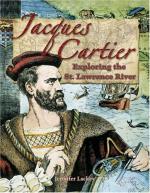
Born 1491,
Saint-Malo, France
Died September 1, 1557,
Saint-Malo, France
During the sixteenth century European navigators had determined that the continents of North and South America were a barrier to a direct sea route from Europe to Asia. Nevertheless, it was still believed that a natural waterway could be found through this landmass, so numerous explorers continued to search for the route, which became known as the Northwest Passage. Among them was Jacques Cartier, a French navigator.
Cartier was born in 1491 in the French port of Saint-Malo in the province of Brittany. Little is known about his early life, but it is clear that he made several sea voyages. According to some accounts, he may have been a crew member in two expeditions to America led by Giovanni da Verrazano (see entry) in 1524 and 1528.
In 1532 the Bishop of Saint-Malo proposed to King François I of France that the king sponsor an expedition to the New World and that Cartier be chosen to lead it. Cartier, the bishop pointed out, had already been to Brazil and the island of Newfoundland. The king approved the nomination, and on April 20, 1534, Cartier set off from Saint-Malo with two ships and 61 men. His mission was “to discover certain islands and lands where it is said that a great quantity of gold, and other precious things, are to be found.” It was clear from the start that Cartier was expected to find mineral wealth.
Cartier’s fleet sailed to the northern tip of Newfoundland and there entered the Strait of Belle Isle, which was known to lead to open waters beyond. Avoiding the barren northern coast, Cartier headed south along the western shore of Newfoundland, naming many of the rivers and harbors he saw. The party continued along the western coast until they came to the channel, now called Cabot Strait, that connects the Gulf of St. Lawrence with the Atlantic Ocean. Since Cartier did not enter Cabot Strait, he did not discover that it separates Newfoundland from Cape Breton Island and is a better route than the Strait of Belle Isle for entering the Gulf of St. Lawrence.
In the course of exploring the Gulf of St. Lawrence, Cartier was the first European to report on the Magdalen Islands (or, in French, Iles de la Madeleine) and Prince Edward Island. Cartier then sailed on to the coast of New Brunswick, where he explored Chaleur Bay, and headed north along the coast to Gaspé Bay, where he claimed the Gaspé Peninsula for France. From Gaspé Cartier continued to Anticosti Island, but he did not travel far enough beyond Anticosti to discover the St. Lawrence River. When Cartier went ashore to claim the land for France, he encountered the Iroquois chief Donnacona; when he left, he took two of the chief’s sons with him as guests (some historians say as prisoners) on the return trip to France.
Upon his arrival in Saint-Malo on September 5, 1534, Cartier received a great welcome. Although he did not find any gold, he brought reports of a warm climate and fertile land in New Brunswick and the Gaspé Peninsula, a region previously considered suitable for fishing but certainly not for settlement and commercial trade. Intrigued by Cartier’s report, the king began planning a second voyage. The following year François provided Cartier with three ships for a return trip to Canada. Cartier left Saint-Malo on May 15, 1535, taking with him Donnacona’s two sons, who had learned French in order to serve as translators.
This was Cartier’s most important voyage. Guided by the Iroquois, he sailed west from Anticosti and, on August 13, entered the great estuary of the St. Lawrence, which would become the main gateway for French exploration in North America for the next two centuries. Cartier sailed up the St. Lawrence past the Saguenay River to the village of Stadacona, on the site of present-day Quebec City. After meeting with Donnacona he traveled farther up the river to the village of Hochelaga, where the city of Montreal is now located.
During his stay in Hochelaga, Cartier climbed Mount Royal to view the St. Lawrence valley, which contained fertile land; he also sighted the Lachine Rapids and the Ottawa River. After planting a cross at Hochelaga, Cartier’s party returned in October to Stadacona, where they settled for the winter. Cartier and his men were the first Europeans to spend the winter in Canada, and they were surprised at the extreme cold.
They also noted that the Iroquois were becoming less friendly toward the French, a fact that would later have significance. Relations, however, were still amicable, and during the winter the Iroquois would save the Europeans’ lives. The Frenchmen were suffering from scurvy, a disease caused by a lack of vitamin C, and were able to survive only because the Iroquois taught them how to make a tea out of white cedar, which was a source of that vitamin. When Cartier left Stadacona for France on May 6, 1536, he took Chief Donnacona back with him. They arrived in France on July 16.
Cartier’s second voyage was a great success. He had found a great waterway that might be the sought-after route to Asia, and he even brought back a few pieces of gold. François wanted to send him back to Canada immediately, but war broke out between France and the Holy Roman Empire, so Cartier was not able to leave the country. In the meantime, the rights to colonize Canada had been granted to a French nobleman, Jean-François de La Rocque, Sieur de Roberval; Cartier was assigned to conduct reconnaissance work for Roberval’s voyage the following year.
On this third voyage Cartier reached Stadacona on August 23, 1541. Donnacona had died in France, but this probably made it easier for Cartier to deal with Donnacona’s successor, Agona, who now did not have to worry about his rival. While building a camp at the present-day town of Charlesbourg, north of Quebec, Cartier found some stones that he thought were diamonds. After making a brief trip back to Hochelaga, he returned to spend the winter at Charlesbourg. Once again the Frenchmen suffered through a harsh winter. They were also faced with the hostility of the Iroquois, so in the spring Cartier and his party decided to leave the camp and head back to France.
He left Stadacona in June 1542 and traveled to the port of St. John’s, Newfoundland. During the entire trip Cartier had not seen Roberval, but the two men met as Cartier was preparing to sail. Cartier received instructions to return to Canada with Roberval and help him found the new colony; however, in the dark of night he slipped away and sailed for France, leaving Roberval to fend for himself. When Cartier arrived back in Saint-Malo, he found that the “gold” he was carrying was iron pyrite and the “diamonds” were quartz crystals.
Cartier was not disciplined for leaving Roberval behind, but he was never given another expedition to command. His book about his second voyage to Newfoundland was published in 1545. Cartier retired in Saint-Malo, where he was a prosperous businessman until his death on September 1, 1557.
This is the complete article, containing 1,216 words
(approx. 4 pages at 300 words per page).