
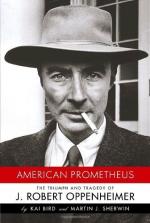
J. Robert Oppenheimer
1904-1967
American Physicist
J. Robert Oppenheimer led the team that developed the first atomic bomb. Between 1943 and 1945, he directed the laboratory in Los Alamos, New Mexico, where the bomb was designed and built.
Oppenheimer was born in New York City on April 22, 1904, the indulged first child of a prosperous family. At Harvard, he majored in chemistry, but an advanced course on thermodynamics attracted him to physics. He began his postgraduate work in atomic physics at the Cavendish Laboratory at Cambridge University in England. Graduate students at Cavendish were assigned much of the work involved in setting up experiments. Although Oppenheimer excelled at theoretical analysis, he was almost entirely helpless when it came to handling mechanical equipment. Being a perfectionist, these difficulties bothered him a great deal. He was therefore delighted to accept a 1926 offer from Max Born (1882-1970) to join the Institute for Theoretical Physics at Gottingen, Germany. He received his Ph.D. there the next year.
In 1929, Oppenheimer began teaching physics at the University of California at Berkeley and at the California Institute of Technology. He liked the idea of splitting his time between the two institutions, the dry air of the West was good for his rather delicate health, and he enjoyed being closer to the ranch his family eventually purchased in New Mexico.
Events of the 1930s caused Oppenheimer to take an interest in politics for the first time. The Nazis took power in Germany, and Oppenheimer attempted to orchestrate escape plans for his relatives there as well as for Jewish scientists and teachers. He also donated money to the Spanish Loyalists fighting against the Fascist military leader Francisco Franco. Closer to home, he was troubled by the poverty and suffering brought on by the Depression, and became attracted to the ideas of socialism. However, unlike many other intellectuals of the time, he did not join the Communist Party, being afraid that the organization might attempt to take advantage of his work in nuclear physics research. In 1940 he married Katherine "Kitty" Puening, a Caltech graduate student. They soon started a family, and Oppenheimer began to lose interest in radical causes.
By the end of 1941, the United States was involved in World War II. President Roosevelt was persuaded by Albert Einstein (1879-1955) and other physicists to begin the Manhattan Project to build an atomic bomb, lest Hitler obtain such a bomb and be unopposed. At first the project was decentralized, and Oppenheimer participated by making calculations in his Berkeley office. Eventually more organization was required, and Oppenheimer was chosen to head the project's main laboratory. He suggested it be located in Los Alamos, New Mexico, near the White Sands missile range and only 60 mi (95.6 km) from his beloved desert ranch. He recruited many eminent scientists, including Enrico Fermi (1901-1954) and Niels Bohr (1885-1962).
The first atomic bomb was exploded in a test on July 16, 1945. Germany had surrendered two months before. The scientists were relieved that the project had succeeded, but many had deep reservations about the power that had been unleashed. Oppenheimer was moved to quote from the Hindu scriptures, "I am become Death, the Destroyer of Worlds." Three weeks later anatomic bomb was dropped on the Japanese city of Hiroshima and, three days later, on Nagasaki. The ancient cultural center of Kyoto had been the first intended target, but was spared when Oppenheimer objected.
After the war, Oppenheimer became the director of the Institute for Advanced Study in Princeton. He also remained an important government advisor on nuclear issues, and helped draft the policies of the U.S. Atomic Energy Commission (AEC). However, in the early 1950s, Oppenheimer's patriotism was questioned, in part because of his suggestions about international cooperation in the control of nuclear energy. In the toxic atmosphere of the "McCarthy Era," old friendships from the 1930s were cited as evidence of Communist associations. A rival scientist, Edward Teller (1908- ), testified against him. An AEC security panel failed to find any evidence of disloyalty, but decided nonetheless to bar him from further access to classified information. This injustice was very hard on Oppenheimer and his family.
In 1963, with the old enmities fading, the AEC, including Teller, voted unanimously to bestow upon Oppenheimer the Enrico Fermi Award for "outstanding contributions to the development, use or control of atomic energy." Oppenheimer remained at the Institute for Advanced Study until he retired in 1966. He died of throat cancer on February 18, 1967, at his New Jersey home.
This is the complete article, containing 745 words
(approx. 2 pages at 300 words per page).

