Ivan Petrovich Pavlov
1849-1936
Russian Physiologist
Ivan Petrovich Pavlov was born in Ryazan, Russia. After attending a local theological seminary, Pavlov traveled to the University of St. Petersburg, where he undertook the study of chemistry and physiology. Pavlov earned his medical degree from the Imperial Medical Academy in 1879. A year later, Pavlov assumed a professorship at the academy, a post he was to maintain throughout the tumultuous 1917 Russian Revolution.
Pavlov began his postgraduate work with studies on the mechanistic physiology of the circulatory system. Subsequently, Pavlov's work centered on nervous control of the heart. Eventually, Pavlov moved on to studies of the digestive system, and his efforts resulted in the publication of a well-received 1897 work titled Lectures on the Work of the Digestive Glands.
Although Pavlov's work on digestive secretions earned a 1904 Nobel Prize for physiology or medicine, Pavlov is best known for his work with conditioned reflexes. Pavlov's classic experiment involved training a hungry dog to salivate at the sounding of a bell, rather than at the food itself. Pavlovian conditioning involves associating one event with another in such a manner that the response to one event is associated, or transferred, to the other event.
Pavlov's work laid the foundation for the scientific analysis of behavior. Pavlov's work was seminal in the formulation of modern psychology and many psychiatric treatment programs. Classical conditioning is often referred to as Pavlovian conditioning, and much of the terminology associated with those concepts derives from Pavlov's famous experiments using quantitative measurement of salivary secretion in dogs as a measure of reflex or response to food stimulus. More specifically, Pavlovian refers to the conditioning of responses to previously neutral stimuli.
According to Pavlov, an unconditioned stimulus (meat) was a stimulus that elicited an unconditioned response (salivation). A conditioned stimulus (Pavlov's bell) was a previouslyneutral stimulus that did not normally elicit a response until after being paired or otherwise associated with an unconditioned stimulus (meat). Ultimately Pavlov was able to observe a conditioned response (salivation to a bell).
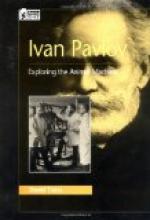
Ivan Pavlov. (Library of Congress. Reproduced with permission.)
Important psychological principles were ultimately derived from Pavlov's work, including concepts related to habituation (the loss of potency by a stimulus caused by overuse of that stimulus so that greater or more intense presentation of the stimulus is required to elicit response), generalization (responses to stimuli other than the conditioned stimulus in a manner similar to the conditioned stimulus), discrimination (Pavlov demonstrated that dogs could discriminate between high and low pitch tones as conditioning stimuli), and extinction (the disappearance of a conditioned response when a conditioning stimulus is repeatedly presented without the unconditioned stimulus). Other important Pavlovian-derived psychological models involve spontaneous recovery, higher order conditioning, sensory preconditioning, and counter conditioning.
Pavlov was often at odds with the post-revolutionary communist government. At great peril to himself, he often argued passionately against the triumphant Bolsheviks. Vladimir Lenin (1870-1924) personally refused to allow Pavlov to move his work abroad. In response, Pavlov resisted the Bolshevik hierarchy by refusing to accept the privileges accorded other scientists of his ability and achievement. For instance, Pavlov refused extra food rations not available to his co-workers.
In 1924, Pavlov resigned his professorship in protest of expulsions of students whose families refused to quit the clergy. Even under the iron dictatorial hand of Lenin's successor, Joseph Stalin (1879-1953), Pavlov continued to be a thorn to the communist government. By 1927 Pavlov found himself isolated in the Soviet Academy of Sciences, where he railed against increasing political intrusions into matters of science. At a time when many were put to death for far less, Pavlov bravely defied Stalin and his commissars (Pavlov actually began to deny them actual physical access to his laboratory). By the mid-1930s, however, Pavlov's criticisms of the Soviet government gradually diminished as Pavlov balanced the dangers of Nazi fascism looming on the Western border and the growing agitation with an Imperial Japan to the East with his personal dislike for the communist system.
This is the complete article, containing 652 words
(approx. 2 pages at 300 words per page).