BookRags.com Literature Guides Literature
Guides
Criticism & Essays Criticism &
Essays
Questions & Answers Questions &
Answers
Lesson Plans Lesson
Plans
My Bibliography Periodic Table U.S. Presidents Shakespeare Sonnet Shake-Up
Research Anything:        
History | Encyclopedias | Films | News | Create a Bibliography | More... Login | Register | Help

Search "It Happened One Night"

Contents Navigation
 

It Happened One Night

Print-Friendly  Order the PDF version  Order the RTF version
Frank Capra
About 4 pages (1,083 words)
It Happened One Night Summary

Bookmark and Share

It Happened One Night

A spoiled and willful young heiress, cocooned from reality by bodyguards and her father's trillions, jumps ship off the Florida coast when her father wishes to have her recent unconsummated marriage to a gold-digging roue annulled. Her worried father hires detectives to comb the land for his runaway daughter, offers a hefty reward for news of her, and has headlines blazon her disappearance while she sets off to reach New York by cross-country bus—her first foray into the real world of ordinary people. She runs into difficulties and a broke, straight-talking journalist who has just been fired. He recognizes her, spots a scoop, and escorts her through a series of adventures to the obligatory climax of temporary misunderstandings and true love.

Such are the bones of Night Bus, a short story by Samuel Hopkins Adams that, retitled It Happened One Night, became not only one of the most successful, enduring, and best-loved romantic comedies of all time but—as written for the screen by the accomplished Robert Riskin, directed by Frank Capra with a sure sense of its characters, its comedy, and its humanity, and played with irresistible charm and polish by Clark Gable and Claudette Colbert—was arguably the most influential contribution to screwball comedy.

Screwball was a genre born of the troubled times of the Depression to provide a perfect escape from the humdrum into a celluloid world teeming with glamor, wealth, romance, and laughter. Curmudgeonly or eccentric, but never dangerous, characters supplied a thread of reality. The films satirized the rich in an era of poverty, but did so with affection, often creating a happy alliance between the idle rich and the ordinary working person. Heroines were spirited, independent-minded women, a liberating departure from the sweet-natured and compliant wives or girlfriends, hard-bitten molls, or fallen women who were the staple characters of pre-1930s cinema, and the "feel-good" plot resolutions were always arrived at via comedy, often so screwy as to give the genre its name, but constructed, in the best of them, with infallible logic and sincere conviction.

It Happened One Night conformed gloriously to the rules, and did so with seamless panache. Gable's middle-class journalist, virile, opportunistic, and commanding, gets more than he bargains for from Colbert's heiress, whom he addresses as "Brat" throughout but who turns out to have unexpected wit and intelligence. In a series of inspired sequences that have become justly famous anthology pieces, the pair constantly turn the tables on each other. The best known of these are the "walls of Jericho" and hitchhiking scenes. In the first, he turns the tables on her apprehensive suspicions by lending her his pajamas and stringing a blanket between two beds in a room they're forced to share (Gable's removal of his shirt to reveal a bare chest famously sent the sales of undershirts plummeting); in the second, she triumphs, seductively hitching her skirts to get them a ride after his self-proclaimed expertise with his thumb has failed to stop a succession of vehicles.

The chemistry between Gable and Colbert is potent, a battle of the sexes in which acid insults give way to warm wisecracking and then to a beguiling sweetness and vulnerability in both of them. Aside from the major set-pieces, the film offers a cornucopia of treasurable lunacies—Alan Hale's singing crackpot who gives them a ride; Colbert's unsuitable suitor clad in top hat and tails piloting himself to their wedding in a gyroplane; Gable and Colbert fooling detectives by faking a blue-collar marital row, to mention but three. Amidst the comedy Capra, always a devoted chronicler of the common man, introduces an episode on the bus when a group of passengers play and sing popular songs. Colbert's childlike glee and amazement as she listens to "That Daring Young Man on the Flying Trapeze" serves to highlight with some poignancy her previously cosseted isolation—a moment of truth in the fantasy.

Arguably the first, and certainly the greatest, of the screwball comedies of the 1930s, the tale of It Happened One Night's success is a tale of alchemy: all the right ingredients combined and perfectly controlled to create a concoction of pure magic. It is also, like so many Hollywood success stories, a tale of happy accidents. In 1934 little Columbia, run on a relative shoestring by the foul-mouthed autocratic Harry Cohn, was considered a Poverty Row studio, and struggled tocompete with giants such as MGM. One of its few assets was Frank Capra who, having fallen on hard times after his first early successes with silent comedy, accepted a contract with Columbia in the late 1920s which later proved to have been the turning point in the fortunes of both studio and director.

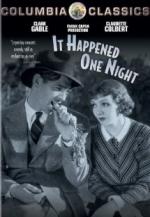
Clark Gable and Claudette Colbert in a scene from the film It Happened One Night.Clark Gable and Claudette Colbert in a scene from the film It Happened One Night.

Capra read Night Bus in Cosmopolitan magazine and persuaded an unenthusiastic Cohn to buy it for $5000. Capra wanted MGM's Robert Montgomery for the role of journalist Peter Warne, but Louis B. Mayer refused to loan him out. He proved amenable, however, to the idea of lending Clark Gable to Columbia, viewing a spell on Poverty Row as suitable punishment for his rising star who, in a rebellion against his tough-guy typecasting, had checked himself into a hospital on grounds of overwork. Several actresses having rejected the role of heiress Ellen Andrews, Columbia turned to Claudette Colbert. (Her debut film, For the Love of Mike [1927], directed by Capra, had been a failure.) By now desperate to fill the role, Columbia agreed to Colbert's punishing demands: double her contract salary at Paramount and a shooting schedule guaranteed not to exceed four weeks. The auguries were not of the best.

At the 1935 Academy Awards, It Happened One Night made a grand slam, winning the Oscars for best picture, director, screenplay adaptation, actor, and actress, an unprecedented feat not equaled until One Flew Over the Cuckoo's Nest forty-one years later. Its success elevated Capra's status, made Colbert a star, brought Gable superstardom and his desired freedom of choice, and transformed Columbia into a major studio.

The film set the tone for a certain style of romantic comedy officially defined as Capraesque over sixty years later and, like all true works of art, defied time to give pleasure to successive generations of viewers.

Further Reading:

Carney, Raymond. American Vision: The Films of Frank Capra. Cambridge, Cambridge University Press, 1987.

McBride, Joseph. Frank Capra: The Catastrophe of Success. New York, Simon and Schuster, 1992.

Pogue, Leland A. The Cinema of Frank Capra: An Approach to Film Comedy. New Jersey, A. S. Barnes, 1973.

This is the complete article, containing 1,083 words (approx. 4 pages at 300 words per page).

More Information
  • View It Happened One Night Study Pack
  • Search Results for "It Happened One Night"
  • Add This to Your Bibliography
  • More Products on This Subject
    It's a Wonderful Life
    Although a box office failure in 1946, Frank Capra's It's a Wonderful Life today is a... more


    Copyrights
    It Happened One Night from St. James Encyclopedia of Popular Culture. ©2005-2006 Thomson Gale, a part of the Thomson Corporation. All rights reserved.


    Join BookRagslearn moreJoin BookRags


    About BookRags | Customer Service | Report an Error | Terms of Use | Privacy Policy