BookRags.com Literature Guides Literature Guides Criticism/Essays Criticism/Essays Biographies Biographies My Bibliography Periodic Table U.S. Presidents Shakespeare Sonnet Shake-Up
Research Anything:        
History | Encyclopedias | Films | News | Create a Bibliography | More... Login | Register | Help
Not What You Meant?  There are 15 definitions for The Invisible Man.

Search "Invisible Man"

Contents Navigation
 

Invisible Man

Print-Friendly  Order the PDF version  Order the RTF version
Ralph Ellison
About 3 pages (1,034 words)
Invisible Man Summary

Bookmark and Share

Invisible Man

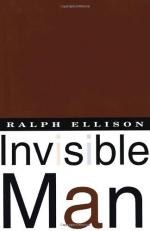
First published in 1952, Ralph Ellison's (1914-1994) Invisible Man revolutionized the literary and cultural world by examining the near-total lack of awareness of African Americans that pervaded mainstream society. One of the most widely read novels in American literature, Invisible Man has been translated into at least 15 languages and has undergone numerous printings and special editions. It has been called the Moby Dick of the twentieth century—epic in scope, mythic in subject, and classic in structure. Part of its appeal lies in its quintessentially American theme: the quest for identity. What distinguishes Ellison's treatment of this theme is his bold creation of a central character who is black and unnamed, everyman and no one.

Foregrounding black identity while universalizing the central character on his quest for self-realization, the text expands the horizons of the American hero to include racial difference. By naming the invisible condition of his central character, Ellison broke barriers of silence and challenged traditional representations of African Americans, anticipating the movement for racial equality of the 1960s.

The book's central metaphor of the "invisible man," however, raises many questions, as Susan Parr and Pancho Savery point out. Particularly important is the question of how best to view the novel: should it "be valued primarily as a work with universal implications, as an example of the best that the American literary tradition offers, or as a representative of black American fiction?" To what extent do the social and political issues represented in the text contribute to its power? Given the nonfictional parameters of these social issues, should the novel be judged by aesthetic or sociological terms? That this novel has opened up these questions points to its importance in helping to shape a continually evolving American identity.

Built on a classical three-part structure consisting of a prologue, a 25-chapter narrative, and an epilogue, the book is narrated in first person by an unnamed narrator and follows a circular rather than linear trajectory. The prologue begins with the narrator's announcement of the book's major interrelated themes of identity and race, innocence and experience, and rebirth and transformation. "I am an invisible man," he says, and the reader enters into the world of the narrator after the series of events about to be told have already taken place. Elaborating on his condition of invisibility, the narrator goes on to say "That invisibility to which I refer occurs because of a peculiar disposition of the eyes of those with whom I come in contact. A matter of the construction of their inner eyes, those eyes with which they look through their physical eyes upon reality." Thus stated, Ellison's narrator brings to light unspoken tensions generated by divisions of race and class.

Much like a bildungsroman, the novel traces the development of the narrator as a young man who believes in the possibility that hard work will reward him with success, through a number of painfully illuminating episodes. Although he retains his innocence through disillusioning experiences, he does mature and undergoes rebirth. From his Southern hometown of Greenwood, he travels to Harlem, and passes through a series of initiations into adulthood. These adventures are often represented as surreal and dream-like, narrated in an energetic and intense voice, often punctuated with humor as he makes observations about white culture and learns more about black history.

Among his most pivotal early experiences is the death of his grandfather, who first opens the young boy's eyes to the fact that appearances do not always represent reality. Following this are his humiliating experiences at a "battle royal" and public speaking contest, which results in an award which sends him to college. Ultimately expelled, he finds his way to Harlem, where he works in a paint factory that blows up, joins "The Brotherhood" of the Communist Party, and eventually returns to the basement where the reader first met him in the prologue. Pondering his condition, he is matter-of-fact: "So, there you have all of it that's important," he says, "Or at least you almost have it. I'm an invisible man and it placed me in a hole—or showed me the hole I was in." Devoid of anger or self pity, the narrator remains philosophical, recognizing that "the world is just as concrete, ornery, vile and sublimely wonderful as before, only now I better understand my relation to it and it to me."

Invisible Man is thick with allusions to other texts, literary, philosophical, political, and psychological. Ellison draws from sources as diverse as classical European texts, major American works ofliterature, African American literature and folklore, Native American mythology, children's games, sermons, blues and gospel music, as well as his own experience. Music plays a major role illuminating some of the book's major themes. Ellison himself identified five works as essential background reading to Invisible Man: Melville's Moby Dick, Malraux's Man's Fate, Stendhal's Red and the Black, Twain's Huckleberry Finn, and Doestoevsky's Brothers Karamazov. In short, as Mark Busby writes, "Ellison uses everything he knows, not to prove anything to anybody but to exploit as fully as possible the artistic materials he is conjuring—to render Harlem with enough accuracy that Harlemites who read the book would recognize the place…."

Ellison was awarded the National Book Award for Invisible Man (his only novel) in 1952. His other work includes two collections of essays, Shadow and Arts (1964) and Going to the Territory (1986), which were republished posthumously in 1995 under one title, The Collected Essays of Ralph Ellison. A collection of short stories, Flying Home and Other Stories, was also published posthumously in 1996.

Further Reading:

Busby, Mark. Ralph Ellison. Boston, Twayne, 1991.

Ellison, Ralph. Invisible Man. New York, Random House, 1952.

——. The Collected Essays of Ralph Ellison. New York, Modern Library, 1995.

——. Flying Home and Other Stories. New York, Random House, 1996.

Graham, Maryemma, and Amritjit Singh, editors. Conversations with Ralph Ellison. Jackson, University of Mississippi, 1995.

O'Meally, Robert, editor. New Essays on Invisible Man. Cambridge, Cambridge University Press, 1988.

Parr, Susan Resneck, and Pancho Savery, editors. Approaches to Teaching Ellison's Invisible Man. New York, Modern Language Association, 1989.

Reilly, John M., editor. Invisible Man: A Collection of Critical Essays. Englewood Cliffs, New Jersey, Prentice-Hall, 1970.

Sundquist, Eric J., editor. Cultural Contexts for Ralph Ellison's Invisible Man. Boston, Bedford Books of St. Martin's Press, 1995.

This is the complete article, containing 1,034 words (approx. 3 pages at 300 words per page).

More Information
  • View Invisible Man Study Pack
  • 15 Alternative Definitions
  • Search Results for "Invisible Man"
  • Add This to Your Bibliography
  • More Products on This Subject
    Betrayal in Ellison's Invisible Man
    In Ralph Ellison's Invisible Man, the nameless narrator is betrayed by a handful of different charac... more

    Invisible Man
    Just yesterday my Grandmother criticized my cousin for having an interracial relationship with a bl... more


    Copyrights
    Invisible Man from St. James Encyclopedia of Popular Culture. ©2005-2006 Thomson Gale, a part of the Thomson Corporation. All rights reserved.

    Join BookRagslearn moreJoin BookRags


    About BookRags | Customer Service | Report an Error | Terms of Use | Privacy Policy