 Print
Print Word
Word PDF
PDF|
This section contains 81 words (approx. 1 page at 300 words per page) |
1724-1804
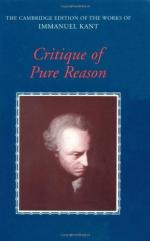
German philosopher whose master work, The Critique of Pure Reason (1781), initiated a "Copernican Revolution" in philosophy by treating many of the observed features of the world as constituted by the human knower. Considered by many the greatest modern philosopher, Kant's early work explicitly addressed scientific topics. His nebular hypothesis (1755) anticipated Pierre-Simon Laplace's more sophisticated formulation. Kant also correctly suggested the Milky Way is lens-shaped, that nebulous stars are galaxies, and that tidal friction slows Earth's rotation.
|
This section contains 81 words (approx. 1 page at 300 words per page) |