Forgot your password?  


Ibn Battuta | Research & Encyclopedia Articles

Print-Friendly   Order the PDF version   Order the RTF version
About 2 pages (453 words)
Ibn Battuta Summary


Ibn Battuta

1304-1368

Arab Traveler

In spite of the fact that Marco Polo (1254-1324) is much better known outside the Arab world, in fact Ibn Battuta traveled much more widely. Over the space of 29 years from 1325 to 1354, he covered some 75,000 miles, or about 120,000 kilometers—three times the distance around the Earth at the Equator.

His full name was Abu 'abd Allah Muhammad ibn 'abd Allah al-Lawati at-Tanji ibn Battuta; fortunately for non-Arabic speakers, however, he is known to history simply as Ibn Battuta. A member of a wealthy family in the Moroccan city of Tangier, Ibn Battuta planned to study law and become ajudge in one of the city's Islamic courts. First, however, he planned to undertake a hajj, a pilgrimage to the Muslim holy city of Mecca in what is now Saudi Arabia. All Muslims are encouraged to make the hajj at least once if they can afford to do so, but it would be Ibn Battuta's remarkable achievement to complete the hajj a total of four times.

On his first hajj (1325-27), Ibn Battuta made a side trip into Persia, then returned to Mecca, thus completing a second hajj. He then sailed along the east African coast to the trading city of Kilwa in the far south before returning to Mecca yet again in 1330. But he was just getting started: over the next three years, he journeyed through Turkey, the Byzantine Empire, and southern Russia, at that time part of the Mongols' Golden Horde. He then passed through Afghanistan and other parts of central Asia before entering India from the north.

Eventually Ibn Battuta wound up in the court of the ruthless sultan Muhammad ibn Tughluq (r. 1325-51) in the great Indian city of Delhi, center of the Delhi Sultanate. Despite Tughluq's bloodthirsty reputation, Ibn Battuta managed to remain in his service as a judge for eight years. Tughluq sent him on an official visit to the Mongol emperor of China, but Ibn Battuta was shipwrecked, and never returned to Tughluq's court.

During the next few years, Ibn Battuta visited Ceylon, Southeast Asia, and China—possibly even as far north as the capital at Beijing. He then made the long journey home, stopping in Mecca a fourth time; but he quickly headed out again, this time to Muslim Spain and then south, across the Sahara into the splendid African empire of Mali.

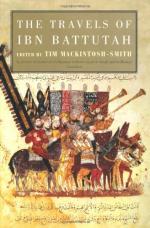
Ibn Battuta stopped traveling in 1354, after which he sat down to write the record of his journeys in a volume entitled the Rihlah (Travels), later published in English as The Travels of Ibn Battuta. Along with all the other activity that filled his life, Ibn Battuta had multiple wives and children, and died when he was more than 60 years of age.

This is the complete article, containing 453 words (approx. 2 pages at 300 words per page).

More Information
  • View Ibn Battuta Study Pack
  • Search Results for "Ibn Battuta"
  • More Products on This Subject
    Muhammad ibn Battuta
    Muhammad ibn Battuta (1304-ca. 1368) was a Moorish traveler whose extensive voyages as far as Sumat... more

    Ibn Battutah
    (1304–1368/69), Arab traveler and writer. AbuʿAbd Allah Muhammad ibnʿAbd Allah... more


    Ask any question on Ibn Battuta and get it answered FAST!
    Answer questions in BookRags Q&A and earn points toward
    discounted or even FREE Study Guides and other BookRags products!
    Learn more about BookRags Q&A
    Copyrights
    Ibn Battuta from Science and Its Times. ©2005-2006 Thomson Gale, a part of the Thomson Corporation. All rights reserved.

    Join BookRagslearn moreJoin BookRags

    Join BookRagslearn moreJoin BookRags