Hoffman, Abbie (1936-1989)
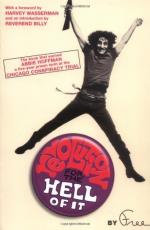
One of the most colorful figures to emerge from the social turmoil of the 1960s, Abbie Hoffman put his personal stamp on the activism of the decade with his insistence that radical politics find expression in personal attitudes as well as political positions. Linking the spirited hedonism of the hippies with the politics of the Civil Rights movement, the New Left and the anti-war movement, Hoff-man's attitude was pure hippie—Revolution for the Hell of It was the title of his first and most influential book. His doctrine of absurdity and wit, combined with an unmatched media savvy, marked him for the elite ranks of the counter-culture. A founding Yippie, and a hippie, activist, visionary and knave, he left an enduring legacy of influence and controversy.
Born in Worcester, Massachusetts, in 1936, Abbie Hoffman's life was an extraordinary patchwork of triumphs, calamities, and accidents. After fighting the Ku Klux Klan in Mississippi, he moved to New York where he joined the hippie counter-culture and undertook a series of flamboyant public stunts designed to infuse the growing hippie mob with political purpose. After organizing protests at the Democratic National Convention in 1968 he went underground in 1973, reappeared in 1980 to resume his activist work, and committed suicide in 1989.
In 1967, Hoffman left the Deep South for Manhattan's Lower East Side, where he joined the "diggers," a group of hippie community pranksters and activists, and opened a store to sell craft products produced in Mississippi homesteads. Together with Jerry Rubin, Hoffman formed the "Yippies" ("Youth International Party" was offered as the formal name only when pressed by reporters), and began a campaign of high-profile stunts meant to focus media attention on the movement. He understood what the media wanted and he set out to give it to them, aiming to swell the ranks of the movement with new conscripts through publicity. His actions, promoted with press releases and high-level media contacts to ensure maximum hype, emphasized the whimsy and humor characteristic of hippies. In one incident, bags of dollar bills were dumped from the visitors' gallery onto the floor of the New York Stock Exchange, causing mayhem as investors squabbled over the cash. In another, soot bombs were sent to Con Edison to protest pollution standards, and over 3,000 marijuana cigarettes were mailed to people randomly selected from the phone book, one of who turned out to be a prominent journalist. A celebration of the Spring Equinox at Grand Central drew over 6,000 hippies to a midnight gathering at the cavernous station, where police in riot gear waited nervously outside as hippies ran wild, tearing the hands off clocks, dancing, and squealing "Yippeee!!" Hoffman's "Exorcism of the Pentagon" was another landmark event, drawing 50,000 hippies to the nation's capital in an effort to levitate the entire Pentagon complex through magical means. The hippies joined hands, forming a human chain around the building as television crews soaked up the colorful event.
However, the tone of Yippie activism changed at the 1968 Democratic National Convention in Chicago. Yippies gathered there to offer a "festival of life" to counter what they called the "convention of death," but their innocence and prankishness turned into ugly riot as the demonstration was consumed in police violence. Outside the convention, where Hubert Humphrey was clinching the Democratic nomination for president, hippies, anti-war activists, and others massed, chanted, and sang, and when Chicago Mayor Richard Daley ordered police to disperse the throng, widespread panic and bloodshed resulted, lending credibility to the conservative call for law and order then being touted by Republican presidential candidate Richard Nixon. Hoffman and seven others stood trial as "the Chicago Eight" for conspiring to incite the riot, though after Black Panther Bobby Seale was remanded for separate trial by Judge Julius Hoffman, the Chicago Seven (which included Rubin and other Yippies and anti-war activists) achieved nationwide notoriety. Though Judge Hoffman issued 175 contempt citations during the trial, the seven were ultimately found innocent and other charges of "crossing State lines to incite a riot" were dropped on appeal in 1973.
By the early 1970s, however, Abbie Hoffman had other problems. Faced with accusations of egoism and showmanship from the organized left, and charged with chauvinism and authoritarianism from feminists, hippies, and other cultural factions, he now found himself standing at the center of a splintering movement. His response was to "resign" in an open letter addressed to the movement in 1971, and in 1974, fearing a lifetime jail term on a cocaine possession charge, he went into hiding, where he would remain for six years. Even underground, however, Hoffman retained his media "smarts," granting a well-publicized interview to Playboy magazine, in which he pledged to maintain his resistance and organize an underground movement aimed at toppling the government of the United States. After undergoing plastic surgery and taking up a prominent role incognito as a community environmental activist in Canada, Hoffman came out of hiding in 1980 to face charges. He served only a short term before he was once again free to resume his activism until his death. Hoffman's public stunts secured his lasting reputation as a spirited activist, cemented by the wide circulation of his books. Revolution for the Hell of It, Steal This Book, and Woodstock Nation were, and continue to be, staple reading for activists and latter-day hippies. His later titles included Steal This Urine Test, a commentary on the drug testing craze of the 1980s, and Square Dancing in the Ice Age.
Abbie Hoffman
Further Reading:
Becker, Ted. Live This Book; Abbie Hoffman's Philosophy for a Free and Green America. New York, Nobel Press, 1991.
Hoffman, Abbie. Revolution for the Hell of It. Chicago, Dial Press, 1968.
——. Steal This Book. New York, Pirate Editions Inc., 1969.
Hoffman, Abbie, and Daniel Simon. The Best of Abbie Hoffman. New York, Four Walls Eight Windows, 1989.
Hoffman, Jack, and Daniel Simon. Run Run Run: The Lives of Abbie Hoffman. New York, Putnam's, 1994.
Jezer, Marty. Abbie Hoffman: American Rebel. New Brunswick, New Jersey, Rutgers University Press, 1992.
Raskin, Jonah. For the Hell of It: The Life and Times of Abbie Hoffman. Berkeley, University of California Press, 1996.
Sloman, Larry. Steal This Dream: Abbie Hoffman and the Counter-cultural Revolution in America. New York, Doubleday, 1998.
This is the complete article, containing 1,033 words
(approx. 3 pages at 300 words per page).