BookRags.com Literature Guides Literature Guides Criticism/Essays Criticism/Essays Biographies Biographies My Bibliography Periodic Table U.S. Presidents Shakespeare Sonnet Shake-Up
Research Anything:        
History | Encyclopedias | Films | News | Create a Bibliography | More... Login | Register | Help
Not What You Meant?  There are 19 definitions for Hamiltonian.  Also try: The Masses Are Asses.

Search "Hamilton, Alexander"

Contents Navigation
 

Hamilton, Alexander

Print-Friendly  Order the PDF version  Order the RTF version
About 3 pages (913 words)
Alexander Hamilton Summary

Bookmark and Share

Hamilton, Alexander

(b. January 11, ca. 1755; d. July 11, 1804) Key aide to General Washington during Revolutionary War; first U.S. Secretary of the Treasury.

As a penniless boy in the British West Indies, Alexander Hamilton dreamed of war and winning fame as a general. Older men saw promise in Hamilton, who had a genius for business facts and figures, and sent him to Britain's North American colonies for an education. He became one of General George Washington's key aides in the American Revolution and played an even more prominent role in the new nation.

Arriving in 1772, Hamilton enrolled in King's College (now Columbia University) in New York. By 1774 his wished-for war loomed on the horizon. The thirteen colonies on the Atlantic seaboard were quarreling with the British parliament about taxation and the right to self-government by their local legislatures. Hamilton sided with the Americans, writing rebellious essays and giving defiant speeches. When war broke out, he became captain of the New York Provincial Artillery. They were among the few units who kept their esprit de corps during the near-ruinous defeats the American army suffered in the latter half of 1776.

In 1777 General Washington invited Hamilton to become a member of his staff with the rank of lieutenant colonel. War had catapulted Hamilton to the summit of the new nation's power structure. He drafted letters for Washington's signature, dealt with generals and visiting congressmen, and soon acquired strong opinions about what was wrong with the revolutionary American government. The Continental Congress lacked power—above all the power to tax. That was why soldiers starved at Valley Forge and other winter camps and went for months without pay.

In 1780 Hamilton married Elizabeth Schuyler, the daughter of General Philip Schuyler, owner of thousands of acres in the Hudson River Valley. The marriage made him a member of upper-class American society. When the Revolutionary War ended in American independence in 1783, Hamilton became a leading spokesman for the reform of the American constitution. At the Constitutional Convention of 1787, he revealed an elitist view of politics, recommending, among other things, a presidency for life.

In 1789 President Washington invited Hamilton to become his secretary of the treasury. The United States was sinking under an $80 million war debt. Its currency was worthless, and there was an alarming shortage of

Alexander Hamilton.Alexander Hamilton.

circulating money. In a series of brilliant state papers, Hamilton persuaded Congress to turn the debt into bonds backed by the full credit of the federal government, which now had the power to raise money by taxes and tariffs. When Hamilton left office in 1795 to practice law in New York, the new republic's credit rating was the highest in the world, and a reliable money supply was fueling prosperity from Boston to Savannah.

In 1794 farmers in western Pennsylvania threatened to revolt over a tax on whiskey. Hamilton persuaded President Washington to raise an army of 15,000 men and crush the Whiskey Rebellion. Hamilton also persuaded Washington to declare America neutral in the war that had broken out between Great Britain and revolutionary France. The neutrality had a distinct tilt toward the English, whose trade was supplying most of the money for Hamilton's financial system. A great many Americans, led by Thomas Jefferson, disagreed with these policies. They already disliked Hamilton's monetary reforms, which seemed to favor the rich. The dissidents formed the Democratic-Republican Party, which contested the Hamilton-led Federalists after Washington left office in 1796.

In 1798 relations with revolutionary France deteriorated into undeclared war. President John Adams expanded the Navy and appointed George Washington head of a 10,000-man army. Washington selected Hamilton as his second in command, with the rank of major general. The army fought no battles, but Hamilton henceforth styled himself as "General Hamilton."

When Jefferson defeated Adams in the 1800 race for the presidency, Federalist party leaders blamed Hamilton. By 1804 he was virtually out of politics and could do little but snipe from the sidelines when Aaron Burr, a colonel in the Revolution, ran for governor of New York with the backing of most of the state's Federalists. Burr had been elected vice president in 1800, but had fallen out with Jefferson. New England Federalists, fearing Jefferson's 1803 purchase of the Louisiana Territory would make them an impotent minority, were considering secession. Burr promised to take New York into this new confederacy.

When Burr lost the election, he decided that only a triumph over General Hamilton would enable him to become the military leader of the secessionists if New England left the union and a civil war broke out. Burr challenged Hamilton to a duel, claiming to be insulted by Hamilton's relatively trivial attack on him when he launched his race for governor.

General Hamilton accepted the challenge in order to stay in the running for the same military role. He too thought a civil war was likely. On July 11, 1804, Burr mortally wounded Hamilton with his first shot, ending a career that had been made—and finally unmade—by war.

Hamilton's Reports; Jefferson, Thomas; Valley Forge; Washington, George.

Bibliography

Fleming, Thomas. Duel: Alexander Hamilton, Aaron Burr and the Future of America. New York: Basic Books, 1999.

Flexner, James Thomas. The Young Hamilton. Boston: Little, Brown, 1978.

Gordon, John Steele. Hamilton's Blessing. New York: Walker, 1997.

Hamilton, Alan McClane. The Intimate Life of Alexander Hamilton. New York: Scribners, 1910.

Hendrickson, Robert. Hamilton. 2 vols. New York: Mason/Charter, 1976.

Kline, Mary-Jo, ed. Alexander Hamilton: A Life in His Own Words. New York: Newsweek Books, 1973; distributed by Harper and Row.

McDonald, Forrest. Alexander Hamilton. New York: Norton, 1979.

This is the complete article, containing 913 words (approx. 3 pages at 300 words per page).

More Information
  • View Hamilton, Alexander Study Pack
  • 19 Alternative Definitions
  • Search Results for "Hamilton, Alexander"
  • Add This to Your Bibliography
  • More Products on This Subject
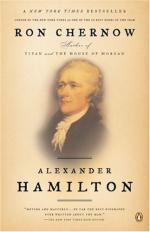
    Alexander Hamilton
    The first U.S. secretary of the Treasury, Alexander Hamilton (1755-1804) was instrumental in develo... more

    Alexander Hamilton
    Author of numerous essays, the Itinerarium (written in 1744), and The History of the Tuesday Club (... more


    Copyrights
    Hamilton, Alexander from Americans at War. Copyright © 2001-2006 by Macmillan Reference USA, an imprint of the Gale Group. All rights reserved.

    Join BookRagslearn moreJoin BookRags


    About BookRags | Customer Service | Report an Error | Terms of Use | Privacy Policy