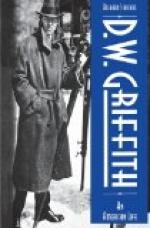
Griffith, D. W. (1875-1948)
Considered the father of the motion picture and the first great artist of the cinema, director D. W. Griffith revolutionized filmmaking with technical innovations and a narrative structure still in use at the end of the twentieth century. His most significant and controversial movie, The Birth of a Nation (1915) established the feature-length film and the Hollywood star system. After a private viewing at the White House, President Woodrow Wilson reportedly remarked that the film "was like writing history with lightning." Released on March 3, The Birth of a Nation was not only the longest and most expensive movie to date, but it was the most popular movie of its time and the most politically explosive film in American history.
David Wark Griffith was born on January 23, 1875, in the town of Crestwood in Oldham County, Kentucky. He was an aspiring actor from 1897-1907, traveling from Portland, Oregon, to Boston, Massachusetts, working in stock companies under the name Lawrence Griffith. In 1906, while in Boston, he married his first wife, Linda Arvidson Johnson. His days as a stage actor were unfruitful.
In 1908, the famed director Edwin S. Porter introduced Griffith to his associates at the Biograph Company on 14th Street in Manhattan. Here the young actor gave up his first love to sell stories and ultimately to begin making movies himself. Along with his trusted and accomplished cameraman, G. W. "Billy" Bitzer, Griffith worked at a tremendous pace. From August 1908 through August 1911, he completed an astonishing 326 one-reel films. Through these early years, Griffith experimented with different camera angles, editing, and narrative styles. He used close-ups to produce greater emotional drama and sharp cuts between scenes to quicken a story's pace, believing that action rather than written titles should propel the movie's plot. In 1912 Griffith made a short, The New York Hat, with Lionel Barrymore and a young Mary Pickford based on a story submitted by sixteen-year-old Anita Loos, soon to be the most sought-after scenarist in Hollywood. Griffith stayed with Biograph just one more year, but he made his longest and most elaborate film todate in 1913, Judith of Bethulia. At four reels, it was four times longer than the standard movie.
D. W. Griffith (third from left) on location.
Griffith reportedly convinced Bitzer to leave Biograph by telling him that he planned on making the greatest film in history. As an independent producer, Griffith acted as director, producer, distributor, and press agent for his epic Birth of a Nation. Based on Thomas Dixon's novel The Clansman (1905), Griffith's movie faithfully depicted the Reconstruction Era that immediately followed the U.S. Civil War as a period in which African-American men threatened the purity of the white race politically, socially, and sexually. From 1915 to 1946, a reported two hundred million people saw the film. During the first weeks of the movie's release, Americans lined up along sidewalks and in New York City paid the extraordinary price of $2.00 a seat for a chance to see the most talked-about movie of the year. With more than twelve reels of film, it ran a record two hours. The movie cost more than $100,000 to film but grossed an astonishing $18 million.
The technical innovations that Griffith employed to make his film have continued to impress viewers and film historians alike since 1915. For example, Griffith had Bitzer set up his camera at ground level to capture the power and frantic torrent of horse hoofs at full gallop on a dusty road. Such a scene illustrated the capabilities of the movie camera if freed from its stationary position in front of a stage. Using an array of camera angles—close-ups, long shots, cutbacks—Griffith proved that directors could make long movies and still hold the audience's attention. Parallel editing—cross-cutting footage of different events—achieved suspense and created the illusion of simultaneous action.
Repugnant to modern audiences yet reflecting widespread American sentiments at the time, the overt racist and nativist imagery, specifically the sympathetic portrayal of the Ku Klux Klan, throughout Birth of a Nation provoked the NAACP, a young organization in 1915, to rally black and white people around the country to picket theaters showing the movie. Surprised by the strong reaction to the film and believing it threatened his freedom of speech and, perhaps more importantly, his artistic integrity, Griffith released the anti-bigotry epic Intolerance in 1916. As popular as Birth of a Nation was, Intolerance proved to have a stronger effect on other directors. Among those under Griffith's influence was the famous Soviet director Sergei Eisenstein, who believed the American's style of rapid-fire editing had advanced filmmaking by a decade.
Griffith directed another twenty-six features between 1916 and 1931 but never again enjoyed adulation as the world's most brilliant director. He ended his career working from his Mamaroneck studio, a suburb of New York City, to be closer to the financial center of the movie industry.
Further Reading:
Barry, Iris. D. W. Griffith: American Film Master. New York, Museum of Modern Art, 1965.
Carter, Everett. "Cultural History Written with Lightning: The Significance of The Birth of a Nation. " Hollywood as Historian. Edited by Peter Rollins. Lexington, University of Kentucky Press, 1998.
Cripps, Thomas. "The Reaction of the Negro to the Motion Picture The Birth of a Nation. " Historian. Vol. 25, 1963.
Franklin, John Hope. "Birth of a Nation—Propaganda as History." In Hollywood's America: United States History through Its Films, edited by Steven Mintz and Randy Roberts. New York, Brandywine Press, 1993.
Graham, Cooper C., Steven Higgins, Elaine Mancini, and Joao Luiz Vieira. D. W. Griffith and the Biograph Company. Metuchen, New Jersey, Scarecrow Press, 1985.
Gunning, Thomas. D. W. Griffith and the Rise of the Narrative Film. Urbana, University of Illinois Press, 1991.
Litwack, Leon F. "The Birth of a Nation." In Past Imperfect: History According to the Movies, edited by Mark C. Carnes. New York, Henry Holt and Company, 1995.
Schickle, Richard. D. W. Griffith: An American Life. New York, Simon and Schuster, 1984.
Stern, Seymour. "The Birth of a Nation." Film Culture. Vol. 36, Spring-Summer, 1965.
Williams, Martin. Griffith: First Artist of the Movies. New York, Oxford University Press, 1980.
This is the complete article, containing 1,010 words
(approx. 3 pages at 300 words per page).