|
|

|
| About 3 pages (944 words) |
|

Greeley, Horace
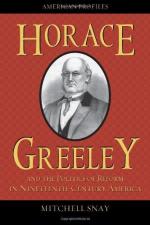
(b. February 3, 1811; d. November 29, 1872) American journalist, editor, and political leader. Newspaper editor Horace Greeley abhorred war. Greeley was one of the most widely read and best known Americans of his day. His life spanned the War of 1812, the Mexican War, and the American Civil War. The Horace Greeley.founding editor of the New York Tribune was an inveterate talker and writer who played a major role in transforming American liberty into American freedom in the years before 1860. Greeley's political language, inspired by the European republican revolutionaries of 1830 and 1848, transformed propertied liberty under the law into equal freedom for all, grounded in God's moral law. Freedom meant both rights guaranteed under the Constitution and the natural rights of all to land, association, and peace. He believed that war threatened both liberty and freedom in a republic. The War of 1812 shaped Greeley's youth. Born in Amherst, New Hampshire, Greeley grew up in Vermont and New York and rose to eminence as a journeyman printer, then became founding editor of the New Yorker (1834) and finally the New York Tribune (1841). As a young man, Greeley listened to opponents of "Mr. Madison's War" and to Fourth of July speeches by Revolutionary War veterans. Greeley entered politics hating Andrew Jackson, Martin Van Buren and other "corrupt" Democrats, suspecting that Freemasons were taking over the country, and admiring Kentucky Senator Henry Clay. In time, he became a protectionist Whig (an anti-Democrat who favored higher tariffs to protect American industries) and then helped form and name the Republican Party in 1854. In New York, Greeley also became a lifelong Universalist who believed that all people, not an elite, deserved Christ's salvation. During the 1840s, Greeley campaigned vigorously for Whig candidates, both at the polls and in his newspaper. After the economic depression of 1837, he urged young unemployed men of eastern cities to take their families and "go West" to find land and employment; thousands did so. In 1840, he helped elect William Henry Harrison to the presidency. For a time, Greeley was a follower of French associationist Charles Fourier, both at Brook Farm near Boston and at the North American Phalanx in Red Bank, New Jersey (organizations large enough to support their own industries and social needs). Greeley was also Henry Thoreau's literary agent in New York for fifteen years. He gave Margaret Fuller her start as a literary editor and invited her to stay for a year in his home. He also became an opponent of slavery, but not an abolitionist. Greeley opposed the Mexican War both because of his pacifist leanings (Greeley wanted to dismantle the U.S. army and navy) and because he believed territorial gains might extend slavery to the American West. In 1849, he supported the Free Soil Party's campaign against slavery in the territories. He also became a major spokesman for organized labor, especially printers, and for women's rights, but not suffrage. Aside from serving out an unexpired term in Congress in 1849, Greeley never held elected office. But the weekly edition of his Tribune became the Bible of farmers and plain folk across the expanding country. He hired a group of militant young writers to staff the newspaper—Charles A. Dana, George Ripley, Margaret Fuller, Karl Marx (who survived in London for a decade on his Tribune articles), and Adam Gurovsky. He sharply opposed the Compromise of 1850, the Kansas Nebraska Act of 1854, the Dred Scott decision, and all other attempts to maintain slavery. In 1860, he helped nominate Lincoln by throwing the votes he had amassed for another candidate to the rail-splitter, largely in order to defeat Greeley's archenemy and former ally, William Seward of New York. In 1861, Greeley opposed the Civil War and urged Lincoln to let the "erring sisters" of the Confederacy depart from the Union in peace. But once war came, he was staunchly supportive, hoping that it would become a war not simply to maintain the Union, but for the emancipation of the slaves. Some blamed Greeley and the Tribune for prematurely encouraging a Union defeat at Bull Run by running daily headlines urging "On to Richmond!" before federal troops were prepared. Greeley subsequently helped inspire Lincoln's Emancipation Proclamation with his widely read "Prayer of Twenty Million." He then tried to negotiate an end to the war with both foreign and Confederate representatives, much to Lincoln's chagrin. After the war, Greeley urged amnesty and charity toward the South. He published a two volume history of the Civil War entitled The American Conflict. Subscriptions to his paper fell off, however, after Greeley helped put up bail money to free Jefferson Davis from prison in 1867. In 1872, Greeley ran for U.S. president as a candidate of both the Liberal Republican and Democratic Parties against Republican Ulysses S. Grant. He lost badly, and died shortly thereafter. Horace Greeley hated war as much as he hated slavery. He was not a socialist, but a bourgeois utopian that cherished peaceful community where men and women were equally free to labor and prosper. He felt war threatened that prosperity and that freedom. Bibliography Fahrney, Ralph Ray. Horace Greeley and the Tribune in the Civil War. Cedar Rapids, IA: Torch Press, 1936. Greeley, Horace. The American Conflict: A History of the Great Rebellion in the United States of America, 1860–1864, 2 vols. Hartford, CT: O. D. Case & Co., 1864–1866. Kirkland, Edward Chase, ed. The Peacemakers of 1864. New York: Macmillan, 1927. Lunde, Erik S. Horace Greeley. Boston: Twayne, 1981. Maihafer, Harry J. The General and the Journalists: Ulysses S. Grant, Horace Greeley, and Charles Dana. Washington DC and London: Brassey's, 1998. Schulze, Suzanne. Horace Greeley: A Bio-Bibliography. New York: Greenwood Press, 1992.
This is the complete article, containing 944 words
(approx. 3 pages at 300 words per page).
Copyrights
Greeley, Horace from Americans at War. Copyright © 2001-2006 by Macmillan Reference USA, an imprint of the Gale Group. All rights reserved.
|