 Print
Print Word
Word PDF
PDF|
This section contains 2,239 words (approx. 8 pages at 300 words per page) |

|
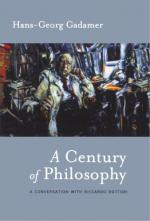
Hans-Georg Gadamer, a Heidelberg philosopher and student of Martin Heidegger, is best known for his hermeneutic philosophy put forward in his Wahrheit und Methode (Truth and Method, 1960). Widely regarded as the most significant German philosopher after Heidegger, Gadamer wrote on Plato, Georg Wilhelm Friedrich Hegel, Heidegger, Aristotle's practical philosophy, reason in an age of science, aesthetics, poetics, Paul Celan, and other topics.
Biography
Gadamer was born in Marburg and grew up in Breslau. His mother died when he was four. His father was a well-known university research scientist in pharmacological chemistry. In 1919 Gadamer's father was called from the University of Breslau to a research chair at the University of Marburg. Gadamer entered Marburg as a second-year student with interests in literature, art history, and classical philology. But he was soon drawn to the great neo-Kantian philosopher and Platonist, Paul Natorp, under whom he completed...
|
This section contains 2,239 words (approx. 8 pages at 300 words per page) |
|