BookRags.com Literature Guides Literature
Guides
Criticism & Essays Criticism &
Essays
Questions & Answers Questions &
Answers
Lesson Plans Lesson
Plans
My Bibliography Periodic Table U.S. Presidents Shakespeare Sonnet Shake-Up
Research Anything:        
History | Encyclopedias | Films | News | Create a Bibliography | More... Login | Register | Help


Francisco Pizarro

Print-Friendly  Order the PDF version  Order the RTF version
About 2 pages (681 words)
Francisco Pizarro Summary

Bookmark and Share Know this topic well? Help others and get FREE products!

Francisco Pizarro

1470?-1541

Spanish Soldier and Explorer

Francisco Pizarro was a Spanish soldier and explorer who conquered the Incan empire and founded the city of Lima, Peru, in 1535. He was also a member of Balboa's expedition that discovered the Pacific Ocean in 1513. Like many of the Spanish conquistadors, Pizarro led a dangerous life dedicated primarily to the accumulation of wealth through the conquering of new lands and people.

Pizarro was born in Trujillo, Spain, around 1470. He was the illegitimate son of Gonzalo Pizarro, who was a captain of infantry. Pizarro was not interested in education while growing up and did not learn to read or write. He was, however, intrigued by adventure. This was especially true of the stories he heard regarding the exploits of his countrymen in America. Determined to live that style of life, he traveled to Hispanola (presently Haiti and the Dominican Republic) in 1502. Bored by colonial life, Pizarro joined an expedition to Columbia with Alonso de Ojeda (1465?-1515) in 1509. He began to develop a reputation as a man who could be trusted in difficult situations; therefore, he was made a captain on the expedition led by Spanish explorer Vasco Núñez de Balboa (1475-1519) that was credited with the European discovery of the Pacific Ocean in 1513. Pizarro later served from 1519-1523 as the mayor of Panama, where he accumulated a small fortune. However, it was not until he was almost 50 years old that the events that he is most famous for took place.

In 1523 Pizarro embarked on an expedition to the west coast of South America in partnershipwith a soldier, Diego de Almagro (1475?-1538), and a priest, Hernando de Luque. Travel and conditions were extremely difficult, and many men perished in the harsh conditions. Almagro was sent back to Panama to obtain reinforcements, but the new governor of Panama ordered the expedition to be halted. Legend has it that at hearing this, Pizarro drew a line in the sand with his sword and invited anyone who was interested in wealth and glory to step over to his side. The men who crossed the line and continued the exploration were known as the "famous thirteen." They continued on to present-day Peru, obtaining firsthand accounts of the Inca Empire. Pizarro traveled back to Spain to gain permission from the emperor Charles V to continue his exploits.

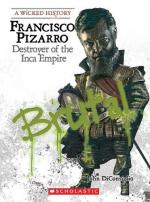
Francisco Pizarro. (Corbis Corporation. Reproduced with permission.)Francisco Pizarro. (Corbis Corporation. Reproduced with permission.)

The king agreed with Pizarro and placed him in charge of New Castle, a province 600 miles (966 km) south of Panama. While all of the "famous thirteen" were granted significant privileges in the new land, both Almagro and Luque were given positions subordinate to Pizarro. Pizarro and his four brothers eventually arrived in Peru with a relatively small contingent of men compared to the 30,000 men in the Incan army. Pizarro set up a meeting with the leader of the Incas, Atahuallpa. He asked the Incan leader to submit to Christianity and to Spain, but the king refused. Pizarro immediately ordered an attack, seizing Atahuallpa and demoralizing the Incanarmy. Atahuallpa was held for ransom, while great rooms were filled by the Incas with gold and silver. Atahuallpa, however, was never released; he was put to death in 1533 on charges of plotting against the Spanish government. With their leader dead, the Incas offered little resistance while Pizarro took over the entire empire.

Pizarro now had the difficult task of defending his hold on the Incan empire. Almagro had grown jealous of Pizarro and his power from the king of Spain. Almagro demanded an equal share of the spoils of the expedition, so an agreement was established that gave him a large portion of Chile. After finding that country poverty stricken, Almagro returned to Peru, where he was captured and executed by Pizarro's brother, Hernando (1475?-1578). Almagro's allies were rounded up and sent to Lima so they could be watched. They realized they were in immediate danger and attacked the Pizarro palace on June 26, 1541. Francisco Pizarro is said to have fought gallantly, but was killed in a sword fight at the hands of Almagro's allies.

This is the complete article, containing 681 words (approx. 2 pages at 300 words per page).

More Information
  • View Francisco Pizarro Study Pack
  • Search Results for "Francisco Pizarro"
  • Add This to Your Bibliography
  • More Products on This Subject
    Francisco Pizarro
    The Spanish conquistador Francisco Pizarro (ca. 1474-1541) was the obscure adventurer and ruffian w... more

    Pizarro, Francisco
    (born c. 1475, Trujillo, Extremadura, Castile [Spain]—died June 26, 1541, Lima [now in Peru])... more


    Ask any question on Francisco Pizarro and get it answered FAST!
    Answer questions in BookRags Q&A and earn points toward
    discounted or even FREE Study Guides and other BookRags products!
    Learn more about BookRags Q&A
    Copyrights
    Francisco Pizarro from Science and Its Times. ©2005-2006 Thomson Gale, a part of the Thomson Corporation. All rights reserved.

    Join BookRagslearn moreJoin BookRags


    About BookRags | Customer Service | Report an Error | Terms of Use | Privacy Policy