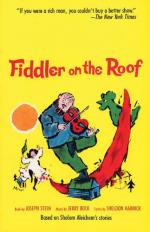
Fiddler on the Roof
One of the most important musicals of the 1960s, in many ways Fiddler on the Roof represents the end of the classic mid-twentieth century American musical theater. The tale of Tevye, a Jewish peasant in turn-of-the-century Russia, and his difficulties with maintaining tradition in the midst of change, has had universal appeal eversince its premiere in 1964. The score includes the hit songs "Tradition," "To Life," "If I Were a Rich Man," and "Sunrise, Sunset."
Zero Mostel in Fiddler on the Roof.
In the early 1960s, composer Jerry Bock, lyricist Sheldon Harnick, and librettist Joseph Stein decided that they wanted to write a musical together. After looking at numerous potential plot sources, they chose Sholom Aleichem's short story "Tevye and His Daughters." The trio persuaded Harold Prince to produce the show, who in turn advised them to engage Jerome Robbins as director-choreographer. With Prince and Robbins—two of Broadway's most significant creative personalities—involved with the production, its success was virtually secure.
Fiddler on the Roof takes place in the Jewish village of Anatevka, Russia, in 1905. Its plot revolves around Tevye, a dairyman, his wife Golde, and their five daughters. Tevye reveals his creed in his opening monologue:
A fiddler on the roof. Sounds crazy, no? But in our little village of Anatevka, you might say every one of us is a fiddler on the roof, trying to scratch out a pleasant, simple tune without breaking his neck. It isn't easy. You may ask, why do we stay here if it's so dangerous? We stay because Anatevka is our home. And how do we keep our balance? That I can tell you in a word—tradition!
Tevye's world is challenged by impending change. Tzeitel, his eldest daughter, marries a poor tailor after Tevye has promised her to a wealthy widowed butcher. Hodel, his second daughter, marries a revolutionary and follows him to Siberia, while Chava, his third daughter, marries a Christian. At the end of the musical, the Czar's Cossacks destroy Anatevka as Tevye and his family leave for an unknown future in America. The show's title—a fiddler on the roof who tries to maintain his balance while playing—suggests the desire for constancy in the face of mutability. The image itself was inspired by Marc Chagall's painting The Green Violinist.
Fiddler on the Roof opened on Broadway on September 22, 1964, at the Imperial Theater, where it played for 3,242 perform-ances—the longest run in the history of the American musical theater to that time. Zero Mostel created the role of Tevye. Other original cast members included Maria Karnilova, Beatrice Arthur, Joanna Merlin, Julia Migenes, Bert Convy, and Tanya Everett. The musical garnered numerous Tony Awards, including best musical, score, book, actor (Mostel), featured actress (Karnilova), choreographer (Robbins), and costumes (Patricia Zipprodt). Topol starred in the London production, which ran for over 2,000 performances, as well as in the 1971 film version.
The success of the show was due largely to its superb musical score. The opening number, "Tradition," is a joyous celebration of life, as is the wedding number "To Life." The waltzes "Matchmaker" and "Sunrise, Sunset" capture the nostalgia of bygone traditions and the passing of time, while Tevye's splendidly dramatic monologue, "If I Were a Rich Man," is one of the great soliloquies of the musical theater. Tevye and Golde's comic duet "Do You Love Me?" is a frank expression of the love that can develop between two people over a lifetime. This expression of matrimony based on traditional matchmaking is contrasted with the "modern" concept of marriage based on love and choice in "Now I Have Everything" and "Miracle of Miracles." The music of Fiddler on the Roof does not generally fit into the standard mold of Broadway show tunes; traditional folk idioms fill the score and infuse it with a particular yet accessible ethnic character that distinguishes it from other shows of its era. As such, it opened the door for more variations on the traditional American musical theater genre through the end of the century.
Fiddler on the Roof is imbedded within its Jewishness without being parochial. The show's emphasis on family and religious interactions against a backdrop of a disintegrating social order gives it a universality that transcends time, place, and ethnicity. Its popularity through professional, amateur, and school productions remains as strong as ever more than thirty years after its premiere.
Further Reading:
Robbins, Harold. Harold Prince Presents Zero Mostel in Fiddler on the Roof: Director's Book. New York, J. Robbins, 1970.
Slobin, Mark. "Some Intersections of Jews, Music, and Theater." In From Hester Street to Hollywood: The Jewish-American Stage and Screen, edited by Sarah Blacher. Bloomington, Indiana University Press, 1983.
Suskin, Steven. Opening Night on Broadway: A Critical Quotebook of the Golden Era of the Musical Theatre, Oklahoma! (1943) to Fiddler on the Roof (1964). New York, Schirmer Books, 1990.
Swain, Joseph P. The Broadway Musical, A Critical and Musical Survey. New York and Oxford, Oxford University Press, 1990.
This is the complete article, containing 815 words
(approx. 3 pages at 300 words per page).