 Print
Print Word
Word PDF
PDF|
This section contains 318 words (approx. 2 pages at 300 words per page) |
French Lawyer and Mathematician
1601–1665
 Pierre de Fermat's disagreements with Descartes over principles of analytic geometry hurt Fermat's reputation as a mathematician, but it was Descartes who admitted in the end that Fermat's methods were correct.
Pierre de Fermat was born in 1601 in Beaumont-de-Lomagne, France, and died in 1665 in Castres, France. He was the founder of modern number theory, one of the initiators of analytic geometry, and co-founder of probability theory. He also invented important mathematical methods that anticipated differential and integral calculus.
Little is known of Fermat's early life. He received his law degree from the University of Orleans and served as councilor to parliament beginning in 1634. His real passion, however, was mathematics. Throughout his life he attacked difficult problems, many times with remarkable success. Unfortunately, he did not publish his results, which were known only through correspondence. Had Fermat published, his contributions would have been more influential during his lifetime.
Fermat applied the methods of algebra to geometry using a coordinate system in his study of loci. Descartes's equivalent approach earned him, not Fermat, credit for founding analytic geometry because Fermat's work was not published until after his death.
Blaise Pascal contacted Fermat in 1654, and through the ensuing correspondence in which they tried to mathematically predict the numbers that dice would show in gambling, they co-founded probability theory. In developing a method of finding tangents to curves and determining the area bounded by curves, Fermat laid the groundwork for both differential calculus and integral calculus.
Fermat developed numerous theorems involving prime numbers and integral numbers and, consequently, is regarded as the founder of modern number theory. The best known of these theorems, Fermat's Last Theorem, was not proved until 1994.
See Also
Fermat's Last Theorem; Probability, Theoretical.
Bibliography
Bell, E. T. Men of Mathematics. New York: Simon and Schuster, 1986.
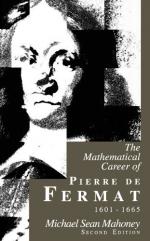
Mahoney, Michael S. The Mathematical Career of Pierre de Fermat. Princeton, NJ: Princeton University Press, 1994.
|
This section contains 318 words (approx. 2 pages at 300 words per page) |