
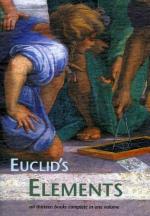
Euclid
325?-250? B.C.
Greek Mathematician
Euclid's Elements, the bible of geometry for 2,000 years, remains the most influential textbook in history, and one of the essential works of human civilization. Therefore it is all the more ironic that the man who wrote it is such a figure of mystery that at various times historians have suggested that he never lived—or that "Euclid" was actually the name for a group of mathematicians.
In fact the historical existence of a man named Euclid of Alexandria, author of the Elements, seems safely established. Most of what scholars know about his life, however, comes from a short summary in Proclus's (410?-485) commentary on the Elements. As for his place of origin, this has been variously identified as Tyre (now in Lebanon), Greece, or Egypt, with the last two being the most likely candidates. Whatever the case, he was almost without a doubt ethnically Greek, and certainly brought up in the Greek language, culture, and civilization.
More difficult is the placement of Euclid in time. Some sources indicate that he traveled as an adult to Alexandria in 322 B.C., but other information on the dates of his life suggests that he would have been a small child in that year. It seems likely that he first studied in Athens at the Academy established by Plato (427?-347 B.C.), though long after Plato's death, and that soon afterward he moved to Alexandria, where he became involved with that city's great library as its first teacher of mathematics. This, too, suggests a later date for his birth: in 322 B.C., the establishment of the Alexandrian library was still several decades in the future.
The one clearly established aspect of Euclid's life—passing over speculation that he was either a myth or the name for a committee—was his authorship of the Elements. Though the book contained concepts of his own, it is primarily a summation of mathematical knowledge passed down from Pythagoras (580?-500? B.C.) onward, and its genius lies in its cogent explanation of basic principles, as well as its clear and thorough explication of geometric proofs.
Consisting of 13 books in which Euclid elaborated on some 450 propositions, the Elements begins with a definition of points, lines, planes, angles, circles, triangles, quadrilaterals, and parallel lines. In Book II, Euclid addressed rectangles and squares; in Book III, circles; and in Book IV polygons. He continued with a discussion of proportion and area (Book V), followed by an application of this theory to plane geometry (Book VI). Book VII covers arithmetic, Book VIII irrational numbers, and Book IX rational numbers, while the remainder of the volume is devoted to three-dimensional, or solid, geometry.
Among Euclid's original contributions was a new proof of the Pythagorean theorem, which included a proof of the existence of irrational numbers. He also developed a means of showing that the number of primes is infinite, and created an exhaustion method for measuring areaand volume, later adopted by Archimedes (287?-212 B.C.).
Euclid. (Bettmann/Corbis. Reproduced with permission.)
Euclid's five postulates are among the most important aspects of his work. The first three of these focus on construction with the straight edge and circle or compass, the only tools of Euclidean geometry, while the fourth states that all right angles are equal. This seems like an easy conclusion, but in reaching it Euclid was forced to adopt a view that was far from obvious, treating space as a homogeneous entity in which a figure is independent of its position.
Most controversial, however, was the fifth postulate, which discussed the relationship between two straight lines placed side by side. If a line placed at a 90° angle to the first line does not also intersect the second line at a 90° angle, Euclid indicated, the first two lines must eventually meet in the direction of the angle that is less than 90°. Later Proclus would develop a well known formulation of the Fifth Postulate: "Through a given point in a plane, one and only one line can be drawn parallel to a given line." Euclid and other mathematicians recognized that the preceding four postulates did not constitute a proof for the fifth, and in later centuries the Fifth Postulate came under increasing challenge. This would culminate with the development of non-Euclidean geometry in the nineteenth century.
Given the significance of his Elements, it may be surprising to learn that Euclid is credited as the author of numerous other texts, including works on plane geometry, spherical geometry, and perspective. Furthermore, he wrote a number of books that have been lost, including a volume called Conics that apparently influenced the more famous work of that name by Apollonius of Perga (262?-190? B.C.).
This is the complete article, containing 767 words
(approx. 3 pages at 300 words per page).

