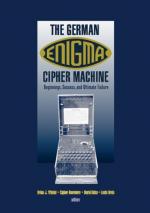
Enigma Machine
The Enigma was a machine used by the German military before and during World War II to encrypt messages. To encrypt (or encipher) a message means to change its form in such a way that it (ideally) becomes unintelligible to anyone besides the sender and the intended receiver. It is the job of decryption analysts to decipher intercepted messages so that the secret information in those messages is revealed.
In 1919 a Dutch inventor patented a device to encrypt messages. A German engineer named Scherbius aided him in constructing the device. Scherbius eventually purchased the patent rights and began marketing the machine, which he dubbed the Enigma, for both commercial and military purposes. By the late 1920s the German military removed the Enigma from the commercial market for their own use. The Enigma, as pictured above, was roughly the size of a typewriter, and it possessed a keyboard similar to a typewriter's keyboard in that it possessed all the letters of the alphabet, but the top "number" row was absent. In place of a typewriter's roller were rotors (i.e., disks or wheels) that were mounted on a common shaft. Originally the Enigma possessed three rotors, and each could be individually rotated. Near the rim of each rotor, and spaced evenly from one another, were the letters of the alphabet. Next to each letter on the rotors was an electrical stud, or contact. Whenever the Enigma was in use, electricity would pass through one, and only one, stud on each of the rotors. The fundamental idea behind the Enigma machine was that pressing a key on the keyboard sent an electric signal through the rotors and changed (or "encrypted") the input character. For example, typing the letter "k" on the keyboard could produce the letter "m" after the signal went through the rotors; the letters in the word "key" might be output as "mzb." Different rotor settings caused the output letters to change accordingly. In this way messages could be "scrambled" and then broadcast. An Enigma message was decoded by using another Enigma machine with identical rotor settings; an operator typed the coded message into his Enigma and the decoded message would be displayed.
Throughout much of the 1920s and 1930s, Germany and Poland were uneasy neighbors. To learn more about German intentions a Polish team of code breakers constructed a machine, called a "Bomba," that used mechanical means (gears, motors, etc.) to mimic the operation of the Enigma. Using the code-breaking Bombas, the Poles were able to eavesdrop on secret German messages throughout much of the 1930s. However, in 1938 five-rotor Enigmas appeared that rendered the Polish Bombas ineffective. Continued improvement of Enigma technology eventually resulted in a capability of one sextillion (equivalent to a one followed by 21 zeroes) different possible combinations of coding characters. In 1939 the Poles handed their Bomba technology over to the British. Using the Bombas as a starting point, the British developed their own decoding machines, which, like the Polish Bombas, were mechanical in nature (i.e., they used no electronic parts). The British referred to their new decoding machines by the slightly different term "Bombe." The British Bombes were quite proficient at deciphering Enigma messages. The breaking of the German Enigma code was of profound importance to the British. For instance, after the German invasion of France in May 1940, the British were privy to the German Enigma communications. Intercepted and decoded Enigma messages helped convince the British government that France would be overrun and that all British forces in France should be withdrawn before they could be captured; the successful British withdrawal from Dunkirk was the result.
The secrets of the Enigma encryption machine were completely uncovered by the British decoding efforts. However, the story of the Enigma did not stop there. In 1942 the German military began coding many of their secret communications using a technology that combined certain Enigma components, such as the rotors, with a "pseudo-random" binary telegraph code. The incorporation of the telegraph code with the Enigma technology (codenamed "Fish" by the British) was beyond the capabilities of the British Bombes to decipher. British engineers began to work on deciphering the German "Fish" code, and came up with the idea of devising a machine that employed electronics, since electronic processing would be faster than the mechanical action used in the Bombes. The first decryption device using electronics was called Heath Robinson (named for a British cartoonist). Though successful, it was decided that a much more powerful device was required. The result was the Colossus computer. By the end of World War II (in 1945) there were a total of ten Colossus computers. The Colossus computers were the first fully functional electronic computers, and succeeded completely in deciphering the "Fish" messages. In effect, the efforts to decode the Enigma machine and other related coding machines led to the development of the world's first operational electronic computer.
This is the complete article, containing 814 words
(approx. 3 pages at 300 words per page).