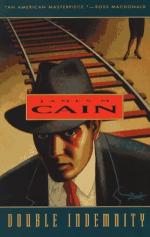
Double Indemnity
Double Indemnity (1935) is one of the classic, tough-talking murder stories of the late 1930s. Written by controversial mystery novelist James M. Cain (1892-1977), Double Indemnity is based upon a true story about a weak-willed insurance agent, Walter Huff, who falls for sultry blond, Phyllis Nirdlinger. Nirdlinger's inconvenient husband has to be eliminated so that his wife and her lover can collect on his life insurance, a policy which doubles in value if the holder dies by accident.
Like The Postman Always Rings Twice, upon which it is modeled, l'amour fou, or sexually charged obsessive love, is at the heart of this psychologically realistic novel. Cain, along with, for example, Raymond Chandler and Dashiell Hammett have been called, perhaps unjustly in Cain's case, members of the hard-boiled school of detective novelists. Edmund Wilson has referred to them as "the poets of the tabloid murder" because of their interest in the low life aspects of American culture, and the often sordid stories of murder, eroticism, and adultery that fascinated them.
Unlike Chandler, with whom he has been compared (and who wrote the screenplay for the film version of Double Indemnity), Cain's writing is deeply pessimistic and far less romantic. His characters are terribly flawed yet very human in their failings, and the eroticism of many of his novels made them controversial in their day. Cain's interests and lean writing style also made him stand apart from much of the popular writing of his time. His gritty, downbeat, stories, like The Postman Always Rings Twice, Mildred Pierce, and Double Indemnity had a pictorial quality which made them attractive for adaptation to the movies. All, however, underwent considerable sanitation before the more censorship-plagued Hollywood studios could make them into films.
In the case of Double Indemnity, the novel ends with Huff and Phyllis on a freighter going nowhere in particular, unable to return to the United States because of their murderous pasts, and contemplating suicide by jumping off the boat into shark infested waters. As Phyllis says, "There's nothing ahead of us, is there Walter." And Walter replies, "No, nothing." This existential gloom did not survive in the film version where Walter, after narrating his sordid tale of adultery and betrayal, lies dying from a gunshot wound inflicted by, perhaps, Phyllis, who he has murdered a few hours before.
Billy Wilder turned the novel into a convention-setting film noir in 1944, starring Fred MacMurray, Barbara Stanwyck, and Edward G.
Barbara Stanwyck and Fred MacMurray in a scene from Double Indemnity.Robinson. Told in a confessional flashback by the dying insurance agent, Wilder's more cynical, but less gloomy version, helped establish flashback—first person narration as a convention in film noir. The unconventional casting of Fred MacMurray, who was noted for his roles in comedy, helped the audience identify with the amoral, but ruthless Huff, who is now called Walter Neff.
In the film version, the first person narration helps to draw the audience into a morally complex position where they viscerally experience the amoral world in which Neff and Phyllis operate—we see the events unfold through his eyes. To put the spectator on edge, Wilder sets the rigid and righteous Barton Keyes (Edward G. Robinson), an insurance investigator and Neff's boss and friend, up against the Neff character, giving the audience a choice between identifying with a slippery, ruthless, and greasily charming insurance salesman or his cold and obsessive nemesis. As in Alfred Hitchcock films, the audience becomes ethically involved with the criminals hoping that they will elude the ever present, relentless Keyes. With its raw, more naturalist flavor, and serious, unsentimental prose the novel makes identification with the characters more difficult. Thus in the film when Neff sets out to kill Phyllis, the audience is uncomfortably aware that they have identified with a hero who is a callous and brutal loner.
Further Reading:
Cain, James M. Double Indemnity. New York, Random House, 1978.
Evans, Peter William. "Double Indemnity (or Bringing up Baby)."In The Book of Film Noir, edited by Ian Cameron. New York, Continuum, 1993, 165-73.
Johnston, Claire. "Double Indemnity." In Women in Film Noir, edited by E. Ann Kaplan. London, The British Film Institute Press, 1980, 100-11.
Palmer, R. Barton. Hollywood's Dark Cinema. New York, Twayne Publishers, 1994.
Schickel, Richard. Double Indemnity. London, British Film Institute, 1992.
Silver, Alain, and Elizabeth Ward, editors. Film Noir: An Encyclopedic Reference to the American Style. Woodstock, New York, Overlook Press, 1992.
This is the complete article, containing 723 words
(approx. 2 pages at 300 words per page).