BookRags.com Literature Guides Literature
Guides
Criticism & Essays Criticism &
Essays
Questions & Answers Questions &
Answers
Lesson Plans Lesson
Plans
My Bibliography Periodic Table U.S. Presidents Shakespeare Sonnet Shake-Up
Research Anything:        
History | Encyclopedias | Films | News | Create a Bibliography | More... Login | Register | Help

Not What You Meant?  There are 16 definitions for DNA.  Also try: SSB or Template or DSB or Edna.

Dna

Print-Friendly  Order the PDF version  Order the RTF version
About 3 pages (866 words)
DNA Summary

Bookmark and Share Know this topic well? Help others and get FREE products!

Dna

An organic substance that encodes and carries genetic information and is the fundamental element of heredity.

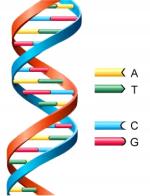
The thousands of genes that make up each chromosome are composed of deoxyribonucleic acid (DNA), which consists of a five-carbon sugar (deoxyribose), phosphate, and four types of nitrogen-containing molecules (adenine, guanine, cytosine, and thymine). The sugar and phosphate combine to form the outer edges of a double helix, while the nitrogen-containing molecules appear in bonded pairs like rungs of a ladder connecting the outer edges. They are matched in an arrangement that always pairs adenine in one chain with thymine in the other, and guanine in one chain with cytosine in the other. A single DNA molecule may contain several thousand pairs. As the transmitter of inherited characteristics, DNA replicates itself exactly and determines the structure of new organisms, which it does by governing the structure of their proteins.

The specific order and arrangement of these bonded pairs of molecules constitute the genetic code of the organism in which they exist by determining, through the production of ribonucleic acid (RNA), the type of protein produced by each gene, as it is these proteins that govern the structure and activities of all cells in an organism. Thus, DNA acts as coded message, providing a blueprint for the characteristics of all organisms, including human beings. When a cell divides to form new life, its DNA is "copied" by a separation of the two strands of the double helix, after which complementary strands are synthesized around each existing one. The end result is the formation of two new double helices, each identical to the original. All cells of a higher organism contain that organism's entire DNA pattern. However, only a small percentage of all the DNA messages are active in any cell at a given time, enabling different cells to "specialize."

Many viruses are also composed of DNA, which, in some cases, has a single-strand form rather than the two strands forming the edges of a double helix. Each particle of a virus contains only one DNA molecule, ranging in length from 5,000 to over 200,000 subunits. (The total length of DNA in a human cell is estimated at five billion isubunits.) Radiation, thermal variations, or the presence of certain chemicals can cause changes, or "mistakes," in an organism's DNA pattern, resulting in a genetic mutation. In the course of evolution, such mutations provided the hereditary blueprints for the emergence of new species.

History

The Swiss researcher Frederick Miescher first discovered DNA in 1869. He extracted a substance (that he called nuclein) containing nitrogen and phosphorus from cell nuclei. The question of whether nucleic acids or proteins, or both, carried the information that make the genes of every organism unique was not answered, however, until the molecular structure of DNA was determined in 1953. This pioneering work was accomplished by an American biochemist, James D. Watson, and three British scientists—Francis Crick, a biochemist, Maurice Wilkins, a biophysicist, and Rosalind Frank, a microchemist.

Since the 1970s, scientists have furthered their understanding of the molecular structure of genes through experiments with recombinant DNA. As its name suggests, this technique combines fragments of DNA from two different species, allowing an experimenter to purify, or clone, a gene from one species by inserting it into the DNA of another, which replicates it together with its own genetic material. The term "recombinant DNA" also refers to other laboratory techniques where a specific portion of DNA is artificially rearranged or reproduced. Although controversial, gene cloning is an important scientific accomplishment that has enabled researchers to produce an unlimited number of gene copies gathered from a variety of organisms, including human ones.

Practical Applications of Dna Research

In the late 1990s, news reports focused on applications of DNA research. For example, medical researchers focused on finding ways to use DNA replication to repair damaged tissue, such as spinal cord, heart muscle, and brain, that is unable to repair itself or regenerate after injury. Other researchers sought ways to stop the uncontrolled growth of cancer cells by understanding the DNA replication process.

In 1997, a 7-month-old lamb named Dolly was introduced to the world by researcher Ian Wilmut of the Roslin Institute in Scotland. Dolly's life began as a speck of DNA from another female sheep, of which she is now a perfect genetic copy. This was the first successful cloning of a mammal from an adult of its species. Debate over ethical and moral issues of cloning will continue for years to come.

DNA analysis was also reportedly gaining increased application. Forensic laboratories used by police departments to analyze crime evidence were using complex DNA analysis on blood samples taken from crime scenes. The DNA from the blood evidence was analyzed and compared to blood samples taken from suspects.

In commerce, some manufacturers were considering implanting DNA into clothing products to fight against the production of illegal copies. DNA is used as a unique identification "tag" in fabric. The DNA molecule is attached to an inorganic base, and can be detected using a special handheld scanner. Counterfeiters would find it difficult to detect and copy the DNA marker in a clothing item, such as a pair of jeans.

For Further Study

Books

Gribbin, John. In Search of the Double Helix. New York: McGraw-Hill, 1985.

This is the complete article, containing 866 words (approx. 3 pages at 300 words per page).

More Information
  • View Dna Study Pack
  • 16 Alternative Definitions
  • Search Results for "Dna"
  • Add This to Your Bibliography
  • More Products on This Subject
    Dna
    organic chemical of complex molecular structure that is found in all prokaryotic and eukaryotic cel... more

    Dna
    One of two types of nucleic acid (the other is RNA); a complex organic compound found in all living... more


    Ask any question on DNA and get it answered FAST!
    Answer questions in BookRags Q&A and earn points toward
    discounted or even FREE Study Guides and other BookRags products!
    Learn more about BookRags Q&A
    Copyrights
    Dna from Encyclopedia of Childhood and Adolescence. ©2005-2006 Thomson Gale, a part of the Thomson Corporation. All rights reserved.

    Join BookRagslearn moreJoin BookRags


    About BookRags | Customer Service | Report an Error | Terms of Use | Privacy Policy