 Print
Print Word
Word PDF
PDF|
This section contains 8,355 words (approx. 28 pages at 300 words per page) |

|
Introduction
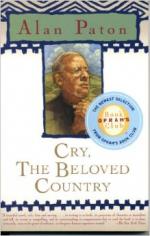
South African Alan Paton was forty-three years old when he began writing his first and most famous novel, Cry, the Beloved Country. He wrote it by hand while on a tour to several countries, which he paid for himself, to study prison reform. As luck would have it, one of the couples that he stayed with had connections to Max Perkins, a famous editor at the Scribner's publishing company. Scribner's published the novel in 1948, and it received immediate acclaim, though Paton had no literary reputation and the history of South Africa was virtually unknown in the United States. Influenced by the works of John Steinbeck and Knut Hamsun, Paton chose to tell his story in a direct, uncomplicated style and to focus nearly as much attention on the land as he did on...
|
This section contains 8,355 words (approx. 28 pages at 300 words per page) |
|