Forgot your password?  

Not What You Meant?  There are 79 definitions for Jäger.  Also try: Yeager.

Chuck Yeager | Research & Encyclopedia Articles

Print-Friendly   Order the PDF version   Order the RTF version
About 4 pages (1,255 words)
Chuck Yeager Summary


Chuck Yeager

Born February 13, 1923,
Myra, West Virginia

Chuck Yeager

Charles Elwood Yeager, known as Chuck, was born in Myra, West Virginia, on February 13, 1923. His father was a driller for natural gas in the West Virginia coalfields. As the United States began mobilizing for World War II, Yeager enlisted in the Army Air Force in September 1941, the summer after he graduated high school at the age of 18. In 1943 he became a flight officer, a noncommissioned officer who could pilot aircraft. During the last two years of the war he went to England, where he flew fighter missions into France and Germany.

Proves to be great fighter pilot

During his first eight missions, at the age of 20, Yeager shot down two German fighters. On his ninth mission he was shot down over German-occupied France. Suffering flak wounds, he bailed out of the airplane and was rescued by members of the French resistance, who smuggled him across the Pyrenees Mountains into Spain. After being jailed briefly in Spain he made his way back to England and flew fighter planes in support of the Allied invasion of Normandy.

On October 12, 1944, Yeager shot down five German fighter planes in succession. On November 6, flying a propeller-driven P-51 Mustang, he downed a Messerschmidt-262, one of Germany’s new jet fighters, and damaged two more. On November 20 he shot down four FW-190s. By the end of the war, at the age of 22, Yeager was credited with having shot down 13½ German planes (he shared one victory with another pilot).

From 1946 to 1947 Yeager was trained as a test pilot at Wright Field in Dayton, Ohio, where he showed a talent for stunt-team flying. He was chosen to go to Muroc Field in California, later to become Edwards Air Force Base, to work on the top-secret XS-1 project.

XS-1 project planned

At the end of the war, the U.S. Army had found that the Germans had developed both the world’s first jet fighter and a rocket plane that had tested at speeds as fast as 596 miles an hour. Just after the war, Britain’s Gloster Meteor had also raised the official world speed record to 606 miles per hour. The next record to be attained was to exceed the speed of sound, Mach 1, which was the goal of the XS-1 project.

The measurement for the speed of sound was named after the German scientist Ernst Mach, who had discovered that sound travels at different speeds at different altitudes, temperatures, and wind speeds. For instance, on a calm day at 60°F at sea level the speed is about 760 miles an hour; this speed decreases at higher altitudes. Airplane pilots who had come close to the speed of sound in dives reported that their controls froze and the structure of the plane shook uncontrollably. A British test plane disintegrated as it approached the speed of sound. Because of these experiences, Mach 1 became known as the “sound barrier.”

The army had developed an experimental plane called the X-1 to break the barrier. Built by the Bell Aircraft Corporation, it was a rocket shaped like a bullet that was launched from another plane once it was airborne. The idea was to send up the X-1 on a number of flights, each time getting a little closer to Mach 1. A top commercial test pilot had been making these flights and had reached.8 Mach, at which time the plane shook violently. The pilot demanded a large bonus to fly the plane up to Mach 1, but the army refused to pay the bonus. Yeager was given the job of piloting the X-1 at his usual salary.

Yeager exceeds Mach 1

In his test flights Yeager was able to get the plane to fly at .9 Mach and still keep control. He believed the plane’s heavy vibration would actually calm down after reaching Mach 1. The date of October 14, 1947, was set for breaking the sound barrier. On the night of October 12, Yeager went horseback riding and fell off his horse. The next day his right side was in pain. Afraid he would be replaced, Yeager visited a civilian doctor who told him he had broken two ribs.

Yeager kept his injury a secret. The broken ribs kept him from closing the plane’s right side door, but he solved the problem by taking the handle of a broomstick with him and using it to close the door with his left hand. Early on the morning of October 14, Yeager went up in the B-29 bomber that carried the X-1. He entered the X-1 and locked himself in at 7,000 feet. The B-29 released the X-1 at 26,000 feet. At .87 Mach the violent vibrations began, but Yeager continued to push the aircraft faster. Just as he had predicted, at .96 Mach the aircraft steadied and he passed Mach 1. At that moment a giant roar—the first man-made sonic boom—was heard on the desert at the experimental test site. Yeager reached Mach 1.05 and stayed above Mach 1 for seven minutes. On his way back to the field he performed victory rolls and wing-over-wing stunts.

As soon as Yeager landed safely, the results were telephoned to the head of army aviation, who ordered the base not to give out any information about the flight. Rumors of the flight appeared in the aviation press in December 1947, but the air force—as the Army Air Force would become—did not confirm the successful test or release Yeager’s name until June 1948.

Sets new record

Yeager continued to test planes at Edwards Air Force Base. In December 1953 he set a new record by flying the X-1A to Mach 2.4. After leaving Edwards in 1954 he went to Okinawa, Japan, where he flew Soviet planes captured in the Korean War to test their performance. He returned to the United States in 1957 to lead an air squadron; he flew on training operations and readiness maneuvers at Air Force bases in the United States and abroad. In 1961 he was appointed director of test flight operations at Edwards air force Base and the following year was made commandant of the Aerospace Research Pilot School at Edwards.

In 1963 Yeager tested the NF-104, an experimental plane designed for high altitude flying, to see if it could beat the record of 113,890 feet set by a Soviet military plane. Yeager had reached 108,000 feet when the plane spun out of control. He was forced to eject from the plane, severely burning the left side of his face and his left hand. He spent a month in the hospital but was able to return to his flying duties and his job as head of the experimental test pilot school.

Receives promotion

Yeager was promoted to brigadier general in 1969, by which time he had flown more than 100 missions in Southeast Asia in B-57 tactical bombers. He had become the most famous pilot in the United States, and the air force called upon him increasingly for its public relations and recruiting efforts. He served in a variety of air force positions until his retirement in 1975. He has received numerous military awards and was awarded the Presidential Medal of Freedom in 1985.

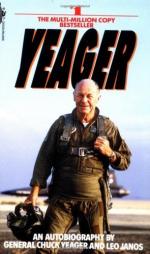
Yeager has written two autobiographies, Yeager and Press On: Further Adventures of the Good Life. In 1979 Tom Wolfe wrote a novel titled The Right Stuff, which retells the story of Yeager’s X-1 flights. A film by the same title was made in 1983, with the actor Sam Shepard playing the role of Yeager.

This is the complete article, containing 1,255 words (approx. 4 pages at 300 words per page).

More Information
  • View Chuck Yeager Study Pack
  • 79 Alternative Definitions
  • Search Results for "Chuck Yeager"
  • More Products on This Subject
    Chuck Yeager
    Charles E. Yeager (born 1923), a test pilot for the United States Air Force, was the first person t... more

    Charles Elwood Yeager
    1923- American Pilot Adecorated World War II fighter pilot, Charles E. ("Chuck") Yeag... more


    Ask any question on Chuck Yeager and get it answered FAST!
    Answer questions in BookRags Q&A and earn points toward
    discounted or even FREE Study Guides and other BookRags products!
    Learn more about BookRags Q&A
    Copyrights
    Chuck Yeager from Explorers and Discoverers. ©2005-2006 by U•X•L. U•X•L is an imprint of Thomson Gale, a division of Thomson Learning, Inc. All rights reserved.

    Join BookRagslearn moreJoin BookRags

    Join BookRagslearn moreJoin BookRags