BookRags.com Literature Guides Literature Guides Criticism/Essays Criticism/Essays Biographies Biographies My Bibliography Periodic Table U.S. Presidents Shakespeare Sonnet Shake-Up
Research Anything:        
History | Encyclopedias | Films | News | Create a Bibliography | More... Login | Register | Help
Not What You Meant?  There are 11 definitions for Catch-22.

Search "Catch-22"

Contents Navigation
 

Catch-22

Print-Friendly  Order the PDF version  Order the RTF version
About 4 pages (1,214 words)
Catch-22 Summary

Bookmark and Share

Catch-22

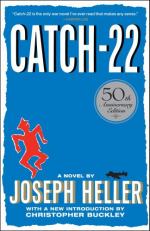
Hailed as "a classic of our era," "an apocalyptic masterpiece," and the best war story ever told, Joseph Heller's blockbuster first novel, Catch-22 (1961), not only exposed the hypocrisy of the military, but it also introduced a catchphrase to describe the illogic inherent in all bureaucracies, from education to religion, into the popular lexicon. The "Catch-22" of the novel's title is a perverse, protean principle that covers any absurd situation; it is the unwritten loophole in every written law, a frustratingly elliptical paradox that defies solution. As Heller demonstrates in his novel, Catch-22 has many clauses, the most memorable of which allows only crazy men to be excused from flying the life-threatening missions ordered by their military superiors. To be excused from flying, a man needs only to ask for release; but by asking, he proves that he is sane and therefore he must continue flying. "That's some catch," observes one of the flyers. "It's the best there is," concurs Doc Daneeka.

Heller drew deeply on his personal experiences in the writing of his novel, especially in his depiction of the central character, Yossarian, a flyer who refuses any longer to be part of a system so utterly hostile to his own values. Like Yossarian, Heller served in the Mediterranean during the later years of World War II, was part of a squadron that lost a plane over Ferrara, enjoyed the varied pleasures that Rome had to offer, and was decorated for his wartime service. And like Yossarian, Heller passionately strove to become an ex -flyer. (After one of his missions, in fact, Heller's fear of flight became so intense that, when the war ended, he took a ship home and refused to fly again for 15 years afterward.)

Although critics usually refer to Catch-22 as a war novel, the war itself—apart from creating the community within which Yossarian operates—plays a relatively small part in the book. While the military establishment comprises an entire society, self-contained and absolute, against which Yossarian rebels, it is merely a microcosm of thelarger American society and a symbol for all other repressive organizations. In the novel, there is little ideological debate about the conflict between Germany and the United States or about definitions of patriotism. Heller, in fact, deliberately sets Catch-22 in the final months of the war, during which Hitler is no longer a significant threat and the action is winding down. The missions required of the flyers have no military or strategic importance except among the administrators, each of whom wants to come out of the war ahead. Inversely, however, the danger to Yossarian from his superiors intensifies as the war draws to a close. Yossarian wisely realizes that the enemy is "anybody who's going to get you killed, no matter which side he's on." And Heller surrounds Yossarian with many such enemies—from generals Dreedle and Peckem, who wage war on each other and neglect the men under their command; to Colonel Scheisskopf—literally the Shithead in charge—who is so fanatic about military precision that he considers implanting metal alloys in his men's thighbones to force them to march straighter; to Colonel Cathcart, obsessed with getting good aerial photos and with making the cover of the Saturday Evening Post, who keeps raising the number of requisite flights; and Colonel Korn, who is so concerned that men might actually learn something at their educational sessions that he implements a new rule: only those who never ask questions will be allowed to do so. Entrepreneur extraordinaire and legendary double-dealer Milo Minderbinder is a new age prophet of profit: he steals and resells the morphine from flight packs and leaves instead notes for the wounded soldiers that what is good for business is actually good for them as well. (To prove his point, he notes that even the dead menhave a share in his "syndicate.") Captain Black insists that everyone "voluntarily" sign his Glorious Loyalty Oath, except his nemesis, who will not be allowed to sign "even if he wants to." And Nately's whore, out to avenge her lover's death, persists in trying to kill the innocent Yossarian. (In Heller's logically illogical world, the whore is symbolic of the universal principle that Yossarian will always be unjustly beset upon—and will probably always deserve it.)

Martin Balsam in a scene from the film Catch-22.Martin Balsam in a scene from the film Catch-22.

Yossarian's increasingly dramatic acts of insubordination against such an irrational system begin with his self-hospitalizations, where he meets the ultimate symbol of the bureaucracy's indifference to the individual: the soldier in white, a faceless, nameless symbol of imminent death. After his friend Snowden's death, Yossarian's insubordination escalates to his refusal to fly or wear a uniform again, and it ends with his decision not to compromise but instead to emulate his comrade Orr's impossible achievement and to affirm life by rowing a small boat to Sweden.

In the film adaptation of Catch-22 (1970), by focusing incrementally—as Heller did—on the Avignon incident during which Snowden literally loses his guts and Yossarian metaphorically loses his, director Mike Nichols succeeds in recreating the novel's circularity and its deliberately repetitive structure. By downplaying much of the novel's truculent satire of American capitalism, however, Nichols is able to concentrate on the traumatizing fear of death, a reality Yossarian (Alan Arkin) cannot face until he re-imagines it through the death of Snowden (Jon Korkes). Nichols also reformulates the well-intentioned capitalistic Milo Minderbinder; played by baby-faced Jon Voight, the film's Milo is a callous and sinister destroyer of youth, every bit as corrupt as his superior officers, the colonels Korn (Buck Henry) and Cathcart (Martin Balsam). Balancing the cynicism of the selfish officers is the affecting naïveté of their victims, including the earnest Chaplain Tappman (Anthony Perkins), the innocent Nately (Art Garfunkel), and the perpetually bewildered Major Major (Bob Newhart).

An even more effective balance is the one Nichols strikes between noise and silence: in sharp contrast to the busy confusion of some of the film's episodes, which aptly reflect the noisy chatter of the novel and the jumble of word games Heller plays, there are subtle moments of silence. The opening scene, for instance, begins in blackness, without words or music; then there appears a tranquil image of approaching dawn, replaced suddenly with the loud roar of plane engines being engaged. It is as if the viewer is seeing the scene through Yossarian's eyes, moving with him from a dream state to the waking nightmare (one of the film's recurring motifs) of his reality. Replete with inside jokes linking it to the Vietnam War (Cathcart's defecating in front of Chaplain Tappman, for instance, recalls LBJ's habit of talking to his aides while sitting on the toilet), Nichols' film adaptation of Catch-22 is thus an interesting and original work as well as a noteworthy reinterpretation of Heller's classic novel.

Further Reading:

Heller, Joseph. Catch-22. New York, Simon & Schuster, 1961.

Kiley, Frederick, and Walter McDonald, editors. A Catch-22 Case-book. New York, Thomas Y. Crowell, 1973.

Lupack, Barbara Tepa. "Seeking a Sane Asylum: Catch-22. " In Insanity as Redemption in Contemporary American Fiction. Gainesville, University Press of Florida, 1995.

——, editor. Take Two: Adapting the Contemporary American Novel to Film. Bowling Green, Popular Press, 1994.

Merrill, Robert. Joseph Heller. Boston: Twayne, 1987.

Merrill, Robert and John L. Simons. "The Waking Nightmare of Mike Nichols' Catch-22." In Catch-22: Antiheroic Antinovel, edited by Stephen W. Potts. New York, Twayne, 1989.

This is the complete article, containing 1,214 words (approx. 4 pages at 300 words per page).

More Information
  • View Catch-22 Study Pack
  • 11 Alternative Definitions
  • Search Results for "Catch-22"
  • Add This to Your Bibliography
  • More Products on This Subject
    Plot Summary of "Catch 22"
    Catch 22, by Joseph Heller, takes place during the second half of World War II. The main character, ... more

    The Role of Women in "Catch-22"
    Since the novel Catch-22 takes place in an army encampment during World War II, women are not mentio... more


    Copyrights
    Catch-22 from St. James Encyclopedia of Popular Culture. ©2005-2006 Thomson Gale, a part of the Thomson Corporation. All rights reserved.

    Join BookRagslearn moreJoin BookRags


    About BookRags | Customer Service | Report an Error | Terms of Use | Privacy Policy