BookRags.com Literature Guides Literature
Guides
Criticism & Essays Criticism &
Essays
Questions & Answers Questions &
Answers
Lesson Plans Lesson
Plans
My Bibliography Periodic Table U.S. Presidents Shakespeare Sonnet Shake-Up
Research Anything:        
History | Encyclopedias | Films | News | Create a Bibliography | More... Login | Register | Help

Search "Caldwell, Erskine (1903-1987)"

Contents Navigation
 
Not What You Meant?  There are 86 definitions for Bastard.  Also try: Journeyman.

Caldwell, Erskine (1903-1987)

Print-Friendly  Order the PDF version  Order the RTF version
About 2 pages (729 words)
Erskine Caldwell Summary

Bookmark and Share

Caldwell, Erskine (1903-1987)

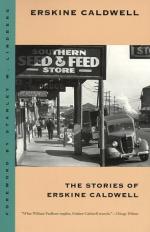
Although Erskine Caldwell gradually descended into obscurity, during his heyday in the 1930s and 1940s his books were perennial best-sellers. Notorious for the explicit sexuality in his novels about Southern poor whites, Caldwell withstood several obscenity trials and saw his work banned on a regular basis. Caldwell's trademark mixture of sex, violence, and black humor garnered various reactions. Southerners in particular felt that Caldwell pandered to stereotypes of the South as a land of ignorance, sloth, and depravity, but many respected literary critics saw burlesque humor, leftist political activism, or uncompromising realism in Caldwell's writing. Caldwell's major fiction included Tobacco Road (1932), God's Little Acre (1933), Kneel to the Rising Sun and Other Stories (1935), Trouble in July (1940), and Georgia Boy (1943). In addition to novels and short stories, Caldwell coauthored a number of photograph-and-text books with his second wife, photographer Margaret Bourke-White, the most popular of which were You Have Seen Their Faces (1937) and Say, Is This the U.S.A.? (1941).

Caldwell was born in rural White Oak, Georgia. He inherited his social conscience from his father, a minister in the rigorous Associated Reformed Presbyterian Church. Because of his father's ministry, Caldwell's family moved frequently, and their financial situation was often strained. Caldwell had little formal education. His mother taught him at home during his early childhood, and he never formally graduated from high school. He later spent brief periods at three different colleges but never obtained a degree. After a long series of odd jobs and some newspaper work for the Atlanta Journal, Caldwell moved to Maine in 1927 to concentrate on writing fiction. He would never again live in the South, though he made occasional visits for documentary projects or creative inspiration.

Caldwell's early years in Maine were spent in utter poverty. His first three books attracted little attention, but his fourth, Tobacco Road, defined his career and made him rich. Published in 1932, Tobacco Road featured Jeeter Lester and family, a brood of destitute sharecroppers in rural Georgia. The dysfunctional Lester clan starved and stole and cussed and copulated throughout the book, which initially received mixed reviews and posted lackluster sales. Jack Kirkland changed all that when he translated Tobacco Road into a phenomenally successful Broadway play. The play ran from December of 1933 through March of 1941, an unprecedented seven-year stretch that was a Broadway record at the time. Touring versions of the play traveled the nation for nearly two decades, playing to packed houses throughout the country. Caldwell's book sales skyrocketed.

Through the 1940s Caldwell's books continued to sell well in dime-store paperback versions with lurid covers, but reviews of his new books were increasingly harsh. Though he continued writing at a prolific pace, Caldwell was never able to repeat the critical success of his earlier work. The quality of his work plummeted, and his relationships with publishers and editors, often strained in the past, deteriorated further.

Despite Caldwell's waning literary reputation, he had a lasting impact on American popular culture. A pioneer in the paperback book trade, he was one of the first critically acclaimed writers to aggressively market his work in paperback editions, which were considered undignified at the time. Most of Caldwell's astonishing sales figures came from paperback editions of books that were first published in hardback years earlier. These cheap editions were sold not in bookstores, but in drug stores and magazine stands; consequently they reached a new audience that many publishers previously had ignored. Sexually suggestive covers aided Caldwell's sales and forever changed the marketing practices for fiction. His censorship battles made Caldwell a pivotal figure in writers' battles for First Amendment rights. Without question, however, Caldwell's greatest legacy has been his depiction of Southern poor whites. The Lesters have been reincarnated in The Beverly Hillbillies, Snuffy Smith, L'il Abner, The Dukes of Hazzard, and countless other poor white icons. Though its origin seems largely forgotten, the term "Jeeter" survives as a slang expression for "poor white trash."

Further Reading:

Cook, Sylvia Jenkins. Erskine Caldwell and the Fiction of Poverty. Baton Rouge, Louisiana State University, 1991.

MacDonald, Scott, editor. Critical Essays on Erskine Caldwell. Boston, G. K. Hall, 1981.

Miller, Dan B. Erskine Caldwell: The Journey from Tobacco Road. New York, Knopf, 1995.

Mixon, Wayne. Erskine Caldwell: The People's Writer. Charlottesville, University of Virginia Press, 1995.

Silver, Andrew. "Laughing over Lost Causes: Erskine Caldwell'sQuarrel with Southern Humor." Mississippi Quarterly. Vol. 50, No. 1, 1996-97, 51-68.

This is the complete article, containing 729 words (approx. 2 pages at 300 words per page).

More Information
  • View Caldwell, Erskine (1903-1987) Study Pack
  • 86 Alternative Definitions
  • Search Results for "Caldwell, Erskine (1903-1987)"
  • Add This to Your Bibliography
  • More Products on This Subject
    Erskine Caldwell
    The American writer Erskine Caldwell (1903-1987) was one of the best-selling authors of all time. H... more

    Erskine (Preston) Caldwell
    Erskine Caldwell 's more than fifty volumes of fiction and nonfiction represent a major contributio... more


    Copyrights
    Caldwell, Erskine (1903-1987) from St. James Encyclopedia of Popular Culture. ©2005-2006 Thomson Gale, a part of the Thomson Corporation. All rights reserved.

    Works by Author
    Join BookRagslearn moreJoin BookRags


    About BookRags | Customer Service | Report an Error | Terms of Use | Privacy Policy