Burkina Faso
Burkina Faso, formerly Upper Volta, is landlocked and borders Côte d'Ivoire, Ghana, Togo, Benin, Mali, and Niger. While the northern drylands fringe the Sahara desert, more favorable ecological and climatic conditions prevail in the savannah and forest areas in the south. In 2004 Burkina Faso had 13.5 million inhabitants. Most people live in rural areas; only 27 percent of residents live in urban areas. Burkina Faso has around sixty ethnic and language groups; some originate from precolonial kingdoms (e.g., Mossi, Fulbe, and Gourmanche) and others from village-based communities (e.g., Bobo, Lobi, Senufo, and Lyela).
The territory came under French colonization by the end of the nineteenth century. Upper Volta was a labor reserve, and colonial economic development was not primarily focused on the colony's own potentials but on the need for plantation labor in Côte d'Ivoire. In the early twenty-first century, 2 to 3 million Burkinabe continued to reside in Côte d'Ivoire, increasingly serving as scapegoats in xenophobic politics, particularly since the civil war in Côte d'Ivoire in September 2002.
In 1960 Upper Volta gained independence. In January 1966 President Maurice Yaméogo (1921–1993) resigned after a popular upheaval, which brought Colonel Sangoulé Lamizana (1916–2005) to power. The latter remained president for different military and civilian governments until 1980, when a coup d'etat ended his regime.
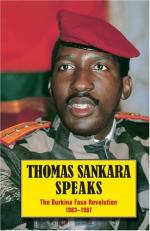
Another coup d'etat occurred in November 1982. In August 1983 "the revolution" brought Captain Thomas Sankara (1949–1987) to power. A period of profound political and economic change began with self-adjustment, self-reliance, and anticorruption policies. In 1984 the country's name was changed to Burkina Faso ("fatherland of dignified men"). In October 1987 President Sankara was killed in a coup d'etat, and his second-in-command Captain Blaise Compaoré (b. 1950) came to power.
President Compaoré and his government soon initiated a democratization process with a new constitution adopted by referendum in June 1991. In 1991 Compaoré was elected president as the single candidate because all other candidates had withdrawn. Legislative elections were held in 1992 and 1997, and municipal elections in 1995 and 2000. In 1998 President Compaoré was re-elected with 87.5 percent of the vote against two other candidates. The radical opposition, led among others by Joseph Ki-Zerbo and Hermann Yaméogo, boycotted the elections.
With the assassination in December 1998 of Norbert Zongo, a journalist and director of the newspaper L'Indépendant, allegedly by members of the president's security forces, Burkina Faso experienced a deep socio-political crisis. The struggle against "impunity" was the credo, and activists were mobilized through the Collectif des organisations démocratiques de masse et des partis politiques, led by Halidou Ouédraogo.
Although the Zongo murder did not have any legal outcome, the sociopolitical upheaval led to electoral reforms. In the 2002 legislative elections a
(MAP BY MARYLAND CARTOGRAPHICS/THE GALE GROUP)
proportional electoral system increased the opposition's seats; of the 111 parliamentary seats, the ruling party Congrès pour la Démocratie et le Progrès won fifty-seven, and the twelve opposition parties took fifty-four.
Three ambiguous features characterize the democratization process. First, although political parties and independent newspapers contribute extensively to public debate, national politics is still mainly reserved for the minority of educated people, who communicate in French. Second, despite the foundation of different democratic institutions and the many political parties, political nomadism is frequent. Third, the ruling party Congrès pour la Démocratie et le Progrès has a long record of modifying the constitution to favor the party.
Côte D'ivoire.
Bibliography
Banégas, Richard. Insoumissions populaires et révolution au Burkina Faso. Bordeaux, France: Institut d'Etudes Politiques and Centre d'Etude d'Afrique Noire, 1993.
Hagberg, Sten. "'Enough is Enough:' An Ethnography of the Struggle against Impunity in Burkina Faso." Journal of Modern African Studies 40 (2002):217–246.
McFarland, Daniel M., and Lawrence A. Rupley. Historical Dictionary of Burkina Faso. Lanham, MD: Scarecrow Press, 1998.
Otayek, René, Filiga M. Sawadogo, and Jean-Pierre Guingané, eds. Le Burkina entre révolution et démocratie (1983–1993): Ordre politique et changement social en Afrique subsaharienne. Paris: Karthala, 1996.
This is the complete article, containing 637 words
(approx. 2 pages at 300 words per page).