
BookRags.com Literature Guides Literature
Guides
Criticism & Essays Criticism &
Essays
Questions & Answers Questions &
Answers
Lesson Plans Lesson
Plans
My Bibliography Periodic Table U.S. Presidents Shakespeare Sonnet Shake-Up
Research Anything:        
History | Encyclopedias | Films | News | Create a Bibliography | More... Login | Register | Help

Not What You Meant?  There are 7 definitions for Boas.

Boas, Franz

Print-Friendly  Order the PDF version  Order the RTF version
About 3 pages (772 words)
Franz Boas Summary

Bookmark and Share Questions on this topic? Just ask!

Boas, Franz

BOAS, FRANZ (1858–1942), German-American anthropologist, was born at Minden, Prussian Westphalia, on July 9, 1858, the son of Jewish parents of comfortable means, both of whom were assimilated into German culture. His education was largely at the local state school and gymnasium. He seems not to have had significant Jewish religious instruction. His mother, Sophie Meyer Boas, who had been part of a circle of liberal and Marxist intellectuals dedicated to the revolutionary principles of 1848, was a major influence in his youth. He studied the sciences at the universities of Heidelberg (1877), Bonn (1877–1879), and Kiel (1879–1881), but he decided upon geography as a career. Shortly after receiving his doctorate, he left for a twelve-month expedition to Baffin Island, studying local geography and anthropology. He qualified as a university instructor at Berlin in 1886 but never taught, instead going to the United States, where he undertook a research trip to the Northwest Coast, whose native peoples became the subjects of his most intensive ethnological scrutiny. He worked for a number of scholarly institutions in the United States and Canada from 1887 until 1896, when he found secure employment in New York City at the American Museum of Natural History and Columbia University. He left the museum in 1906 but continued at Columbia until his retirement in 1936. In his later years he became increasingly involved in public affairs, speaking out especially against racialist ideas. He died in New York on December 22, 1942.

Boas published in a wide range of anthropological fields, exercising a dominating influence on American anthropology both in his own right and through a network of associates and former students, including A. L. Kroeber, Paul Radin, Alexander Goldenweiser, Robert H. Lowie, Ruth Benedict, Leslie Spier, J. R. Swanton, and Margaret Mead. Many of these, Radin and Lowie in particular, were more systematically concerned with religion than he.

Boas was himself a rationalist without conscious religious views. One of the mainsprings of his intellectual life was the search for an explanation of the "psychological origin of the implicit belief in the authority of tradition," a belief foreign to his own mind, and thus for an explication of how "the shackles that tradition has laid upon us" might be recognized and then broken. Alongside this, however, went a relativist's tolerance of the beliefs and values of others.

Boas's anthropological methodology was so strongly particularistic that his religious descriptions usually have little generalizing value in themselves; his approach was so concerned with the integrated totality of a culture that religion often seems to occur only as a by-product in his work. However, the enormous amount of material, especially texts, that he published on mythology, ceremonialism, and secret societies contains rich material for the study of beliefs, and his shorter treatments, including the religion entry in the Handbook of American Indians and his discussion of esoteric doctrines and the idea of future life among primitive tribes, are valuable.

The fundamental concept bearing on the religious life of the North American Indians, Boas wrote, was a belief in the existence of a "magic power," the "wonderful qualities" of which are believed to exist in objects, animals, humans, spirits, or deities and that are superior to the natural qualities of humans. The actions of the Indians were regulated by the desire to retain the good will of powers friendly to them and to control those that were hostile. Taboos, guardian spirits, charms, offerings and sacrifices, and incantations were all means to these ends. Boas also clearly associated religion with social structure in totemic kinship groups, in ceremonialism, and in explanatory mythology.

Bibliography

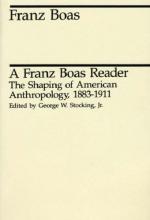
Boas's publications are numerous and scattered. He collected some essays into Race, Language and Culture (New York, 1940), including "The Idea of the Future Life among Primitive Tribes" and "The Ethnological Significance of Esoteric Doctrines." George W. Stocking, Jr., edited another collection, including the essay "The Religion of American Indians," in The Shaping of American Anthropology, 1883–1911: A Franz Boas Reader (New York, 1974), with a fine introduction. Some of Stocking's other studies of Boas are in his Race, Culture, and Evolution, 2d ed. (Chicago, 1982). Boas's Kwakiutl Ethnography (Chicago, 1966) is, with The Social Organization and the Secret Societies of the Kwakiutl Indians (1897; reprint, New York, 1970), his most important discussion of the Kwakiutl. Ake Hultkrantz's The Study of American Indian Religion (New York, 1983), contains a discussion of Boas and his students on the subject. See also Boas's "An Anthropologist's Credo," in The Nation 147 (27 August 1938): 202.

New Sources

Hyatt, Marshall. Franz Boas, Social Activist: The Dynamics of Ethnicity. New York, 1990.

Williams, Vernon J. Rethinking Race: Franz Boas and His Contemporaries. Lexington, Ky., 1996.

This is the complete article, containing 772 words (approx. 3 pages at 300 words per page).

More Information
  • View Boas, Franz Study Pack
  • 7 Alternative Definitions
  • Search Results for "Boas, Franz"
  • Add This to Your Bibliography
  • More Products on This Subject
    Franz Boas
    The German-born American anthropologist Franz Boas (1858-1942) established the modern structure of ... more

    Franz Uri Boas
    Franz Boas, an anthropologist and linguist, helped to found modern cultural anthropology in the Uni... more


    Ask any question on Franz Boas and get it answered FAST!
    Answer questions in BookRags Q&A and earn points toward
    discounted or even FREE Study Guides and other BookRags products!
    Learn more about BookRags Q&A
    Copyrights
    Boas, Franz from Encyclopedia of Religion. Copyright © 2001-2006 by Macmillan Reference USA, an imprint of the Gale Group. All rights reserved.

    Join BookRagslearn moreJoin BookRags


    About BookRags | Customer Service | Report an Error | Terms of Use | Privacy Policy

