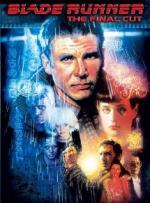
Blade Runner
Ridley Scott's 1982 film adaptation of Philip K. Dick's science fiction novel Do Androids Dream of Electric Sheep? (1968) received poor reviews when it opened. It did not take long, however, for Blade Runner to become known as one of the greatest science fiction films ever made. The film's depiction of Los Angeles in the year 2019 combines extrapolated social trends with technology and the darkness of film noir to create the movie that gave Cyberpunk literature its visual representation.
In true film noir style, the story follows Rick Deckard (Harrison Ford), who is a "Blade Runner," a hired gun whose job is to retire (kill) renegade "replicants" (androids who are genetically designed as slaves for off-world work). The story revolves around a group of replicants who escape from an off-world colony and come to earth to try to override their built in four-year life span. Deckard hunts the replicants, but he falls in love with Rachael (Sean Young)—an experimental replicant. Deckard finally faces the lead replicant (Rutger Hauer) in a struggle that ends with him questioning his own humanity and the ethics of his blade running.
The production of Blade Runner was not without problems. Hampton Fancher had written the screenplay that offered a much darker vision than Dick's novel and only drew on its basic concepts. After the success of Alien (1979), Ridley Scott showed interest in directing the film. Scott replaced Fancher with David Peoples after eight drafts of the script. Scott's goal was to rework the script to be less action-oriented with a plot involving "clues" and more human-like adversaries. He worked closely with Douglas Trumbull—2001: A Space Odyssey —to design an original visual concept. Although some of the actors flourished under Scott's directing style, many were frustrated with his excessive attention to the set design and lighting. Eventually, the production company that was supporting the film pulled out after spending two million dollars. New funding was provided by three interests—a subsidiary of Warner Brothers, Run Run Shaw, and Tandem Productions (which gained rights to control the final version).
Preview audiences were befuddled by the film's ambiguous resolution and frustrated by the lack of light-hearted action they expected from Harrison Ford. The response was so weak that Tandem Productions decided to change the film. Scott was forced to include voice-overs, and to add a "feel good" ending in which Deckard and Rachael drive off into Blade Runner's equivalent of a sunset.
The film opened strong at the box office, but critics railed against the voice-overs and the happy ending. The release of Steven Spielberg's E.T.: The Extra Terrestrial, within two weeks of Blade Runner, eclipsed the film and ended its theater run. Blade Runner has,however, endured. In 1993, the National Film Preservation Board selected to preserve Blade Runner as one of its annual 25 films deemed "culturally, historically, or aesthetically important." The British Film Institute also included Blade Runner in its Modern Classics series.
Harrison Ford in a scene from the film Blade Runner.Part of Blade Runner's success is due to its serious treatment of important philosophical and ethical questions. Some look at Blade Runner as a rehashing of Frankenstein. In true Cyberpunk style, though, the monsters have already escaped and there is an explicit question about whether humans are the real monsters. Blade Runner goes beyond that, asking hard questions about religion, the ethics of genetic manipulation, racism and sexism, and human interaction with technology. The film also presents two other major questions: "What is it to be human?"; and "How should our society handle its 'kipple?"'—the accumulating garbage (especially human "kipple"). These issues are so thought provoking that Blade Runner has become one of the most examined films in academic circles.
Blade Runner is often touted as the primary visual manifestation of the Cyberpunk movement and the first Cyberpunk film. The film predated the beginning of the Cyberpunk movement (William Gibson's Neuromancer), however, by two years. Hallmark themes of Cyberpunk fiction are the merging of man with machine and a dark, morbid view of the near future mixed with the delight of new technology. With dark and bleak imagery and androids that are "more human than human," it is not surprising that Blade Runner became a Cyberpunk watershed, offering a hopeful vision of what technology can do and be.
In 1989, Warner Brothers uncovered a 70mm print of Blade Runner and showed it to an eager audience at a film festival. The studio showed this version in two theaters in 1991, setting house attendance records and quickly making them two of the top-grossing theaters in the country. Warner Brothers agreed to fund Scott's creation of a "director's cut" of the film. Scott reworked the film and re-released it in 1992 as Blade Runner: The Director's Cut. The voice-overs were taken out, the happy ending was cut, and Scott's "unicorn" scene was reintegrated.
Because this film was initially so poorly received, no film or television sequels resulted. Blade Runner did, however, vault Dick'sbooks past their previous recognition. It also spawned two book sequels by K.W. Jeter both of which received marginal reviews. In 1997, Westwood Studios released the long-awaited CD-ROM game. The Internet bustles with dozens of pages dedicated to the film and discussion groups, which never tire of examining the movie.
Blade Runner's most important contribution has been to the film and television industries, creating a vision of the future that has continued to resonate in the media. Scott's dystopian images are reflected in films and television shows such as Robocop, Brazil, Total Recall, Max Headroom, Strange Days, and Dark City. Blade Runner has become one of the standards for science fiction imagery, standing right beside Star Wars and 2001: A Space Odyssey. Many reviewers still use Blade Runner as the visual standard for science fiction comparisons. It has survived as a modern cult classic and it will certainly impact our culture for a long time to come.
Further Reading:
Albrecht, Donald. "'Blade Runner' Cuts Deep into American Culture." The New York Times. September 20, 1992, sec. 2, p. 19.
"'Blade Runner' and Cyberpunk Visions of Humanity." Film Criticism. Vol. 21, No. 1, 1996, pp. 1-12.
Bukatman, Scott. Blade Runner. London, British Film Institute, 1997.
Clute, John, and Peter Nicholls, editors. "Blade Runner." The Encyclopedia of Science Fiction. New York, St. Martin's Press, 1993.
Kerman, Judith B., editor. Retrofitting Blade Runner: Issues in Ridley Scott's Blade Runner and Philip K. Dick's Do Androids Dream of Electric Sheep? Bowling Green, Ohio, Bowling Green State University Popular Press, 1991.
McCarty, John. "Blade Runner." International Dictionary of Films and Filmmakers. Vol. 1, Detroit, St. James Press, 1997.
Romney, Jonathan. "Replicants Reshaped." New Statesman & Society. Vol. 5, No. 230, 1992, pp. 33-34.
Sammon, Paul M. Future Noir: The Making of Blade Runner. New York, HarperPrism, 1996.
Turan, Kenneth. "Blade Runner 2." Los Angeles Times Magazine. September 13, 1992, 19.
This is the complete article, containing 1,124 words
(approx. 4 pages at 300 words per page).