BookRags.com Literature Guides Literature
Guides
Criticism & Essays Criticism &
Essays
Questions & Answers Questions &
Answers
Lesson Plans Lesson
Plans
My Bibliography Periodic Table U.S. Presidents Shakespeare Sonnet Shake-Up
Research Anything:        
History | Encyclopedias | Films | News | Create a Bibliography | More... Login | Register | Help

Not What You Meant?  There are 35 definitions for Atom.

Atom

Print-Friendly  Order the PDF version  Order the RTF version
About 3 pages (1,011 words)
Atom Summary

Bookmark and Share

Atom

Atoms are the elementary building blocks of material substances. Although the term atom, derived from the Greek word atomos, meaning indivisible, would seem inappropriate for an entity that, as science has established, is divisible, the word atom still makes sense, because, depending on the context, atoms can still be regarded as indivisible. Namely, once split, the atom loses its identity. For example, an atom of gold is the building block of gold. If we split a gold atom, there is no more gold. As Carl H. Snyder has written, an atom is "the smallest particle of an element that we can identify as that element."

Atoms share many characteristics with other material objects: they can be measured, and they also have mass and weight. For example, a gold atom, which is could be regarded as an atom of average size, measures approximately 3_1010_8 in diameter, and its mass is about 3.3 _10_22 g. Because traditional methods of measuring are difficult to use for atoms and subatomic particles, scientists have created a new unit, the atomic mass unit (amu), which is defined as the one-twelfth of the mass of the average carbon atom.

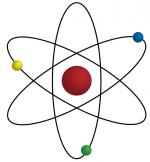
The principal subatomic particle are the nucleus, the proton, the neutron, and the electron (elektron is Greek for yellow amber; the ancient Greeks were among the first to observe static electricity, produced when a piece of amber is rubbed). A nucleus, the atom's core, consists of protons, which are positively charged particles, and neutrons, particles without any charge. Electrons are negatively charged particles with negligible mass which move around the nucleus. Compared to an atom's total mass, the subatomic particles are truly min:scule. For example, neutrons and protons have the mass of 1.67 x10⁻²⁴ , while electrons have the hardly detectable mass of 0.0009 x10⁻²⁴ . An electron's mass is so small that it is usually given a 0 value in atomic mass units, compared to the value of 1 assigned to neutrons and protons. In fact, as the nucleus represents more than 99% of an atom's mass, it is interesting to note that an atom is mostly space. For example, if a hydrogen atom's nucleus were enlarged to the size of a marble, the atom's diameter would be around 0.5 mi (800 m).

Scientists used to believe that electrons circled around the nucleus in planet-like orbits. Because all subatomic particles, including electrons, exhibit wave-like properties, it is makes no sense to conceptualize the movement of electrons as planetary rotation. Scientists therefore prefer terms like "electron cloud patterns," or "shells," indicating an electron's pattern of movement in relation to the nucleus. Thus, for example, hydrogen has one electron shell, containing one electron; lithium has two shells, with one electron in the inner shell, and two in the outer. Scientists have posited the existence of four shells, each containing one or more electrons, and each defined by a particular level of energy.

While subatomic particles may, in a certain way, be regarded as generic and interchangeable, they, in fact, determine an atom's identity. For example, we know that an atom with a nucleus consisting of one proton must be hydrogen (H). An atom with two protons is always a helium (He) atom. Thus, we see that the key to an atom's identity is to be found in the atom's inner structure. In addition, a chemical element is an instance of atomic equilibrium: for example, in a chemical element, the number of positively charged particles (protons) always equals the number of negatively charged particles (electrons). While elements are not always stable, sometimes appearing as different isotopes, the balance of forces within an atom is regarded as a fundamental feature.

Research into the atom's nucleus has uncovered a variety of subatomic particles, including quarks and gluons. Considered by some researchers the true building blocks of matter, quarks are the particles which form protons and neutrons. Gluons hold smaller clusters of quarks together.

Although the atom, particularly its mysterious inner world of quantum laws and wave-like particles, may seem far removed from the practical concerns of chemistry, and more relevant to theoretical physics than to anything else, there is a clear connection between atomic structure and the tangible, observable characteristics of substances, which is obviously the domain of chemistry. In particular, chemists study reactions, the behavior of elements in interaction, and reactions, such as those leading to the formation of chemical compounds, involve electrons. For example, the formation of sodium chloride, also known as table salt, would be impossible without specific changes at a subatomic level. The genesis of sodium chloride (NaCl) starts when a sodium (Na) atom, which has 11 electrons, loses an electron. With ten electrons, the atom now has one proton too many, thus becoming a positively charged ion, or cation. The electron lost by the sodium atom is gained by a chlorine atom, which has 17 electrons distributed in three shells. The newly acquired electron goes into the outer shell, also known as the valence shell, which contains seven electrons. The chlorine atom's behavior also exemplifies the general tendencies of atoms to enter reactions in order to attain eight electrons in the valence shell. But the chlorine atom not only reaches an octet balance; it also becomes a negatively charged ion, or anion, since it now has 18 electrons to its 17 protons. Crystals of table salt consist of equal numbers of sodium cations and chlorine anions, cation-anion pairs being held together by a force of attraction.

Interestingly, not long after scientists realized that an atom is divisible, transmutation, or the old alchemic dream of turning one substance into another, became a reality. Scientists even succeeded in creating gold by bombarding platinum-198 with neutrons to create platinum-199 which decays to gold-199. Although clearly demonstrating the reality of transmutation, this particular is by no means a cheap method of producing gold--quite the contrary, since platinum, particularly the platinum-199 isotope is more expensive than gold. However, the symbolic value of the experiment is immense, as it shows that the idea, developed by ancient alchemists and philosophers, of material transmutation does not essentially contradict our understanding of the atom.

This is the complete article, containing 1,011 words (approx. 3 pages at 300 words per page).

More Information
  • View Atom Study Pack
  • 35 Alternative Definitions
  • Search Results for "Atom"
  • Add This to Your Bibliography
  • More Products on This Subject
    Atom
    smallest unit into which matter can be divided without the release of electrically charged particle... more

    Atom
    Smallest unit into which matter can be divided and still retain the characteristic properties of an... more


    Copyrights
    Atom from World of Physics. ©2005-2006 Thomson Gale, a part of the Thomson Corporation. All rights reserved.

    Join BookRagslearn moreJoin BookRags


    About BookRags | Customer Service | Report an Error | Terms of Use | Privacy Policy