 Print
Print Word
Word PDF
PDF|
This section contains 1,576 words (approx. 6 pages at 300 words per page) |

|
Overview
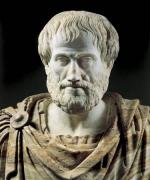
In addition to his great reputation as a philosopher, Aristotle (384-322 B.C.) is also regarded as the father of biology and the first ecologist. Despite that fact that his observations on biology, astronomy, and physics comprise the vast majority of his writings, Aristotle gets much more respect for his contributions to ethics, politics, and moral philosophy.
Aristotle offered an all-encompassing system for finding the meaning of reality through the senses. His curiosity about the world of living things and his attempts to fit these into a comprehensive system is unrivaled. Indeed, Aristotle laid the groundwork for the formulation of the scientific method.
Background
Aristotle's influence on the founding of biology was closely tied to the conjunction of several factors. First, as the son of a physician of the medical guild of Asclepius, he had the privilege...
|
This section contains 1,576 words (approx. 6 pages at 300 words per page) |
|